Skip to content
Claim this template

Free course template · Global

Ethical market research: Running compliant surveys and focus groups with consent and integrity

A ready-made course, live deck and two surveys for market researchers. 40 minutes, 6 lessons. Last reviewed 21 October 2026; not legal advice.

Claim the templatePreview the courseDownload SCORM for your LMS

Free. No credit card. Edit everything.

Play a game from the course

Ethical market research: try 3 questions

Three questions from this course. Pick an answer, then see why.

Play the game

Game not loading? Open it in a new tab (opens in a new tab)

Three pieces that work together

Learners sign in, so every finish and score is recorded. 12 fields to fill in with your details.
Claim the template
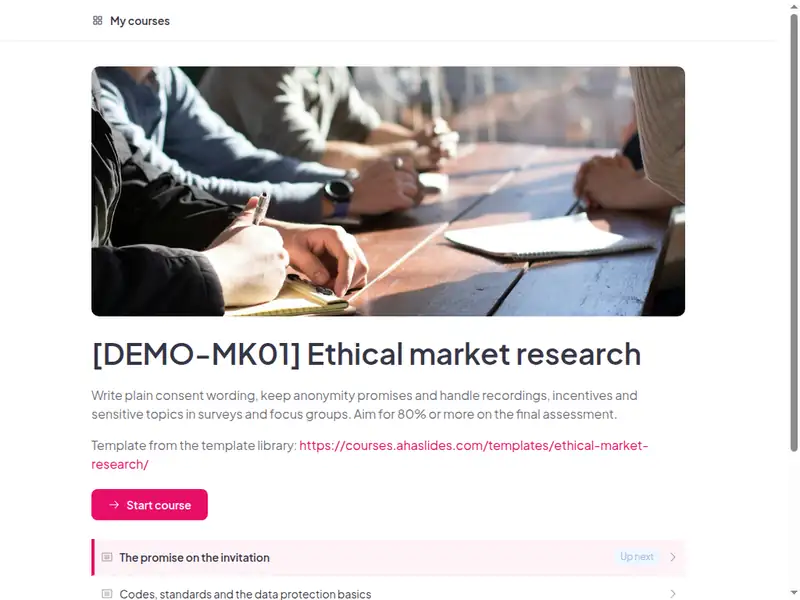
The Ethical market research: Running compliant surveys and focus groups with consent and integrity course as a learner first sees it

6 lessons, about 40 minutes

Minutes are an estimate.

  • Lesson 1: The promise on the invitation · 8 min

    Before you begin · The recording nobody expected · Why it matters

  • Lesson 2: Codes, standards and the data protection basics · 8 min

    Who sets the rules · Key terms · Check

  • Lesson 3: Designing ethical research: a five-step check · 8 min

    The five-step check · Fix the invitation · Check

  • Lesson 4: Grey areas: sensitive topics, children, incentives and identification · 7 min

    The client wants to know who said it · Younger participants and sensitive questions · Sort it

  • Lesson 5: Speak up and apply · 7 min

    Who to ask · Pressure from a deadline · Check

  • Lesson 6: Final assessment and completion · 2 min

    Practice

Claim the template

Inside this course

Taken from the course itself.

By the end, learners can

  • Explain why honest purpose, voluntary participation and respondent protection matter to data quality and trust
  • Describe what makes consent valid for research participants: clear wording, free choice, easy withdrawal
  • Design a survey that is neutral, honest about its purpose and proportionate in the data it asks for
  • Handle recordings, anonymity, incentives and sensitive answers in a focus group without breaking promises made to participants
  • Spot a breach in a fieldwork plan and raise it to the right person before fieldwork starts

Sample questions, with answers

  1. The product director wants the clip. What is the best first response?

    • Explain what participants agreed to and offer a written summary or a new consent request
    • Share a short clip
    • Share only the audio
    • Share it internally without telling anyone

    Answer: Explain what participants agreed to and offer a written summary or a new consent request. The promise was recording for the research team only. A summary stays within it, and a new request lets people choose again.

    Lesson 1: The promise on the invitation

  2. When is the best time to raise a doubt about consent wording?

    • After the fieldwork ends
    • When a participant complains
    • Before the first participant is recruited
    • After the report goes out

    Answer: Before the first participant is recruited. Early is cheapest. Nobody has been told anything wrong yet, and you can fix the wording.

    Lesson 5: Speak up and apply

  3. Why does a clear statement of purpose on a survey invitation matter?

    • People can make a free choice about taking part, and answers are more honest
    • It makes the survey shorter
    • It removes the need for consent
    • It is only needed for focus groups

    Answer: People can make a free choice about taking part, and answers are more honest. A clear purpose lets people choose freely and answer honestly.

    Lesson 6: Final assessment and completion

A scenario from "Grey areas: sensitive topics, children, incentives and identification"

A client asks which respondent gave a harsh comment in an anonymous employee-style survey of dealers.

Best response: Explain the anonymity promise, offer grouped themes and a quote with identifying details removed.

Weaker response: For internal use only.

Common questions

Yes. Claiming the template and editing it are free.

Yes. The course is self-paced and online, and the live deck lets you add a live session in the room or online.

Before a new research programme, at onboarding for insight and product marketing roles, and annually before fieldwork seasons.

Market researchers, product marketers and insight teams who commission or run surveys, panels and focus groups, including agency-side moderators; run by L&D with insights, brand and data protection teams.

Record completion in your own LMS or record system, so you can show who finished the course and when.

Your own details, each highlighted inside the course:
  • Policy link
  • Help contact
  • Escalation route
  • Where data retention periods for research data are set
  • The organisation's approved consent and privacy-notice wording for research
  • National research codes and privacy laws your legal team wants taught, and rules for children
  • Next course link
  • LMS or record system
  • Course URL
  • Live session URL
Then edit anything else you like: wording, scenarios, your logo.
Visit the help centre (opens in a new tab)