
Lesson 1: Why this matters · 4 min
Explain your site's policy: who may fight a fire and who must evacuate.
Learners sign in, so every finish and score is recorded. 5 fields to fill in with your details.
Minutes are an estimate.
Explain your site's policy: who may fight a fire and who must evacuate.
Describe the fire triangle and the stages of fire, and what "incipient stage" means.
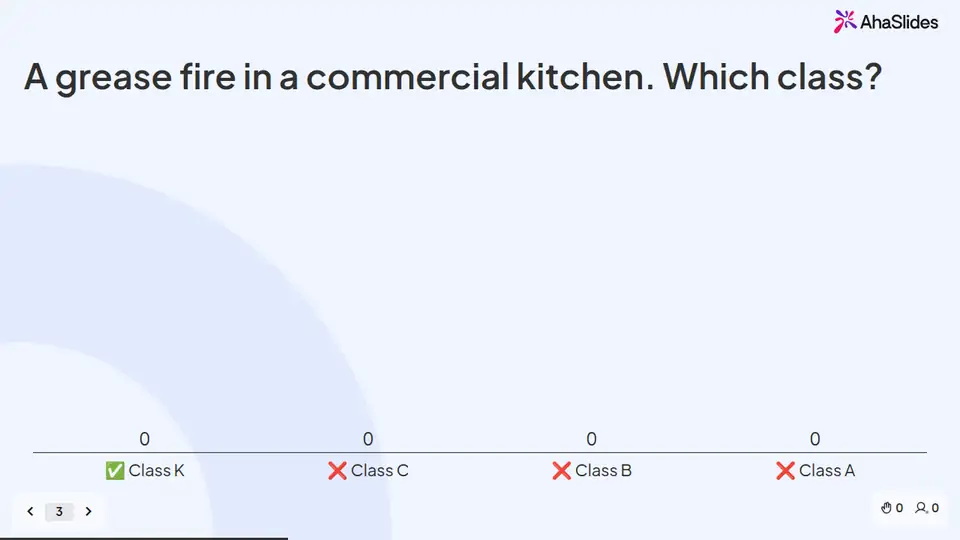
Match extinguisher classes (A, B, C, D, K) to fuels and read the label.
Decide fight-or-flight using the go/no-go checklist.
Use an extinguisher with the PASS technique.
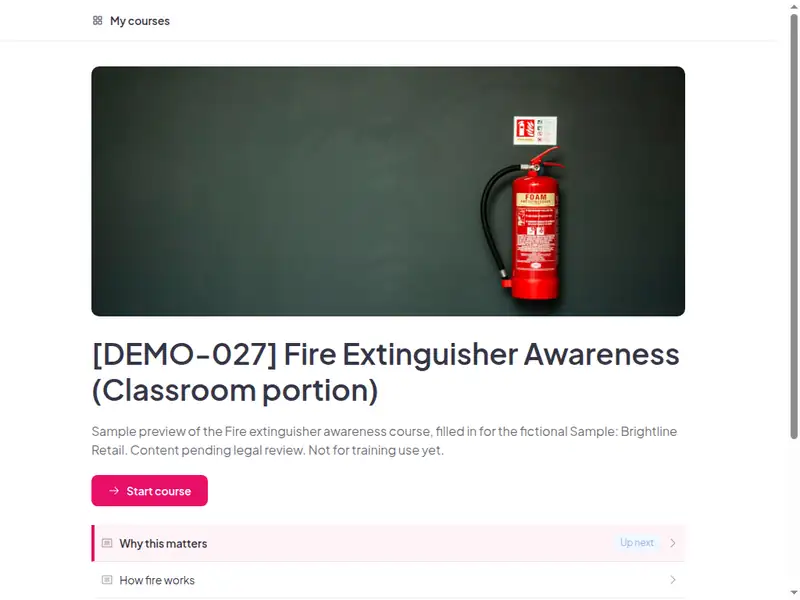
Locate extinguishers and recognise one that is not ready for use.
10 questions, 80% to pass. The result is saved to the learner's record.
Taken from the course itself.
A grease fire starts in a deep fryer. What should you never do?
Answer: Throw water on it. Water on a grease fire can spread burning oil. Use the right extinguisher or get out.
Lesson 1: Why this matters
At which stage of a fire is a portable extinguisher appropriate?
Answer: Incipient, when the fire is small and contained. An extinguisher is only for a small fire that has not started to spread.
Lesson 2: How fire works
Which situation means you should NOT fight the fire?
Answer: The fire is spreading and the exit is behind it. If the fire is spreading or the exit is blocked, leave.
Lesson 4: Fight or flight?
Warehouse: cardboard fire beside a racking aisle, growing past waist height, only exit is past the fire.
Best response: Evacuate and raise alarm.
Weaker response: Try one extinguisher first.
29 CFR 1910.157(g)(1)-(4).
Courses teams often run alongside this one.

OSHA Training

An article from the AhaSlides blog that uses this course.

Comments from trainers
No comments yet. Tell other trainers how the course went.
Your comment
Comments are public. We remove spam and personal details.