Skip to content
Claim this template

Free course template · US federal

Identity theft Red Flags Rule

A ready-made course, live deck and two surveys for staff. 30 minutes, 7 lessons, 10-question final check. Last reviewed 8 October 2026; not legal advice.

Claim the templatePreview the courseDownload SCORM for your LMS

Free. No credit card. Edit everything.

Play a game from the course

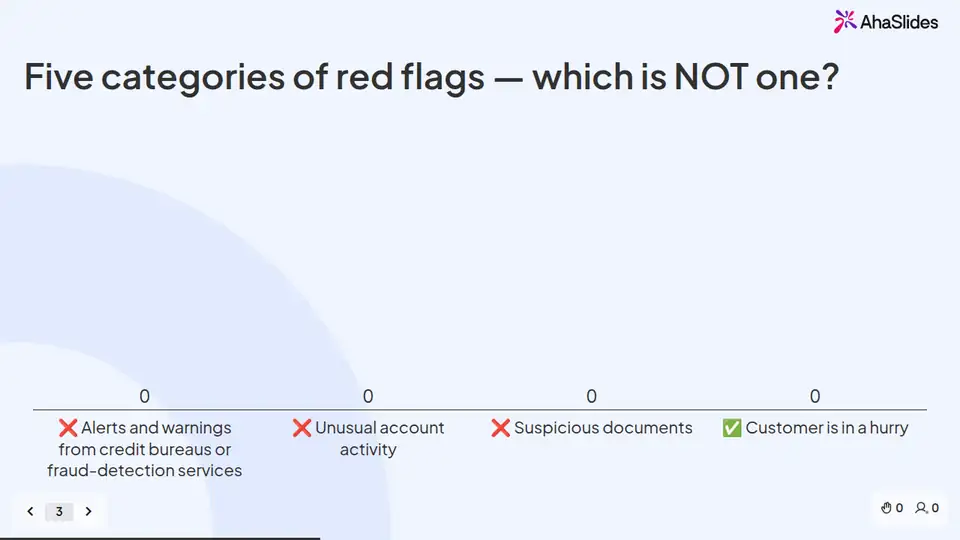
Identity theft Red Flags Rule: try 3 questions

Three questions from this course. Pick an answer, then see why.

Play the game

Game not loading? Open it in a new tab (opens in a new tab)

Three pieces that work together

Learners sign in, so every finish and score is recorded. 4 fields to fill in with your details.
Claim the template
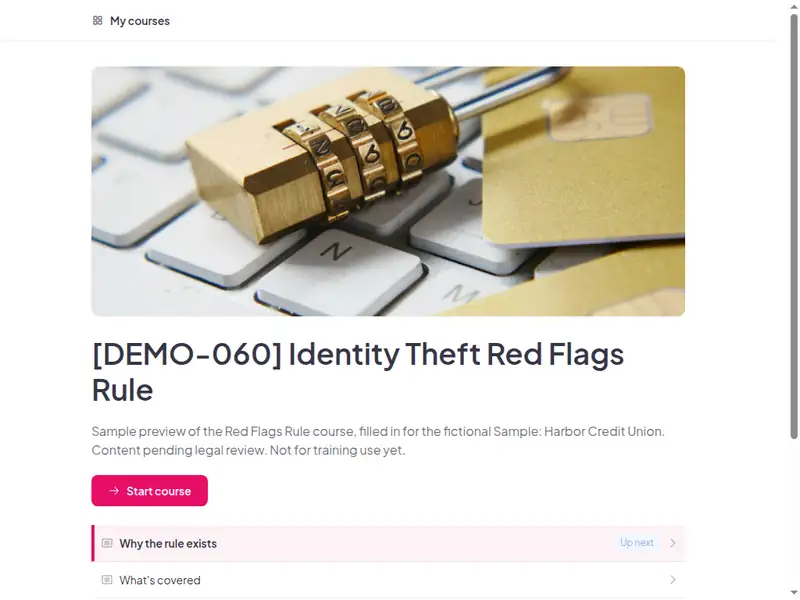
The Identity theft Red Flags Rule course as a learner first sees it

7 lessons, about 30 minutes

Minutes are an estimate.

  • Lesson 1: Why the rule exists · 5 min

    Explain why the Red Flags Rule exists and who it covers.

  • Lesson 2: What's covered · 4 min

    Identify the five categories of red flags.

  • Lesson 3: The five categories · 7 min

    Detect red flags during account opening and servicing.

  • Lesson 4: Respond · 4 min

    Respond appropriately to prevent and mitigate identity theft.

  • Lesson 5: Case practice · 4 min

    Report incidents through the program owner.

  • Lesson 6: Escalate correctly · 2 min

    Program owner

  • Lesson 7: Final assessment · 4 min

    10 questions, 80% to pass. The result is saved to the learner's record.

Claim the template

Inside this course

Taken from the course itself.

Sample questions, with answers

  1. Who is hurt when someone opens an account with a stolen identity?

    • The victim and the business
    • Only the victim
    • Only the business
    • Nobody

    Answer: The victim and the business. Victims spend months clearing debts, and the business can take the loss.

    Lesson 1: Why the rule exists

  2. Who decides whether your business has covered accounts?

    • Each customer
    • Your program owner, using the rule's definitions
    • The first teller who sees one
    • Nobody

    Answer: Your program owner, using the rule's definitions. Coverage depends on the rule's definitions and your own risk assessment.

    Lesson 2: What's covered

  3. A credit report shows a fraud alert with a phone number to call. What is the best response?

    • Proceed if the ID looks fine
    • Ask the applicant to explain
    • Call the number on the alert
    • Ignore the alert

    Answer: Call the number on the alert. Call the number on the alert to confirm the applicant's identity.

    Lesson 4: Respond

A scenario from "Case practice"

Applicant's license looks laminated over; credit report shows active fraud alert with phone number to call.

Best response: Stop, call the number on the alert, escalate.

Legal basis

FACTA s.114; Red Flags Rule 16 CFR Part 681 (FTC) incl. 681.1(e)(3) "train staff, as necessary"; App. A Guidelines & Supplement A (illustrative red flags); parallel rules for banks (12 CFR 41/222/334/717) and SEC/CFTC entities (Reg S-ID).

Common questions

Yes. Claiming the template and editing it are free.

The course itself is self-paced and online, and the live deck lets you add a live session. Whether online delivery meets your local rules depends on the law that applies to you, so check FACTA s.114 or ask your own counsel.

At hire + annually (per board-approved program).

Staff at financial institutions and "creditors" with covered accounts - auto dealers, utilities, telecoms, healthcare billing, lenders - who open or service accounts.

Record completion in your own LMS or record system, so you can show who finished the course and when. Check the retention period that applies to you in FACTA s.114.

Your own details, each highlighted inside the course:
  • Our covered accounts
  • Response procedures
  • Red flags program coordinator
  • LMS or record system
Then edit anything else you like: wording, scenarios, your logo.
Visit the help centre (opens in a new tab)