Skip to content
Claim this template

Free course template · Global

AI in finance, audit and accounting: Controls, accuracy and accountability

A ready-made course, live deck and two surveys for finance. 40 minutes, 6 lessons, 10-question final check. Last reviewed 21 October 2026; not legal advice.

Claim the templatePreview the courseDownload SCORM for your LMS

Free. No credit card. Edit everything.

Play a game from the course

AI in finance, audit and accounting: Controls, accuracy and accountability: try 3 questions

Three questions from this course. Pick an answer, then see why.

Play the game

Game not loading? Open it in a new tab (opens in a new tab)

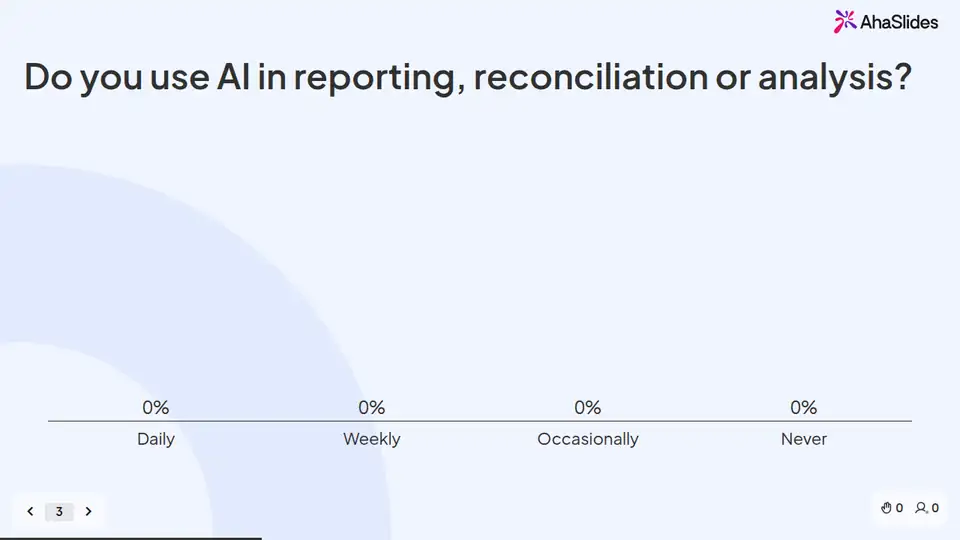
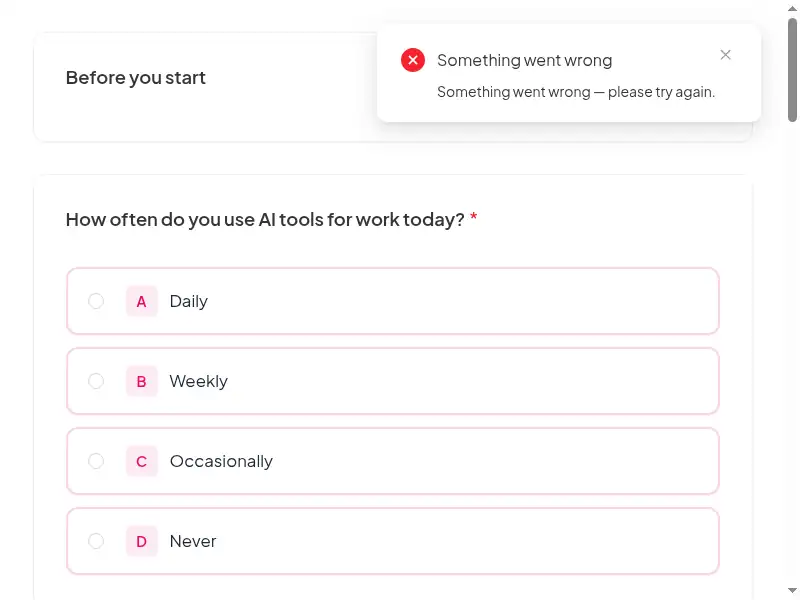
Three pieces that work together

Learners sign in, so every finish and score is recorded. 8 fields to fill in with your details.
Claim the template
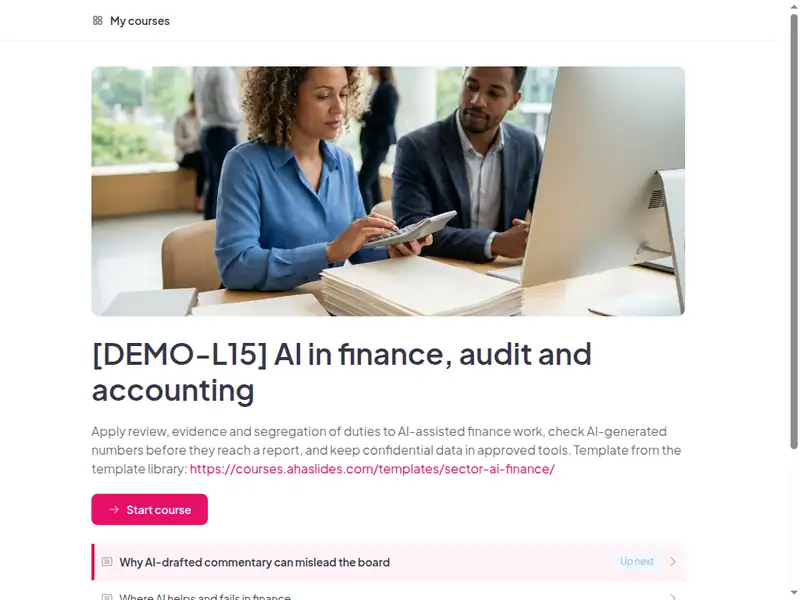
The AI in finance, audit and accounting: Controls, accuracy and accountability course as a learner first sees it

6 lessons, about 40 minutes

Minutes are an estimate.

  • Lesson 1: Why AI-drafted commentary can mislead the board · 8 min

    Before you begin · The invented driver · What failed

  • Lesson 2: Where AI helps and fails in finance · 8 min

    Helps and fails · Sort the task · Check

  • Lesson 3: Control steps for AI-assisted close and reporting · 7 min

    Four control steps · Segregation of duties · Evidence for audit

  • Lesson 4: Grey areas: duplicated suppliers, unexplained credit refusals, public uploads · 7 min

    Duplicated suppliers · The unexplained refusal · The public upload

  • Lesson 5: Applying finance AI controls in your team · 5 min

    Your team's rules · Where to ask

  • Lesson 6: Final assessment · 5 min

    10 questions, 80% to pass. The result is saved to the learner's record.

Claim the template

Inside this course

Taken from the course itself.

By the end, learners can

  • Apply internal controls to AI-assisted finance work: review, evidence, segregation of duties
  • Check AI-generated numbers and narratives before they enter reports
  • Recognise when an AI use affects customers' access to credit or insurance and needs extra safeguards
  • Keep confidential financial data out of unapproved tools
  • Document AI use for audit trails

Sample questions, with answers

  1. What should the reviewer have done first with the draft commentary?

    • Check that the writing is clear and the tone confident
    • Trace each stated driver to the ledger or a source document
    • Ask the assistant whether it is certain
    • Shorten the commentary so there is less to check

    Answer: Trace each stated driver to the ledger or a source document. Every driver in the commentary should be traced to the ledger or a source document before it is used. Fluent writing, a confident tone or the assistant's own assurance say nothing about whether a reason is true.

    Lesson 1: Why AI-drafted commentary can mislead the board

  2. An auditor asks how a figure in the pack was produced. Which record helps most?

    • A note that says 'AI was used somewhere in this pack'
    • The tool and prompt, the source file, the reviewer's name and the date
    • The preparer's memory of what happened
    • A screenshot of the final chart only

    Answer: The tool and prompt, the source file, the reviewer's name and the date. A note of the tool and prompt, the source file used, the reviewer and the date lets the auditor follow the work step by step. A general statement that AI was used, or a recollection, cannot be tested.

    Lesson 3: Control steps for AI-assisted close and reporting

  3. Your colleague says: 'I took the client name out, so it is fine.' What do you say?

    • 'Fine, as long as nobody finds out'
    • 'A name is not the only identifier. Let us use the approved tool or sample data'
    • 'Fine, but only upload the last page'
    • 'Fine for a chart, not for a report'

    Answer: 'A name is not the only identifier. Let us use the approved tool or sample data'. Removing a name does not make the data safe to share. Use an approved tool or agreed sample data, and ask the control owner if you are unsure. Say it kindly: the aim is to help a colleague avoid a slip, not to blame them.

    Lesson 4: Grey areas: duplicated suppliers, unexplained credit refusals, public uploads

A scenario from "Grey areas: duplicated suppliers, unexplained credit refusals, public uploads"

An assistant proposes merging two suppliers with similar names and bank details.

Best response: Flag for review, do not merge.

Weaker responses: Merge on the assistant's say-so; Ignore it.

Related articles

2 articles from the AhaSlides blog that use this course, newest first.

Common questions

Yes. Claiming the template and editing it are free.

Yes. The course is self-paced and online, and the live deck lets you add a live session in the room or online.

Before a finance team adopts AI in close, reporting or analysis; annually for finance and audit teams.

Finance, accounting, audit, tax, banking and insurance staff; run by finance leadership with internal audit or risk.

Record completion in your own LMS or record system, so you can show who finished the course and when.

Your own details, each highlighted inside the course:
  • Finance AI control steps
  • Approved finance AI tools
  • Finance control owner
  • AI policy link
  • Audit evidence template
  • LMS or record system
Then edit anything else you like: wording, scenarios, your logo.
Visit the help centre (opens in a new tab)