
Lesson 1: Why this matters · 8 min
Explain why preventing sexual harassment is now a legal duty for every employer.
Learners sign in, so every finish and score is recorded. 8 fields to fill in with your details.
Minutes are an estimate.
Explain why preventing sexual harassment is now a legal duty for every employer.
Define harassment, sexual harassment and less favourable treatment for rejecting/submitting under the Equality Act.
Distinguish sexual harassment from acceptable workplace behaviour, including online and at social events.
Act as an active bystander and respond as a target, including when the harasser is a customer or client.
Report through internal channels and know external routes (Acas, tribunal, EHRC).
(Managers) Respond to a complaint promptly and fairly and take preventative steps.
12 questions, 80% to pass. The result is saved to the learner's record.
Taken from the course itself.
Where does our commitment to preventing sexual harassment apply?
Answer: Wherever work happens, including home working, work trips, social events and group chats. It applies wherever work or work-related contact happens, and to everyone who works for us, not only permanent staff.
Lesson 1: Why this matters
A manager hints that a promotion could depend on having a drink alone together. Which description fits best?
Answer: Possible less favourable treatment linked to sexual conduct, which should be reported. Linking a work benefit to sexual conduct is the kind of treatment s.26(3) covers. Context and power matter, and one incident can be enough.
Lesson 3: Spot it
A customer harasses a member of staff. What is the employer's position?
Answer: The employer should take steps to protect staff, and the law on third-party harassment is changing. Employers must take reasonable steps now. Under the Employment Rights Act 2025, from 30 October 2026 they must take all reasonable steps and can be liable for harassment of staff by customers and other third parties.
Lesson 4: What would you do?
Leeds call-centre: team leader Gareth makes sexual remarks about new starter Aisha in a team huddle; you're Priya at the next desk.
Best response: Distract/check in with Aisha after, offer to support a report.
Weaker responses: Laugh along; Post about it on social media.
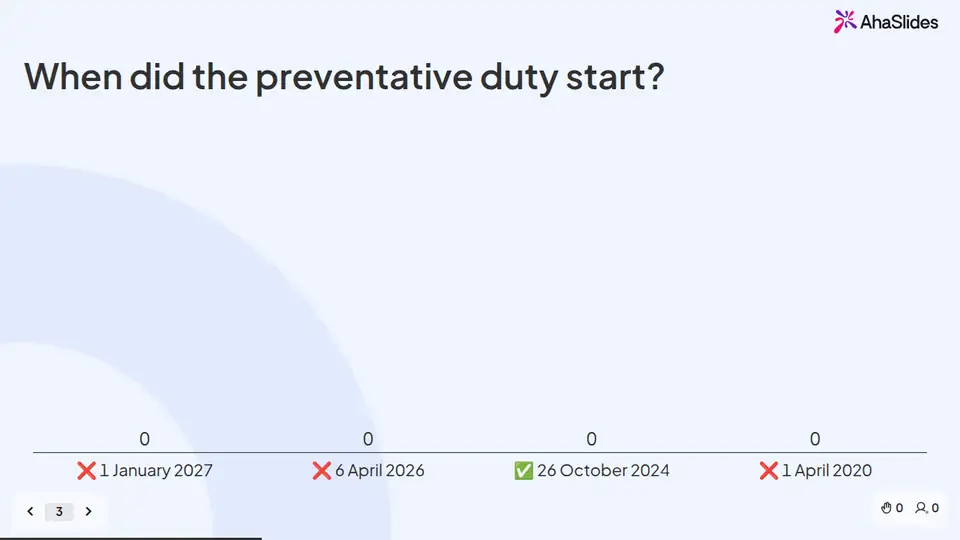
Equality Act 2010 s.26 (harassment), s.27 (victimisation), s.40 & s.109 (employer liability), s.40A (duty to take reasonable steps to prevent sexual harassment - inserted by the Worker Protection (Amendment of Equality Act 2010) Act 2023, in force 26 Oct 2024), s.124A (up to 25% compensation uplift); Employment Rights Act 2025 (Royal Assent 18 Dec 2025): duty becomes "all reasonable steps" and liability for third-party harassment - due October 2026 (verify commencement); sexual-harassment disclosures protected under PIDA from 6 April 2026; EHRC Technical Guidance on sexual harassment and harassment at work (updated 2024) and 8-step guide.
Courses teams often run alongside this one.

Security Awareness Training

Ethics & Compliance Training

Ethics & Compliance Training
An article from the AhaSlides blog that uses this course.

Comments from trainers
No comments yet. Tell other trainers how the course went.
Your comment
Comments are public. We remove spam and personal details.