Skip to content
Claim this template

Free course template · Global

Advertising law essentials: Truthful claims and compliant price promotions for marketing teams

A ready-made course, live deck and two surveys for marketers. 40 minutes, 6 lessons, 10-question final check. Last reviewed 21 October 2026; not legal advice.

Claim the templatePreview the courseDownload SCORM for your LMS

Free. No credit card. Edit everything.

Play a game from the course

Advertising law essentials: try 3 questions

Three questions from this course. Pick an answer, then see why.

Play the game

Game not loading? Open it in a new tab (opens in a new tab)

Three pieces that work together

Learners sign in, so every finish and score is recorded. 12 fields to fill in with your details.
Claim the template
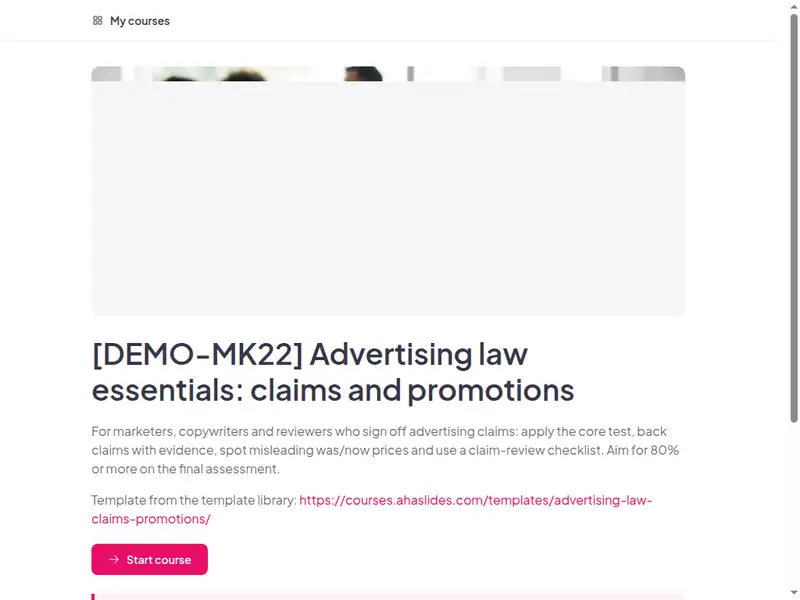
The Advertising law essentials: Truthful claims and compliant price promotions for marketing teams course as a learner first sees it

6 lessons, about 40 minutes

Minutes are an estimate.

  • Lesson 1: Why "can this campaign go live?" is a team question · 8 min

    Before you begin · Friday at 4pm · Who is responsible?

  • Lesson 2: The core test in brief · 8 min

    Misleading or unfair · Who sets the rules · Check

  • Lesson 3: Evidence for claims, and prices that are honest · 7 min

    What counts as evidence · Price promotions · Sort the ads

  • Lesson 4: Grey areas: puffery, small print and certification labels · 7 min

    Bold is not always false · The retailer and the label · The discount with no history

  • Lesson 5: Working with legal review and speaking up · 5 min

    Claim review checklist · You think it is wrong

  • Lesson 6: Final assessment · 5 min

    10 questions, 80% to pass. The result is saved to the learner's record.

Claim the template

Inside this course

Taken from the course itself.

By the end, learners can

  • Explain who regulates advertising claims and why the organisation's own sign-off matters
  • Apply the core test: would the claim mislead an average consumer into a decision they would not otherwise make?
  • Recognise when a claim needs evidence on file before launch, including environmental, health and "certified" claims
  • Spot a misleading price reference in a "was/now" promotion and describe the prior-price rule
  • Use a claim-review checklist and send unclear cases to legal review

Sample questions, with answers

  1. When should evidence for a claim be gathered?

    • Before the claim is published
    • After a complaint arrives
    • Only for health claims
    • Once sales rise

    Answer: Before the claim is published. Evidence comes first. Waiting for a complaint means the claim has already reached customers.

    Lesson 1: Why "can this campaign go live?" is a team question

  2. You are unsure about a claim. The best first move is to…

    • wait and see if anyone complains
    • raise it early, with the evidence, through the legal review route
    • assume last year's approval still holds
    • ask a friend outside the company

    Answer: raise it early, with the evidence, through the legal review route. Raise it early, with the evidence, through the agreed route.

    Lesson 5: Working with legal review and speaking up

  3. A claim is misleading if…

    • it uses a large font
    • the legal team has not seen it
    • it is likely to lead an average consumer to a decision they would not otherwise make
    • it makes a competitor unhappy

    Answer: it is likely to lead an average consumer to a decision they would not otherwise make. The test is about the likely effect on the average consumer.

    Final check

A scenario from "Grey areas: puffery, small print and certification labels"

A retailer that is not certified wants to put a certification logo next to a product to suggest it is.

Best response: Only mention a certification the product or retailer actually holds, in the way the scheme's rules allow.

Weaker response: Inspired by.

Common questions

Yes. Claiming the template and editing it are free.

The course itself is self-paced and online, and the live deck lets you add a live session. Whether online delivery meets your local rules depends on the law that applies to you, so check the rules that apply to you or ask your own counsel.

At hire for marketing and copy roles, before seasonal sales periods, and when a new product category launches.

Marketers, copywriters, product and legal-review teams who write, approve or sign off advertising claims.

Record completion in your own LMS or record system, so you can show who finished the course and when. Check the retention period that applies to you in the rules that apply to you.

Your own details, each highlighted inside the course:
  • Help contact
  • Policy link
  • The laws and codes your legal team says apply in your markets
  • The reference-price rule your legal team confirms for each market
  • Where evidence for claims is filed
  • How to send an ad for legal review
  • Next course link
  • LMS or record system
  • Course URL
  • Live session URL
Then edit anything else you like: wording, scenarios, your logo.
Visit the help centre (opens in a new tab)