Skip to content
Claim this template

Free course template · US federal

Consumer protection & UDAAP

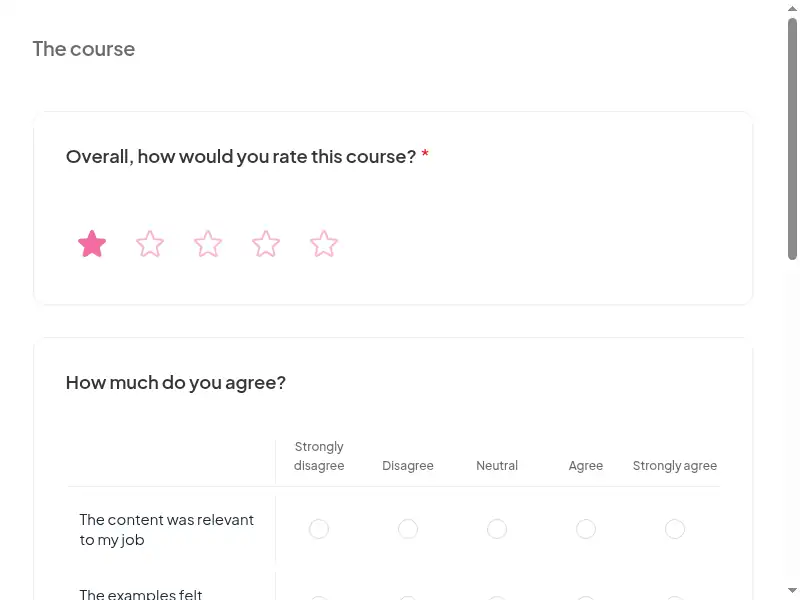
A ready-made course, live deck and two surveys for customer-facing staff. 35 minutes, 7 lessons, 10-question final check. Last reviewed 8 October 2026; not legal advice.

Claim the templatePreview the courseDownload SCORM for your LMS

Free. No credit card. Edit everything.

Play a game from the course

Consumer protection & UDAAP: try 3 questions

Three questions from this course. Pick an answer, then see why.

Play the game

Game not loading? Open it in a new tab (opens in a new tab)

Three pieces that work together

Learners sign in, so every finish and score is recorded. 5 fields to fill in with your details.
Claim the template
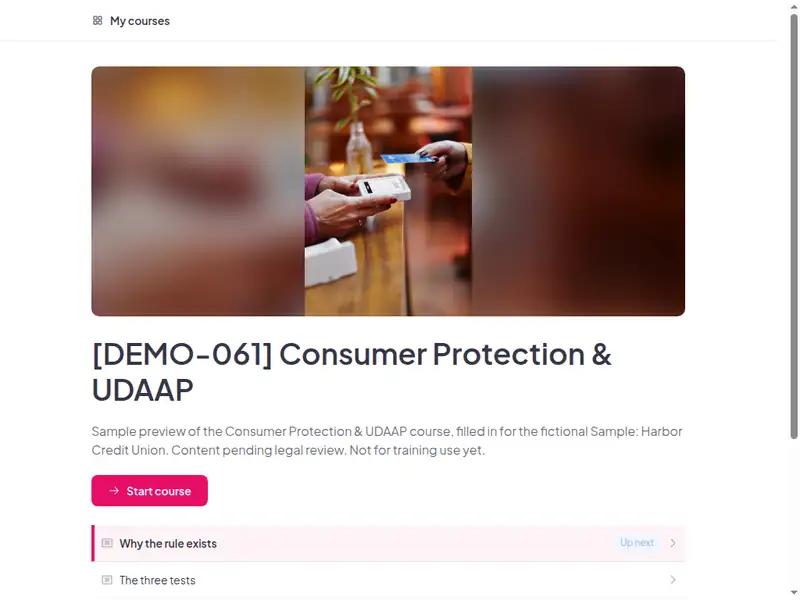
The Consumer protection & UDAAP course as a learner first sees it

7 lessons, about 35 minutes

Minutes are an estimate.

  • Lesson 1: Why the rule exists · 5 min

    Explain who enforces UDAAP/UDAP and why it matters.

  • Lesson 2: The three tests · 8 min

    Apply the tests for unfair, deceptive and abusive.

  • Lesson 3: Allowed vs not allowed · 5 min

    Classify everyday sales, marketing and servicing practices.

  • Lesson 4: Red flags & duties · 5 min

    Recognise complaint signals that point to UDAAP risk.

  • Lesson 5: Case practice · 5 min

    Escalate a practice or script that may mislead.

  • Lesson 6: Escalate correctly · 2 min

    Practice

  • Lesson 7: Final assessment · 5 min

    10 questions, 80% to pass. The result is saved to the learner's record.

Claim the template

Inside this course

Taken from the course itself.

Sample questions, with answers

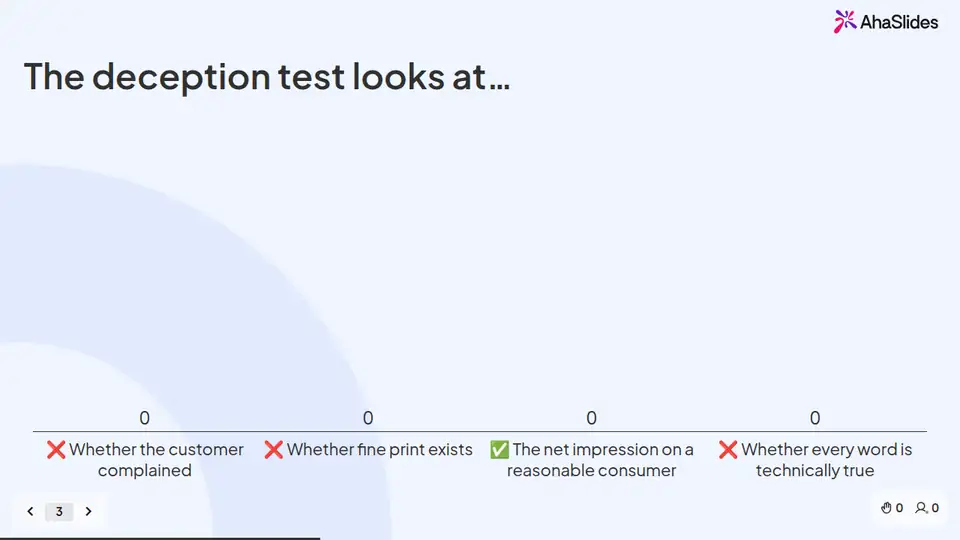
  1. The poster said "no monthly fee" and that was true. What is the main problem?

    • The customer may reasonably have understood there would be no fees at all
    • The poster was too colorful
    • The account was too cheap
    • The bank used a poster

    Answer: The customer may reasonably have understood there would be no fees at all. The test looks at the overall impression on a reasonable customer, not whether each word is literally true.

    Lesson 1: Why the rule exists

  2. A customer says "just fix my card". What should you do?

    • Enroll them in a card protection plan too
    • Fix the card first; mention extras only if relevant, and never enroll without clear consent
    • Say the plan is needed to fix the card
    • Offer it and assume silence means yes

    Answer: Fix the card first; mention extras only if relevant, and never enroll without clear consent. Offering a relevant product with clear disclosure is fine. Enrolling someone without clear consent, or saying a product is required when it is not, is not. Silence is not consent.

    Lesson 4: Red flags & duties

  3. You think a script may mislead customers, but it is already approved. What do you do?

    • Ignore it because it is approved
    • Change the wording yourself
    • Raise it with Compliance anyway
    • Wait for a complaint

    Answer: Raise it with Compliance anyway. Approved scripts can still mislead. Raising it early is what your compliance process expects.

    Lesson 6: Escalate correctly

A scenario from "Case practice"

Agent's incentive pushes add-on products; customer says "just fix my card".

Best response: Don't enrol without clear consent.

Legal basis

Dodd-Frank Act ss.1031 & 1036 (12 U.S.C. 5531, 5536) - unfair, deceptive or abusive acts; s.1042 (state AG enforcement); FTC Act s.5 (15 U.S.C. 45); FTC Policy Statements on Deception (1983) and Unfairness (1980).

Common questions

Yes. Claiming the template and editing it are free.

The course itself is self-paced and online, and the live deck lets you add a live session. Whether online delivery meets your local rules depends on the law that applies to you, so check Dodd-Frank Act ss.1031 & 1036 or ask your own counsel.

At hire + annually; when products or marketing change.

Customer-facing staff, collections, marketing, product and sales teams at banks, lenders, fintechs, servicers and any consumer business.

Record completion in your own LMS or record system, so you can show who finished the course and when. Check the retention period that applies to you in Dodd-Frank Act ss.1031 & 1036.

Your own details, each highlighted inside the course:
  • Complaint logging process
  • Approved scripts location
  • Compliance contact
  • Ethics hotline
  • LMS or record system
Then edit anything else you like: wording, scenarios, your logo.
Visit the help centre (opens in a new tab)