Skip to content
Claim this template

Free course template · US federal

Emergency action & fire prevention plans

A ready-made course, live deck and two surveys for all employees. 30 minutes, 7 lessons, 10-question final check. Last reviewed 8 October 2026; not legal advice.

Claim the templatePreview the courseDownload SCORM for your LMS

Free. No credit card. Edit everything.

Play a game from the course

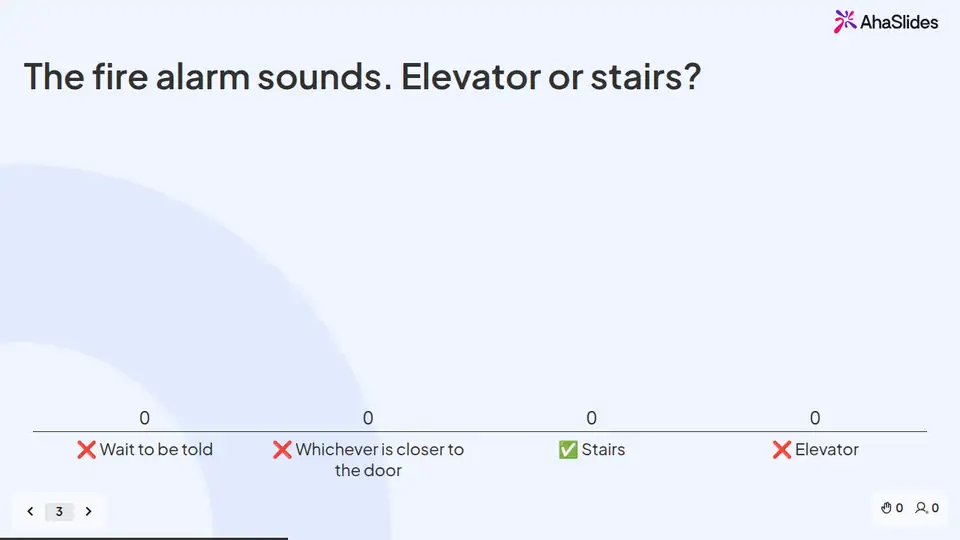
Emergency action & fire prevention plans: try 3 questions

Three questions from this course. Pick an answer, then see why.

Play the game

Game not loading? Open it in a new tab (opens in a new tab)

Three pieces that work together

Learners sign in, so every finish and score is recorded. 13 fields to fill in with your details.
Claim the template
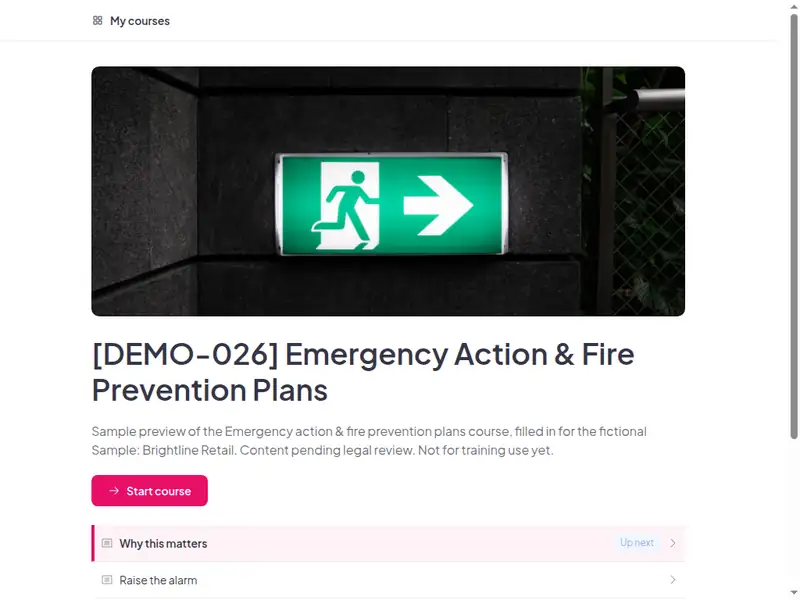
The Emergency action & fire prevention plans course as a learner first sees it

7 lessons, about 30 minutes

Minutes are an estimate.

  • Lesson 1: Why this matters · 4 min

    Explain what an emergency action plan and fire prevention plan are and why you must know yours.

  • Lesson 2: Raise the alarm · 4 min

    Recognise how emergencies are reported and how the alarm sounds at your site.

  • Lesson 3: Get out safely · 6 min

    Follow your evacuation route, exit procedure and assembly point.

  • Lesson 4: Stay, shelter and special roles · 4 min

    Describe shelter-in-place and duties of employees who stay to run critical operations or perform rescue.

  • Lesson 5: Prevent the fire · 6 min

    Identify the major fire hazards in your workplace and how they are controlled.

  • Lesson 6: When things go wrong · 2 min

    Describe the role of evacuation wardens and how to help colleagues who need assistance.

  • Lesson 7: Final assessment · 4 min

    10 questions, 80% to pass. The result is saved to the learner's record.

Claim the template

Inside this course

Taken from the course itself.

Sample questions, with answers

  1. What is the main purpose of an emergency action plan?

    • So everyone knows how to report an emergency and get out safely
    • To decide who is blamed afterwards
    • To replace fire alarms
    • To avoid telling employees anything

    Answer: So everyone knows how to report an emergency and get out safely. The plan tells people how to report an emergency, how to evacuate and who does what.

    Lesson 1: Why this matters

  2. A tornado warning sounds. What does your plan most likely tell you to do?

    • Run outside to your car
    • Shelter in place in a designated area
    • Wait at your desk
    • Take the elevator

    Answer: Shelter in place in a designated area. Weather emergencies usually mean sheltering in a safe interior location.

    Lesson 2: Raise the alarm

  3. You smell smoke and the alarm sounds. What do you do?

    • Finish your email first
    • Take the elevator to save time
    • Leave by the stairs and go to the assembly point
    • Go to the parking lot alone and drive away

    Answer: Leave by the stairs and go to the assembly point. Leave at once by the stairs and report to your assembly point. Do not use the elevator or go back for belongings.

    Lesson 3: Get out safely

A scenario from "When things go wrong"

Retail store: smoke alarm during a busy Saturday, customer in a wheelchair on mezzanine, elevator recall.

Best response: Alert warden, guide to designated area of refuge/stair, report location to responders.

Weaker responses: Use elevator; Leave customer to find own way.

Legal basis

29 CFR 1910.38 (esp. (c), (e), (f)); 29 CFR 1910.39 (esp. (c), (d), (e)).

Related articles

22 articles from the AhaSlides blog that use this course, newest first.

Common questions

Yes. Claiming the template and editing it are free.

The course itself is self-paced and online, and the live deck lets you add a live session. Whether online delivery meets your local rules depends on the law that applies to you, so check 29 CFR 1910.38 (esp. (c), (e), (f)) or ask your own counsel.

When the plan is first developed or employee is first assigned + when responsibilities change + when the plan changes; annual refresher and drills best practice.

All employees (with a supervisor/evacuation-warden add-on page); offices, retail stores, warehouses, plants, clinics.

Record completion in your own LMS or record system, so you can show who finished the course and when. Check the retention period that applies to you in 29 CFR 1910.38 (esp. (c), (e), (f)).

Your own details, each highlighted inside the course:
  • Emergency reporting method
  • Alarm system description
  • Site specific emergency types
  • Evacuation map image
  • Assembly points
  • Headcount procedure
  • Shelter locations
  • Critical ops roles
  • Warden names by area
  • Fire hazards and controls
  • Fire prevention responsible persons
  • Person/job title employees can contact for more info about the plan
  • LMS or record system
Then edit anything else you like: wording, scenarios, your logo.
Visit the help centre (opens in a new tab)