Skip to content
Claim this template

Free course template · Global

Responsible and ethical marketing: Practical judgement for brand and campaign teams

A ready-made course, live deck and two surveys for marketers and brand managers. 35 minutes, 6 lessons, 10-question final check. Last reviewed 21 October 2026; not legal advice.

Claim the templatePreview the courseDownload SCORM for your LMS

Free. No credit card. Edit everything.

Play a game from the course

Responsible and ethical marketing: Practical judgement for brand and campaign teams: try 3 questions

Three questions from this course. Pick an answer, then see why.

Play the game

Game not loading? Open it in a new tab (opens in a new tab)

Three pieces that work together

Learners sign in, so every finish and score is recorded. 11 fields to fill in with your details.
Claim the template
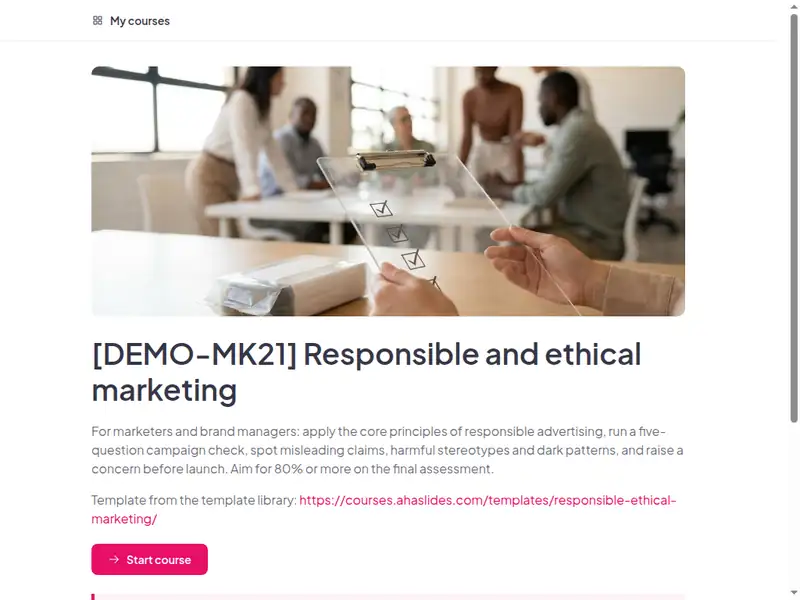
The Responsible and ethical marketing: Practical judgement for brand and campaign teams course as a learner first sees it

6 lessons, about 35 minutes

Minutes are an estimate.

  • Lesson 1: Why a campaign can win clicks and lose trust · 7 min

    Before you begin · The campaign that went too far · Where is the line?

  • Lesson 2: The principles in brief · 7 min

    Four principles · Voluntary does not mean optional · Check

  • Lesson 3: The five-question campaign check · 7 min

    Five questions · Pass or review? · Check

  • Lesson 4: Grey areas: causes, stereotypes and vulnerable audiences · 6 min

    Joining a social cause · The gendered ad · Who is watching?

  • Lesson 5: Speak up and respond in a crisis · 4 min

    Raise it before launch · When a health-themed ad is criticised

  • Lesson 6: Final assessment · 4 min

    10 questions, 80% to pass. The result is saved to the learner's record.

Claim the template

Inside this course

Taken from the course itself.

By the end, learners can

  • Explain why responsible marketing protects trust and brand value, and where persuasion becomes manipulation
  • Describe the core principles of advertising self-regulation: legal, decent, honest and truthful, with a sense of responsibility
  • Spot claims or disclosures that could mislead, including sponsored content
  • Recognise harmful stereotypes and extra care needed for vulnerable audiences
  • Spot manipulative digital triggers and dark patterns and raise a campaign for review

Sample questions, with answers

  1. What did the team skip?

    • A short pre-launch check
    • A larger budget
    • A second hashtag
    • A shorter caption

    Answer: A short pre-launch check. A short check would have caught the claim, the tone and the audience risk.

    Lesson 1: Why a campaign can win clicks and lose trust

  2. Who should write the public response to a campaign backlash?

    • Whoever posted the ad
    • Each team in its own words
    • One agreed owner, using the response route
    • The loudest critic

    Answer: One agreed owner, using the response route. One agreed response avoids contradictions.

    Lesson 5: Speak up and respond in a crisis

  3. A voluntary advertising code is best described as…

    • a law with a fine
    • irrelevant to marketers
    • only for lawyers
    • a standard you can be judged against, even though it is not law

    Answer: a standard you can be judged against, even though it is not law. Voluntary does not mean optional.

    Final check

A scenario from "Grey areas: causes, stereotypes and vulnerable audiences"

A brand wants to post about a social-justice moment because competitors are.

Best response: Ask whether the brand has a real, long-standing connection and what it will actually do.

Weaker responses: Post a slogan only; Borrow the imagery of a protest; Delete critics quietly.

Common questions

Yes. Claiming the template and editing it are free.

The course itself is self-paced and online, and the live deck lets you add a live session. Whether online delivery meets your local rules depends on the law that applies to you, so check the rules that apply to you or ask your own counsel.

At hire for marketing roles, before a major campaign cycle, and after a public campaign controversy.

Marketers and brand managers.

Record completion in your own LMS or record system, so you can show who finished the course and when. Check the retention period that applies to you in the rules that apply to you.

Your own details, each highlighted inside the course:
  • Help contact
  • Escalation route
  • Policy link
  • The codes and laws your ethics and legal team say apply in your markets
  • Who runs pre-launch review
  • Next course link
  • LMS or record system
  • Course URL
  • Live session URL
Then edit anything else you like: wording, scenarios, your logo.
Visit the help centre (opens in a new tab)