Skip to content
Claim this template

Free course template · Global

Responsible lending, credit assessment and collections

A ready-made course, live deck and two surveys for loan officers. 40 minutes, 6 lessons. Last reviewed 21 October 2026; not legal advice.

Claim the templatePreview the courseDownload SCORM for your LMS

Free. No credit card. Edit everything.

Play a game from the course

Responsible lending, credit assessment and collections: try 3 questions

Three questions from this course. Pick an answer, then see why.

Play the game

Game not loading? Open it in a new tab (opens in a new tab)

Three pieces that work together

Learners sign in, so every finish and score is recorded. 11 fields to fill in with your details.
Claim the template
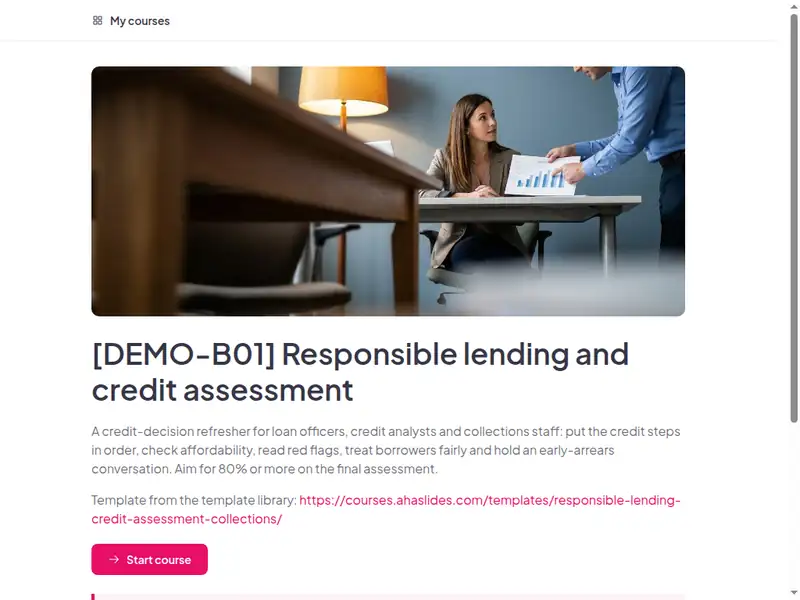
The Responsible lending, credit assessment and collections course as a learner first sees it

6 lessons, about 40 minutes

Minutes are an estimate.

  • Lesson 1: Why careful lending matters · 7 min

    Before you begin · A Friday afternoon application · What responsible lending means

  • Lesson 2: The credit lifecycle and affordability · 7 min

    From application to monitoring · Order the steps · Affordability in brief

  • Lesson 3: Reading scores, grades and red flags · 7 min

    What a score is and is not · Red flags · Check

  • Lesson 4: Grey areas: can we lend? · 7 min

    Scenario · Scenario · Match the response

  • Lesson 5: Collections conversations, hardship and speaking up · 7 min

    An early-arrears call · Dos and don'ts · Who to tell

  • Lesson 6: Final assessment · 5 min

    Practice · Completion

Claim the template

Inside this course

Taken from the course itself.

By the end, learners can

  • Put the stages of the credit lifecycle in order: application, assessment, approval, monitoring, collections
  • Carry out an affordability check using stated income, commitments and living costs, and say when to refer
  • Read a risk grade and spot red flags in an application without treating a score as the whole decision
  • Treat borrowers fairly at every stage, including clear disclosure of cost and terms
  • Hold an early-arrears conversation that explores hardship options and records the outcome

Sample questions, with answers

  1. Why does a lending decision rest on the borrower's ability to repay?

    • A debt the borrower cannot repay harms them and the lender
    • It makes approvals faster
    • It keeps the target low

    Answer: A debt the borrower cannot repay harms them and the lender. A decision must rest on the borrower's ability to repay, not on the lender's target.

    Lesson 1: Why careful lending matters

  2. Which of these may you use to decide on a credit application?

    • Evidence of income, commitments and living costs
    • The applicant's race or religion
    • The applicant's marital status
    • Whether the income comes from benefits

    Answer: Evidence of income, commitments and living costs. Decide on credit-relevant evidence only. Protected characteristics, and the source of lawful income such as benefits, are not grounds for a decision.

    Lesson 3: Reading scores, grades and red flags

  3. A customer asks for more credit than their need suggests. What comes first?

    • A conversation about what they need
    • Approving the maximum
    • Offering a linked product

    Answer: A conversation about what they need. Understanding the need comes first. The amount and the cost follow from it.

    Lesson 4: Grey areas: can we lend?

A scenario from "Grey areas: can we lend?"

A borderline application and a team target.

Best response: Assess on the evidence, decline or adjust the offer, and record why.

Weaker responses: Stretch the figures; Approve and watch; Pass it on without a note.

Related articles

2 articles from the AhaSlides blog that use this course, newest first.

Common questions

Yes. Claiming the template and editing it are free.

Yes. The course is self-paced and online, and the live deck lets you add a live session in the room or online.

At onboarding for credit and collections roles, and yearly as a refresher.

Loan officers, credit analysts, card and consumer-finance sales staff and collections agents; run by the retail-credit academy, consumer-finance learning team or compliance owner.

Record completion in your own LMS or record system, so you can show who finished the course and when.

Your own details, each highlighted inside the course:
  • Compliance contact
  • Policy link
  • Speak up route
  • Jurisdiction and regulator
  • Lending policy link
  • Approved product list
  • LMS or record system
  • Course URL
  • Live session URL
Then edit anything else you like: wording, scenarios, your logo.
Visit the help centre (opens in a new tab)