
Lesson 1: Why FERPA exists · 7 min
Explain FERPA's purpose, the rights it gives parents and eligible students, and enforcement.
Learners sign in, so every finish and score is recorded. 8 fields to fill in with your details.
Minutes are an estimate.
Explain FERPA's purpose, the rights it gives parents and eligible students, and enforcement.
Distinguish education records, directory information and what is excluded (e.g. sole-possession notes).
Decide when disclosure needs consent and when an exception applies.
Handle records securely and log disclosures as required.
Apply FERPA to common requests from parents, police, employers and colleagues.
Escalate requests and suspected breaches to the right person.
12 questions, 80% to pass. The result is saved to the learner's record.
Taken from the course itself.
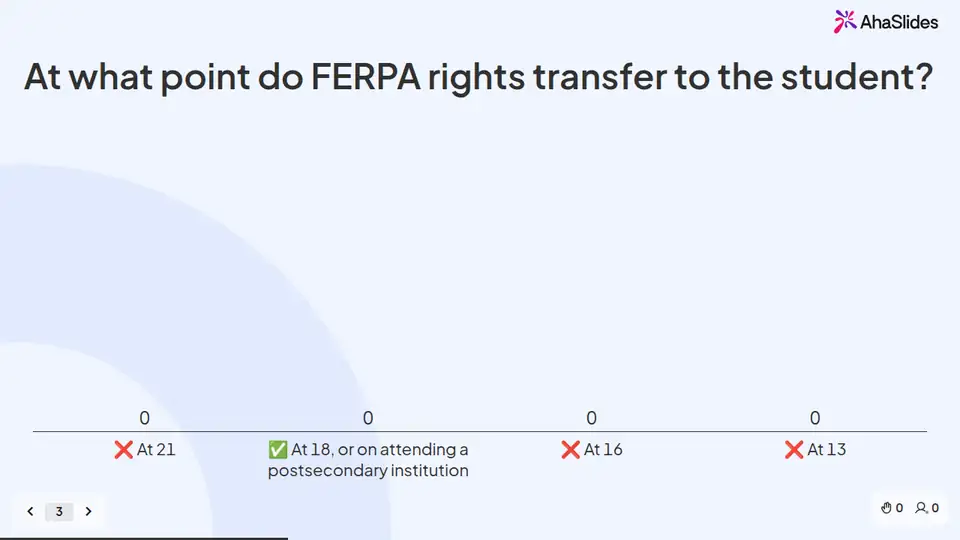
When do FERPA rights pass from a parent to the student?
Answer: At 18, or on attending a postsecondary institution. Rights pass to the student at 18 or when they attend a postsecondary institution. They are then called an eligible student.
Lesson 1: Why FERPA exists
Which statement about an exception is correct?
Answer: It allows a disclosure but rarely requires it. Exceptions permit a disclosure under certain conditions. They rarely require one.
Lesson 3: Allowed vs not allowed
A student's parent asks to see their child's record. What is the response deadline?
Answer: Within 45 days. A school must respond to an access request within 45 days.
Lesson 4: Handle records safely
University adviser Ms. Liang gets a call from a father demanding his 19-year-old's grades.
Best response: Verify whether student consented or is a tax dependent per policy , otherwise decline politely and explain.
Weaker response: Because he pays tuition.
Family Educational Rights and Privacy Act, 20 U.S.C. 1232g; 34 CFR Part 99.
Courses teams often run alongside this one.

Ethics & Compliance Training

Professional Development for Teachers

Professional Development for Teachers
Comments from trainers
No comments yet. Tell other trainers how the course went.
Your comment
Comments are public. We remove spam and personal details.