Skip to content
Claim this template

Free course template · Global

Influencer and sponsored-content disclosure: Staying compliant across the US, UK and EU

A ready-made course, live deck and two surveys for social. 35 minutes, 6 lessons. Last reviewed 21 October 2026; not legal advice.

Claim the templatePreview the courseDownload SCORM for your LMS

Free. No credit card. Edit everything.

Play a game from the course

Influencer and sponsored-content disclosure: try 3 questions

Three questions from this course. Pick an answer, then see why.

Play the game

Game not loading? Open it in a new tab (opens in a new tab)

Three pieces that work together

Learners sign in, so every finish and score is recorded. 11 fields to fill in with your details.
Claim the template
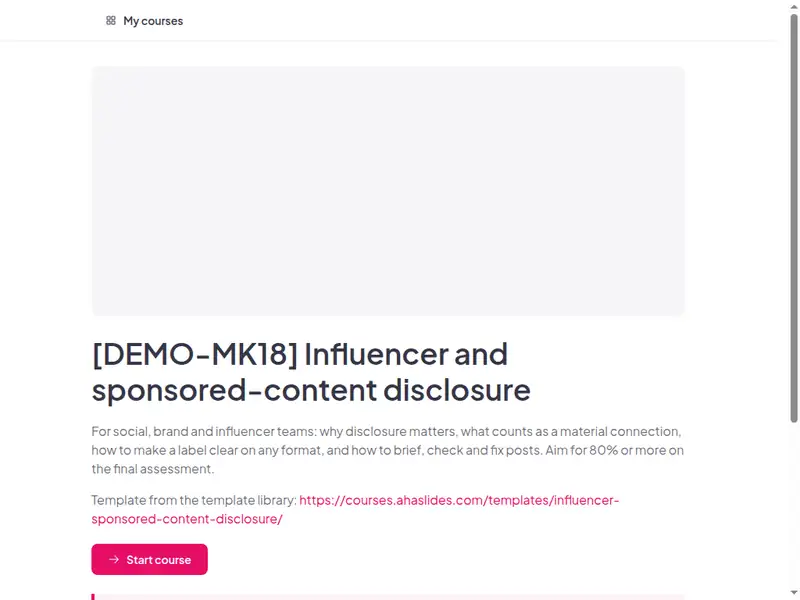
The Influencer and sponsored-content disclosure: Staying compliant across the US, UK and EU course as a learner first sees it

6 lessons, about 35 minutes

Minutes are an estimate.

  • Lesson 1: Why disclosure matters · 7 min

    Before you begin · The free blender · Is it an ad?

  • Lesson 2: Reading the rules · 6 min

    Three frameworks, one idea · Who is accountable? · Check

  • Lesson 3: What counts as a material connection · 6 min

    Spot the connection · Free is not free · Check

  • Lesson 4: Making disclosures clear · 6 min

    Clear means seen · Fix the post · Video and live

  • Lesson 5: Briefing, contracting and monitoring · 6 min

    The brief · A spoken-only disclosure · Check and monitor

  • Lesson 6: Review posts and fix them · 4 min

    Your next steps · Practice

Claim the template

Inside this course

Taken from the course itself.

By the end, learners can

  • Explain why disclosure matters for audience trust and who is accountable, the brand as well as the creator
  • Describe in principle what the US, UK and EU frameworks expect: a clear sign that content is advertising or that a connection exists
  • Decide whether a post has a material connection: payment, gifts, free products, affiliate links or a relationship
  • Judge whether a disclosure is clear: wording, placement, platform tools, video and live formats
  • Brief, contract and monitor influencers and agencies so disclosure is built in and fixed quickly when wrong

Sample questions, with answers

  1. Lucia gets a free blender and says nothing about it. What is the best reading?

    • She should disclose the free product clearly
    • No payment, so nothing to tell
    • Only a problem if she gets paid later
    • Only a problem if she has over 100,000 followers

    Answer: She should disclose the free product clearly. A free product can create a connection the audience would want to know about.

    Lesson 1: Why disclosure matters

  2. A creator buys a kitchen gadget herself and posts an honest opinion. There is no relationship with the brand. The post…

    • needs a label anyway
    • needs no label
    • needs a label if it goes viral
    • needs a label if it is positive

    Answer: needs no label. No connection, no disclosure. Ask legal if you are unsure.

    Lesson 3: What counts as a material connection

  3. Who is accountable for clear disclosure?

    • Only the creator
    • Only the platform
    • Nobody, if the brief did not say
    • The brand, the agency and the creator together

    Answer: The brand, the agency and the creator together. Accountability is shared.

    Lesson 6: Review posts and fix them

A scenario from "What counts as a material connection"

A brand sends a free product to ten creators with the note, "Post if you like it".

Best response: Treat it as gifted and ask the creators to disclose clearly if they post.

Weaker responses: Say there is no need because there is no payment; Ask them to keep it quiet; Send an unlabelled thank-you to all.

Common questions

Yes. Claiming the template and editing it are free.

The course itself is self-paced and online, and the live deck lets you add a live session. Whether online delivery meets your local rules depends on the law that applies to you, so check the rules that apply to you or ask your own counsel.

At onboarding for social and influencer staff, before each influencer campaign briefing, and annually.

Social, brand and PR teams, influencer managers and agencies.

Record completion in your own LMS or record system, so you can show who finished the course and when. Check the retention period that applies to you in the rules that apply to you.

Your own details, each highlighted inside the course:
  • Help contact
  • Policy link
  • Escalation route
  • The current rules and approved labels for each region the organisation markets in, written by the legal team
  • How to use each platform's paid-partnership tools
  • Next course link
  • LMS or record system
  • Course URL
  • Live session URL
Then edit anything else you like: wording, scenarios, your logo.
Visit the help centre (opens in a new tab)