Skip to content
Claim this template

Free course template · Global

Deepfakes and AI-enabled fraud: Spot, stop and report synthetic voice, video and image scams

A ready-made course, live deck and two surveys for all staff. AhaSlides tracks progress, completion and scores for you. 35 minutes, 6 lessons, 10-question final check. Last reviewed 21 October 2026; not legal advice.

Claim the templatePreview the courseDownload SCORM for your LMS

Free. No credit card. Edit everything.

Course outline at a glance

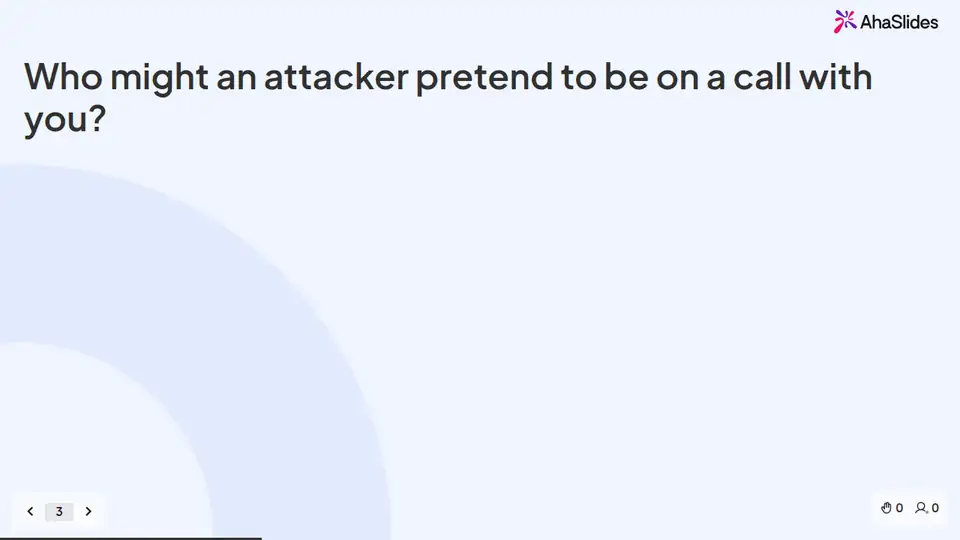
  • The call from "the CFO"
  • Timeline
  • Quiz

  • Four types
  • Why spotting fails
  • The rules in plain words
  • Tabs
  • Flashcards
  • Multi-select quiz
  • Accordion

  • Four steps
  • Verify or proceed?
  • Branching decision
  • Process
  • Sorting activity
  • Scenario
  • Quiz

  • Real or AI?
  • The candidate interview
  • An image going round the office
  • Quiz
  • Flashcards
  • Scenario
  • Multi-select quiz

  • What to say and do
  • Process
  • Checklist
  • Quiz

Final check: 10 questions, 80% to pass

Try some questions from the course

Question 1 of 3

What should Maya do first?


She should end the call and verify through a number she already holds. Everyone on the call could be synthetic, so asking them to prove who they are, or checking with a colleague on the same call, proves nothing. A call-back on a number from a trusted record is the most reliable way to reach the real person.

Lesson 1, Anatomy of a cloned-executive video call, teaches this. See the outline

Question 2 of 3

You call the director back on the stored number and she confirms the bank-detail change. What is the next step?


A confirmed change of bank details still needs dual approval. The call-back checks who asked; the second approver checks the change itself. Details should never be sent by voice note or posted in chat.

Lesson 3, Pause, verify, approve, report: the process, teaches this. See the outline

Question 3 of 3

A colleague tells you someone has made a fake image of them. What do you say first?


Start by believing them and offering help. Questioning whether it is fake, blaming them or asking to see the image adds to the harm. Reporting and evidence come after.

Lesson 5, Speaking up and supporting targeted colleagues, teaches this. See the outline

Learners earn a certificate

Your organisation

Certificate of completion

This certifies that

Alex Morgan

has completed

Deepfakes and AI-enabled fraud: Spot, stop and report synthetic voice, video and image scams

Completed on12 October 2026
Sample certificate with a placeholder learner name.

Style 1 of 6: Coral geometric

Everyone who finishes gets a certificate with their name, the course title and the completion date. Add your own logo, colours and signer.

Three pieces that work together

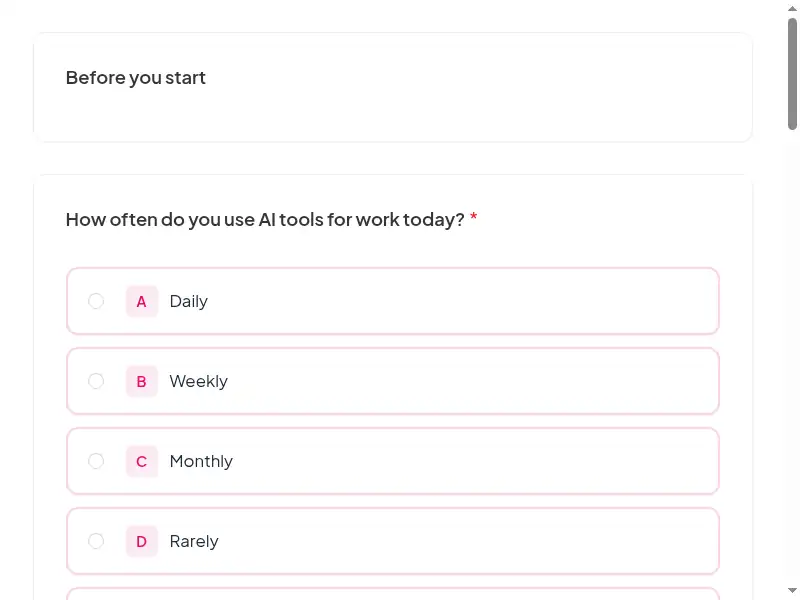
Learners prepare on their own, you answer questions live, and the surveys tell you what stuck. 10 fields to fill in with your own policy, contacts and locations; each one is highlighted inside the course.
Claim the template
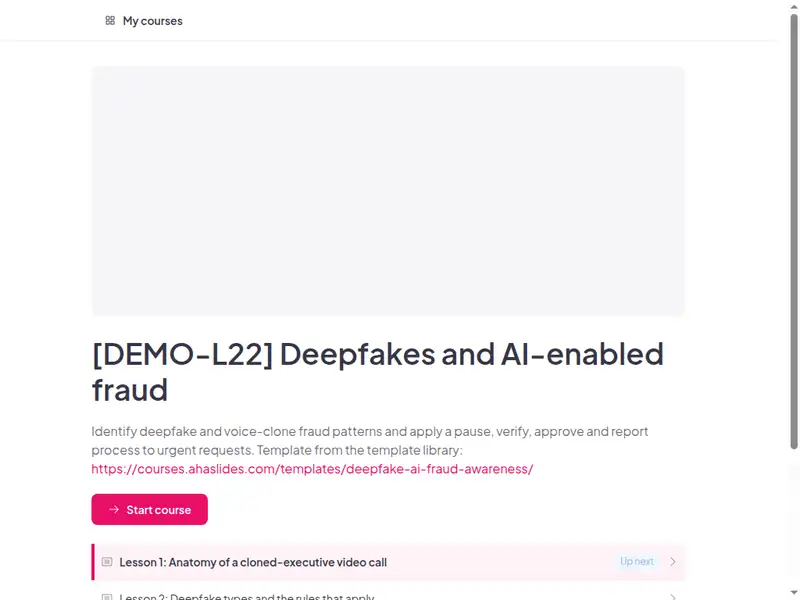
The Deepfakes and AI-enabled fraud: Spot, stop and report synthetic voice, video and image scams course as a learner first sees it

Completion is tracked for you

Learners sign in to take the course, so every start, finish and score is recorded in AhaSlides. No spreadsheet to keep.

  • Who has finished

    See who has not started, who is in progress and who has completed the course.

  • Every score

    Each learner's result on the 10-question final check, against the 80% pass mark.

  • What landed

    Survey results show what people took away, and the 30-day check-in shows whether they use it.

Claim the template

6 lessons, about 35 minutes

What learners can do at the end of each lesson. Minutes are an estimate.

  • Lesson 1: Anatomy of a cloned-executive video call · 7 min

    Before you begin · The call from "the CFO" · Check

  • Lesson 2: Deepfake types and the rules that apply · 7 min

    Four types · Why spotting fails · The rules in plain words

  • Lesson 3: Pause, verify, approve, report: the process · 7 min

    Four steps · Verify or proceed? · Branching decision

  • Lesson 4: Grey areas: voice notes, candidates, circulating images · 6 min

    Real or AI? · The candidate interview · An image going round the office

  • Lesson 5: Speaking up and supporting targeted colleagues · 4 min

    What to say and do · Check

  • Lesson 6: Final assessment · 4 min

    10 questions, 80% to pass. The result is saved to the learner's record.

Claim the template

Common questions

Yes. The course, the live deck and both surveys are free. Claiming the template into your AhaSlides account is free too.

Yes. The course is self-paced and online, and the live deck lets you add a live session in the room or online.

At hire, annually, and after any publicised deepfake fraud affecting your sector.

All staff.

Record completion in your own LMS or record system, so you can show who finished the course and when.

Yes, everything. Change the wording, swap scenarios for ones from your workplace, add your logo, or remove parts that don't apply.

Your own details, each highlighted inside the course:
  • How to verify a request: which stored numbers or channels to use
  • Payment threshold or change types needing a second approver
  • Where to report a suspected deepfake
  • HR contact and candidate verification step
  • HR contact and candidate verification step
  • Employee assistance route for targeted colleagues
  • Policy, survey and completion record
  • Policy, survey and completion record
Then edit anything else you like: wording, scenarios, your logo.
Visit the help centre (opens in a new tab)