Skip to content
Claim this template

Free course template · Global

ITIL 4 and IT service management: Incident, problem and change on the service desk

A ready-made course, live deck and two surveys for service-desk agents. 45 minutes, 6 lessons. Last reviewed 21 October 2026; not legal advice.

Claim the templatePreview the courseDownload SCORM for your LMS

Free. No credit card. Edit everything.

Play a game from the course

ITIL 4 and IT service management: Incident, problem and change on the service desk: try 3 questions

Three questions from this course. Pick an answer, then see why.

Play the game

Game not loading? Open it in a new tab (opens in a new tab)

Three pieces that work together

Learners sign in, so every finish and score is recorded. 6 fields to fill in with your details.
Claim the template
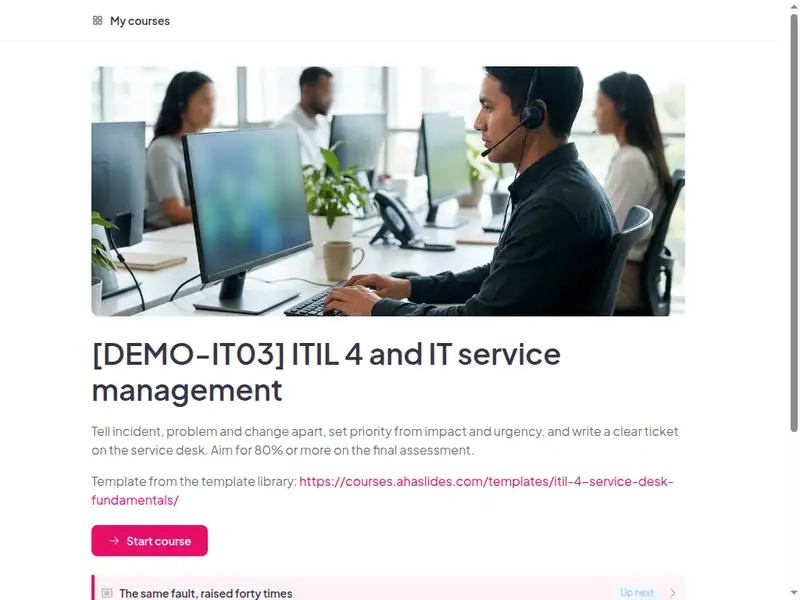
The ITIL 4 and IT service management: Incident, problem and change on the service desk course as a learner first sees it

6 lessons, about 45 minutes

Minutes are an estimate.

  • Lesson 1: The same fault, raised forty times · 9 min

    Before you begin · The pattern · What went wrong

  • Lesson 2: Service value system and the four dimensions · 8 min

    Value in plain words · Match · Check

  • Lesson 3: Guiding principles in a service-desk story · 6 min

    Principles · Which principle?

  • Lesson 4: Incident, problem and change: how they differ · 8 min

    Differences · Classify · Check

  • Lesson 5: Prioritising by impact and urgency, and SLAs · 6 min

    Matrix · Set priority

  • Lesson 6: Writing a good ticket, handover and measuring the desk · 8 min

    Ticket · Measures · Practice

Claim the template

Inside this course

Taken from the course itself.

By the end, learners can

  • Describe the service value system and four dimensions in plain terms
  • Apply the guiding principles to a service-desk story
  • Tell incident, problem and change apart and route each
  • Set priority from impact and urgency and explain SLAs
  • Write a good ticket, hand over cleanly and read desk measures

Sample questions, with answers

  1. What should have been opened once the fault kept coming back?

    • A problem record
    • Another incident only
    • A new SLA
    • A change freeze

    Answer: A problem record. A repeated fault needs a problem record so its cause is found.

    Lesson 1: The same fault, raised forty times

  2. Which principles say to start with a short form and improve it?

    • Keep it simple and progress iteratively
    • Add every field at once
    • Copy a rival
    • Wait for perfection

    Answer: Keep it simple and progress iteratively. Small steps and simplicity get a useful form into use quickly.

    Lesson 3: Guiding principles in a service-desk story

  3. Priority is set from...

    • Impact and urgency
    • Who shouts loudest
    • The time of day
    • The ticket's length

    Answer: Impact and urgency. Impact and urgency together give a fair, consistent priority.

    Lesson 5: Prioritising by impact and urgency, and SLAs

A scenario from "Guiding principles in a service-desk story"

A team plans a huge new ticket form.

Best response: Keep it simple and start with the fields the desk really uses.

Weaker responses: Add every field; Copy a rival's form; Delay for a year.

Related articles

An article from the AhaSlides blog that uses this course.

Common questions

Yes. Claiming the template and editing it are free.

Yes. The course is self-paced and online, and the live deck lets you add a live session in the room or online.

At onboarding of service-desk staff, and before an ITIL foundation exam or a service-desk redesign.

Service-desk agents, IT support leads, service managers and new IT hires; run by IT service management teams with L&D.

Record completion in your own LMS or record system, so you can show who finished the course and when.

Your own details, each highlighted inside the course:
  • Link to the service levels and priority matrix
  • Who to ask for help or to report a concern
  • Where completion is recorded
  • Link to the self-paced course
Then edit anything else you like: wording, scenarios, your logo.
Visit the help centre (opens in a new tab)