Skip to content
Claim this template

Free course template · Global

Blood transfusion safety: Bedside checks, reactions and anticoagulation

A ready-made course, live deck and two surveys for registered nurses and midwives. AhaSlides tracks progress, completion and scores for you. 45 minutes, 6 lessons. Last reviewed 21 October 2026; not legal advice.

Claim the templatePreview the courseDownload SCORM for your LMS

Free. No credit card. Edit everything.

Course outline at a glance

  • Identify a patient positively and label a pre-transfusion sample correctly at the bedside
  • Flashcards
  • Quiz
  • Step-by-step
  • Scenario

  • Carry out the bedside pre-transfusion checks and the observations your policy requires
  • Accordion
  • Multi-select quiz
  • Process
  • Sorting activity
  • Quiz
  • Timeline

  • Recognise signs of an acute transfusion reaction and take the immediate actions
  • Flashcards
  • Process
  • Scenario
  • Quiz
  • Checklist

  • Activate and support your major haemorrhage protocol without delay
  • Tabs
  • Quiz
  • Scenario

  • Support VTE risk assessment and spot warning signs of clots and bleeding in patients on anticoagulants
  • Process
  • Quiz
  • Tabs
  • Sorting activity
  • Checklist

  • Final assessment
  • Completion
  • Quiz

Try some questions from the course

Question 1 of 3

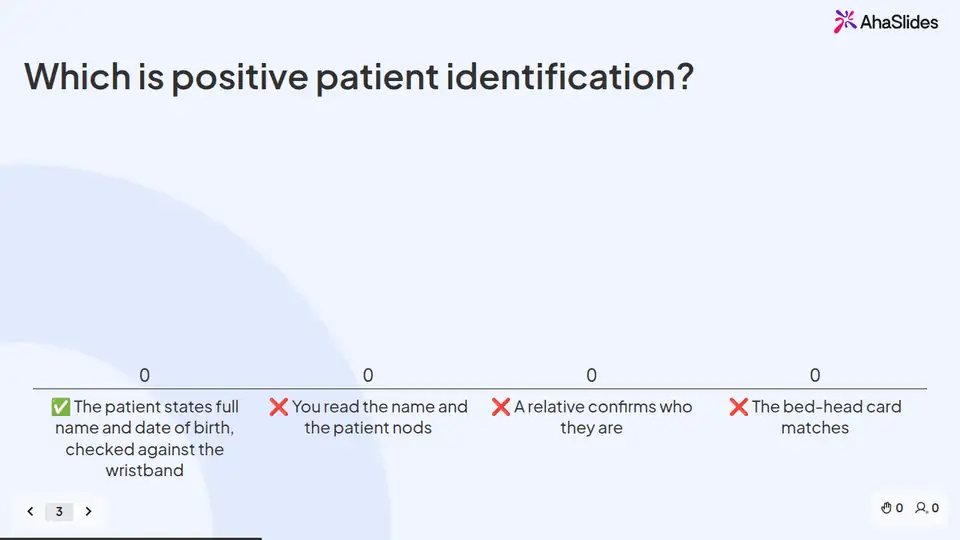
What does positive patient identification mean before a transfusion sample or transfusion?


The patient must tell you their details; reading details out lets a confused or anxious patient agree to the wrong name.

Lesson 1, Positive patient identification and sample labelling, teaches this. See the outline

Question 2 of 3

Where must the final pre-transfusion identity check take place?


The check links the unit to the person in front of you, so it must be done at the bedside.

Lesson 2, Bedside pre-transfusion checks, teaches this. See the outline

Question 3 of 3

A patient develops a fever and low blood pressure during a transfusion. What do you do first?


Stop the transfusion, keep the line for treatment, assess ABC and call the medical team immediately.

Lesson 3, Recognising and managing transfusion reactions, teaches this. See the outline

Learners earn a certificate

Your organisation

Certificate of completion

This certifies that

Alex Morgan

has completed

Blood transfusion safety: Bedside checks, reactions and anticoagulation

Completed on12 October 2026
Sample certificate with a placeholder learner name.

Style 1 of 6: Purple geometric

Everyone who finishes gets a certificate with their name, the course title and the completion date. Add your own logo, colours and signer.

Three pieces that work together

Learners prepare on their own, you answer questions live, and the surveys tell you what stuck. 25 fields to fill in with your own policy, contacts and locations; each one is highlighted inside the course.
Claim the template
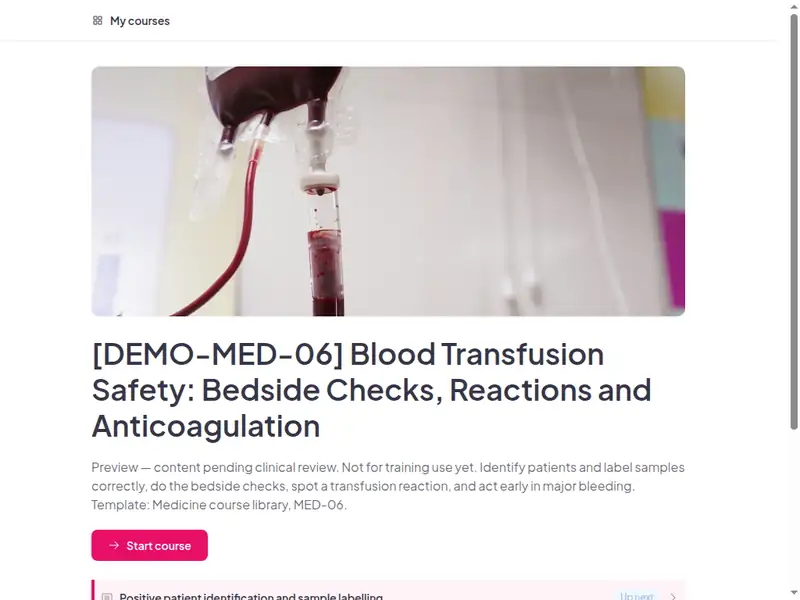
The Blood transfusion safety: Bedside checks, reactions and anticoagulation course as a learner first sees it

Completion is tracked for you

Learners sign in to take the course, so every start, finish and score is recorded in AhaSlides. No spreadsheet to keep.

  • Who has finished

    See who has not started, who is in progress and who has completed the course.

  • Every score

    Each learner's answers to the quizzes and activities in the course.

  • What landed

    Survey results show what people took away, and the 30-day check-in shows whether they use it.

Claim the template

6 lessons, about 45 minutes

What learners can do at the end of each lesson. Minutes are an estimate.

  • Lesson 1: Positive patient identification and sample labelling · 9 min

    Identify a patient positively and label a pre-transfusion sample correctly at the bedside.

  • Lesson 2: Bedside pre-transfusion checks · 8 min

    Carry out the bedside pre-transfusion checks and the observations your policy requires.

  • Lesson 3: Recognising and managing transfusion reactions · 8 min

    Recognise signs of an acute transfusion reaction and take the immediate actions.

  • Lesson 4: Major haemorrhage protocol · 6 min

    Activate and support your major haemorrhage protocol without delay.

  • Lesson 5: Anticoagulants and VTE prevention · 8 min

    Support VTE risk assessment and spot warning signs of clots and bleeding in patients on anticoagulants.

  • Lesson 6: Final assessment · 6 min

    Final assessment · Completion

Claim the template

Common questions

Yes. The course, the live deck and both surveys are free. Claiming the template into your AhaSlides account is free too.

Yes. The course is self-paced and online, and the live deck lets you add a live session in the room or online.

At induction and before first giving blood, then a regular update and competency reassessment at the interval your organisation sets (organisation policy).

Registered nurses and midwives who give blood components, healthcare assistants and phlebotomists who take pre-transfusion samples, porters and staff who collect blood, transfusion laboratory staff, junior doctors.

Record completion in your own LMS or record system, so you can show who finished the course and when.

Yes, everything. Change the wording, swap scenarios for ones from your workplace, add your logo, or remove parts that don't apply.

Your own details, each highlighted inside the course:
  • How and by whom practical competency is assessed and recorded
  • Laboratory minimum identifiers and handwritten / printed label rules
  • When a second group sample is needed
  • Irradiated, antigen-negative and other special requirements and how they are flagged
  • Local TACO risk assessment tool
  • Maximum time from removal from storage to completion, and the return rule for unused units
  • Local bedside checklist and one- or two-person checking rule
  • Whether an electronic bedside identification system is used
  • Local transfusion observation schedule
  • The medical emergency number
  • Incident reporting system
  • Haemovigilance scheme
  • Major haemorrhage number
  • Mhp roles
  • Emergency ID policy
  • Mhp drug guidance
  • Vte risk tool
  • Anticoagulant policy
  • Anticoagulation service contact
  • Transfusion practitioner contact
  • Educator contact
  • Course URL
  • LMS or record system
  • Live session URL
Then edit anything else you like: wording, scenarios, your logo.
Visit the help centre (opens in a new tab)