Skip to content
Claim this template

Free course template · US federal

Hazard communication & GHS

A ready-made course, live deck and two surveys for all employees. AhaSlides tracks progress, completion and scores for you. 40 minutes, 8 lessons, 12-question final check. Last reviewed 8 October 2026; not legal advice.

Claim the templatePreview the courseDownload SCORM for your LMS

Free. No credit card. Edit everything.

Course outline at a glance

  • Explain your right to know about chemical hazards and where the written HazCom program is
  • Video
  • Accordion
  • Quiz

  • Identify the hazardous chemicals and operations in your work area
  • Tabs
  • Sorting activity
  • Quiz

  • Recognise physical and health hazards, incl. simple asphyxiants, combustible dust, pyrophoric gases and HNOC
  • Step-by-step
  • Flashcards
  • Matching quiz

  • Read a GHS label: its six elements and the pictograms
  • Accordion
  • Video
  • Scenario
  • Quiz

  • Find key information in a 16-section SDS
  • Process
  • Sorting activity
  • Quiz

  • Detect a release (monitoring, appearance, odour) and use the protective measures provided
  • Flashcards
  • Quiz

  • Describe what changed in the 2024 update and what it means on the job
  • Process
  • Scenario
  • Quiz

Final check: 12 questions, 80% to pass

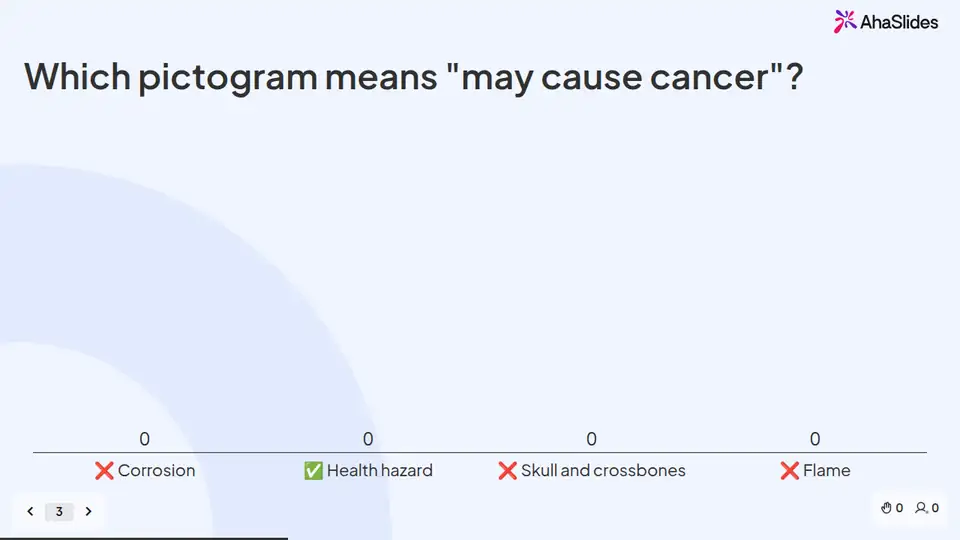
Try some questions from the course

Question 1 of 3

Which of these must your employer provide under the HazCom standard?


Employers must provide a written program, labels, safety data sheets and training on the hazards of the chemicals you work with.

Lesson 1, Why this matters, teaches this. See the outline

Question 2 of 3

Why is a flour dust cloud in a bakery dangerous?


A cloud of fine dust can burn or explode. OSHA covers combustible dust as its own hazard group, and the dust can also irritate the lungs.

Lesson 2, Know the hazards, teaches this. See the outline

Question 3 of 3

You need first aid information after a splash. Which SDS section has it?


Section 4 describes first-aid measures. Know where it is before you need it.

Lesson 4, Use the SDS, teaches this. See the outline

Learners earn a certificate

Your organisation

Certificate of completion

This certifies that

Alex Morgan

has completed

Hazard communication & GHS

Completed on12 October 2026
Sample certificate with a placeholder learner name.

Style 1 of 6: Purple geometric

Everyone who finishes gets a certificate with their name, the course title and the completion date. Add your own logo, colours and signer.

Three pieces that work together

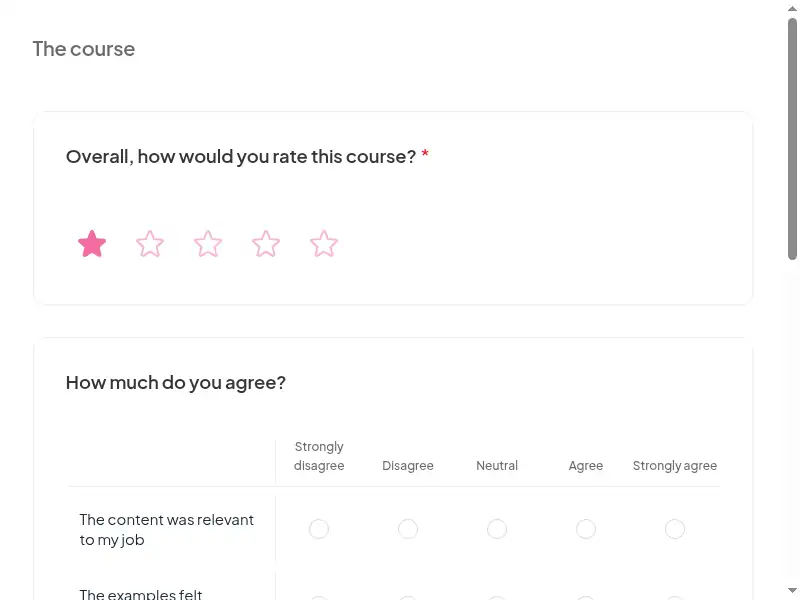
Learners prepare on their own, you answer questions live, and the surveys tell you what stuck. 8 fields to fill in with your own policy, contacts and locations; each one is highlighted inside the course.
Claim the template
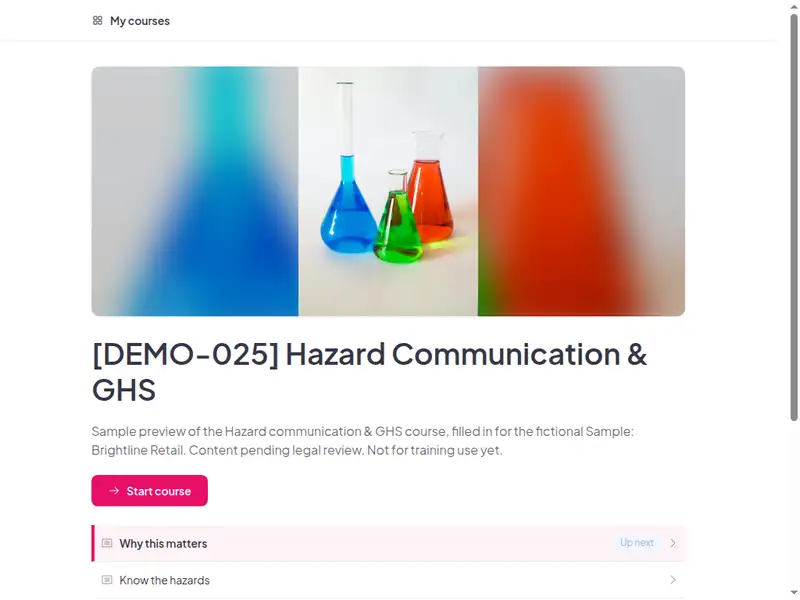
The Hazard communication & GHS course as a learner first sees it

Completion is tracked for you

Learners sign in to take the course, so every start, finish and score is recorded in AhaSlides. No spreadsheet to keep.

  • Who has finished

    See who has not started, who is in progress and who has completed the course.

  • Every score

    Each learner's result on the 12-question final check, against the 80% pass mark.

  • What landed

    Survey results show what people took away, and the 30-day check-in shows whether they use it.

Claim the template

8 lessons, about 40 minutes

What learners can do at the end of each lesson. Minutes are an estimate.

  • Lesson 1: Why this matters · 7 min

    Explain your right to know about chemical hazards and where the written HazCom program is.

  • Lesson 2: Know the hazards · 7 min

    Identify the hazardous chemicals and operations in your work area.

  • Lesson 3: Read the label · 6 min

    Recognise physical and health hazards, incl. simple asphyxiants, combustible dust, pyrophoric gases and HNOC.

  • Lesson 4: Use the SDS · 4 min

    Read a GHS label: its six elements and the pictograms.

  • Lesson 5: Protect yourself · 6 min

    Find key information in a 16-section SDS.

  • Lesson 6: The 2024 update · 2 min

    Detect a release (monitoring, appearance, odour) and use the protective measures provided.

  • Lesson 7: When things go wrong · 4 min

    Describe what changed in the 2024 update and what it means on the job.

  • Lesson 8: Final assessment · 4 min

    12 questions, 80% to pass. The result is saved to the learner's record.

Based on: 29 CFR 1910.1200(h) (as updated by the 2024 final rule aligning with GHS Rev. 7, 89 FR 44144)

Claim the template

Common questions

Yes. The course, the live deck and both surveys are free. Claiming the template into your AhaSlides account is free too.

The course itself is self-paced and online, and the live deck lets you add a live session. Whether online delivery meets your local rules depends on the law that applies to you, so check 29 CFR 1910.1200(h) or ask your own counsel.

At initial assignment + whenever a new chemical hazard is introduced (no fixed annual requirement; annual refresher is best practice).

All employees who may be exposed to hazardous chemicals (manufacturing, warehouse, cleaning/janitorial, labs, auto shops, salons, retail stockrooms).

Record completion in your own LMS or record system, so you can show who finished the course and when. Check the retention period that applies to you in 29 CFR 1910.1200(h).

Yes, everything. Change the wording, swap scenarios for ones from your workplace, add your logo, or remove parts that don't apply. Keep anything your own law requires you to cover.

Your own details, each highlighted inside the course:
  • Hazcom program location
  • Chemical inventory for area
  • GHS-style, NFPA/HMIS
  • SDS access method
  • PPE for chemical tasks
  • Eyewash shower locations
  • Spill response contact
  • LMS or record system
Then edit anything else you like: wording, scenarios, your logo.
Visit the help centre (opens in a new tab)