Skip to content
Claim this template

Free course template · Global

Educator code of ethics, professional boundaries and legal duties for teaching staff

A ready-made course, live deck and two surveys for teachers. 35 minutes, 6 lessons. Last reviewed 21 October 2026; not legal advice.

Claim the templatePreview the courseDownload SCORM for your LMS

Free. No credit card. Edit everything.

Play a game from the course

Educator code of ethics, professional boundaries and legal duties: try 3 questions

Three questions from this course. Pick an answer, then see why.

Play the game

Game not loading? Open it in a new tab (opens in a new tab)

Three pieces that work together

Learners sign in, so every finish and score is recorded. 13 fields to fill in with your details.
Claim the template
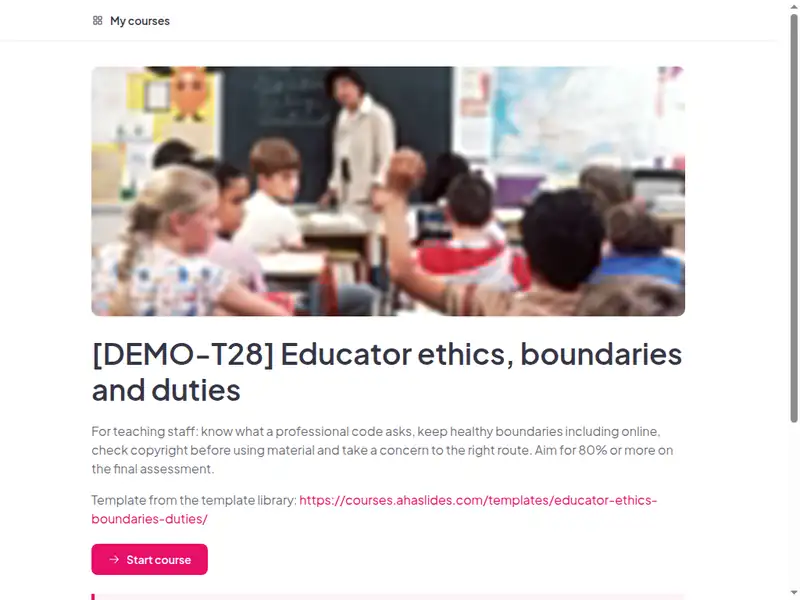
The Educator code of ethics, professional boundaries and legal duties for teaching staff course as a learner first sees it

6 lessons, about 35 minutes

Minutes are an estimate.

  • Lesson 1: Why small choices become big ones · 7 min

    Before you begin · The friendly message · Where did it start?

  • Lesson 2: Codes, duties and rules in brief · 6 min

    What codes ask for · The duties that apply to you · Check

  • Lesson 3: A way to decide: the boundary check · 6 min

    Five questions · Apply the check · Try it

  • Lesson 4: Grey areas: copyright, online and mixed duties · 6 min

    Using other people's material · Online and social media · Check

  • Lesson 5: Speak up and apply · 6 min

    Raising a concern · A colleague's boundary · Order the steps

  • Lesson 6: Final assessment and completion · 4 min

    Your next steps · Practice

Claim the template

Inside this course

Taken from the course itself.

By the end, learners can

  • Describe what a professional code of ethics asks of an educator and where your own code sits
  • Recognise healthy and unhealthy boundaries with learners, parents and colleagues, including online
  • Explain in plain words the duties that apply to teaching staff in your setting: safeguarding, confidentiality and duty of care
  • Decide whether a use of third-party material is likely to need permission, and where to check
  • Take a boundary or conduct concern to the right route, in the right order

Sample questions, with answers

  1. Where could this have been handled differently?

    • At several points, starting with the personal account
    • Only at the very end
    • Never, it was fine
    • Only by the learner

    Answer: At several points, starting with the personal account. Several earlier choices could have changed the outcome.

    Lesson 1: Why small choices become big ones

  2. What is the main purpose of a professional code of ethics?

    • To set shared standards of conduct that protect learners and the profession
    • To list punishments only
    • To replace the law
    • To limit what you may teach

    Answer: To set shared standards of conduct that protect learners and the profession. A code sets shared standards.

    Lesson 6: Final assessment and completion

  3. A learner wants to chat privately on your personal account. The best answer is…

    • yes, if the account is private
    • to say no kindly and use the official channel
    • yes, but only in the evening
    • yes, if you tell no one

    Answer: to say no kindly and use the official channel. Official channels keep the relationship professional.

    Lesson 6: Final assessment and completion

A scenario from "A way to decide: the boundary check"

A learner offers an expensive gift after a course.

Best response: Decline politely, explain the policy and tell the line manager.

Weaker responses: Accept and say nothing; Accept and give a gift back; Ignore the policy.

Common questions

Yes. Claiming the template and editing it are free.

Yes. The course is self-paced and online, and the live deck lets you add a live session in the room or online.

At induction, annually for all teaching and training staff, and before staff start delivering online.

Teachers, trainers, facilitators, mentors and school or academy staff who need a working grasp of conduct standards, boundaries, copyright and social media rules; assigned by a school group, academy trust, university or training academy and run by a staff-development lead or L&D manager.

Record completion in your own LMS or record system, so you can show who finished the course and when.

Your own details, each highlighted inside the course:
  • Ld contact
  • Training standards link
  • Concern route
  • Support and adjustments route
  • Professional code link
  • Legal duties summary link
  • Copyright and licence rule
  • LMS or record system
  • Next course link
  • Course URL
  • Live session URL
Then edit anything else you like: wording, scenarios, your logo.
Visit the help centre (opens in a new tab)