Skip to content
Claim this template

Free course template · India, Singapore & Mexico

Singapore: Personal data protection (PDPA)

A ready-made course, live deck and two surveys for all staff. AhaSlides tracks progress, completion and scores for you. 30 minutes, 7 lessons, 10-question final check. Last reviewed 12 October 2026; not legal advice.

Claim the templatePreview the courseDownload SCORM for your LMS

Free. No credit card. Edit everything.

Course outline at a glance

  • Explain why the PDPA matters and the PDPC's enforcement powers
  • Video
  • Tabs
  • Quiz

  • Identify personal data, including NRIC numbers and business contact information
  • Flashcards
  • Accordion
  • Multi-select quiz

  • Apply the data protection obligations to everyday tasks
  • Sorting activity
  • Tabs
  • Quiz

  • Handle access and correction requests and Do Not Call checks
  • Process
  • Quiz

  • Report a suspected data breach immediately so assessment (30 days) and PDPC notification (3 calendar days) can be met
  • Scenario
  • Quiz

  • Escalate to the DPO
  • Quiz

Final check: 10 questions, 80% to pass

Try some questions from the course

Question 1 of 3

A payroll company processes salaries for another business, following its instructions. In PDPA terms, what is the payroll company?


An organisation that processes personal data on behalf of another organisation is a data intermediary. It still has duties, such as protecting the data.

Lesson 1, Why it matters, teaches this. See the outline

Question 2 of 3

A gym wants to check that a member is who they say they are at sign-up. What is the best approach under PDPC guidance?


PDPC guidance asks organisations to use alternatives to NRIC numbers where they can. Copying or keeping the card is generally not allowed without a legal need.

Lesson 3, Allowed vs not allowed, teaches this. See the outline

Question 3 of 3

A breach exposes the details of 600 customers, sent to an outside company by mistake, with no financial or health data. Is it notifiable?


A breach affecting 500 or more individuals is of significant scale and is notifiable, even without significant harm. Accidents count too. Breaches that stay entirely within the organisation are an exception; the DPO decides.

Lesson 4, Duties & deadlines, teaches this. See the outline

Learners earn a certificate

Your organisation

Certificate of completion

This certifies that

Alex Morgan

has completed

Singapore: Personal data protection (PDPA)

Completed on12 October 2026
Sample certificate with a placeholder learner name.

Style 1 of 6: Slate mono

Everyone who finishes gets a certificate with their name, the course title and the completion date. Add your own logo, colours and signer.

Three pieces that work together

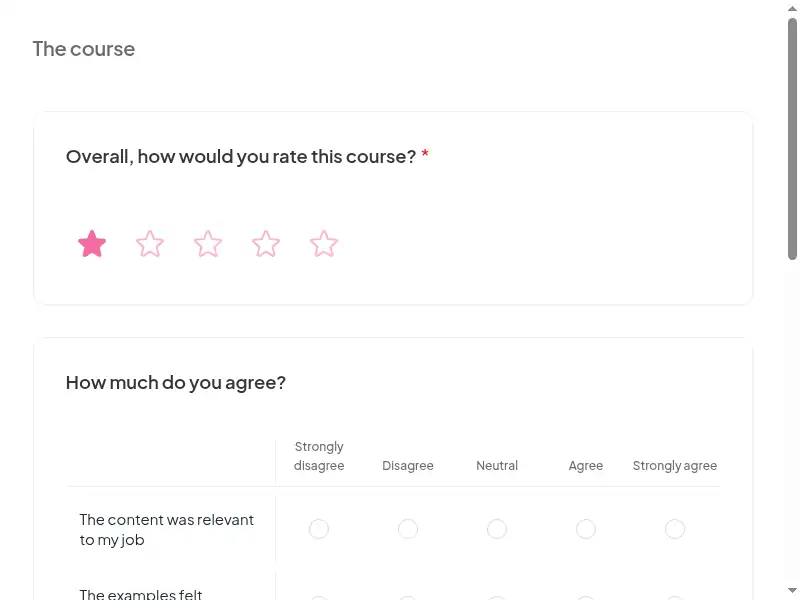
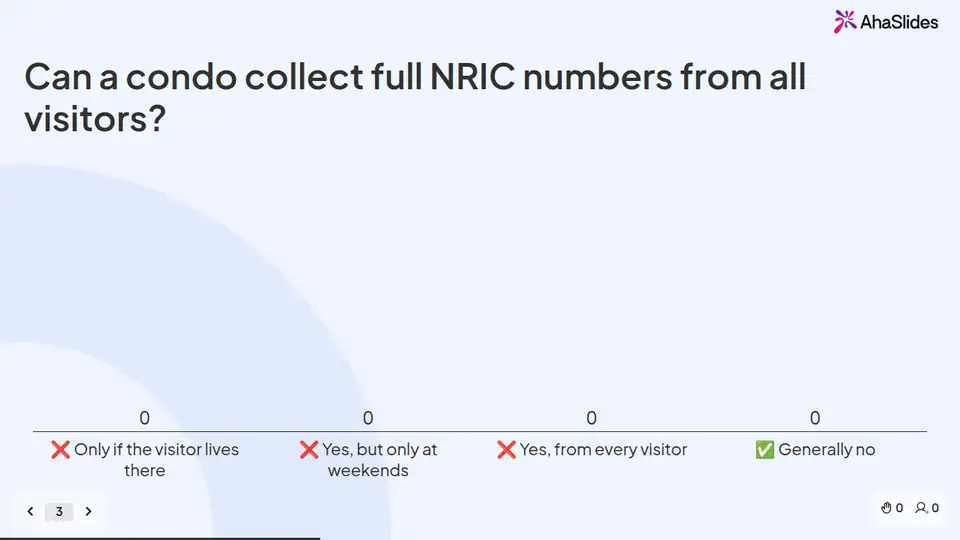
Learners prepare on their own, you answer questions live, and the surveys tell you what stuck. 7 fields to fill in with your own policy, contacts and locations; each one is highlighted inside the course.
Claim the template
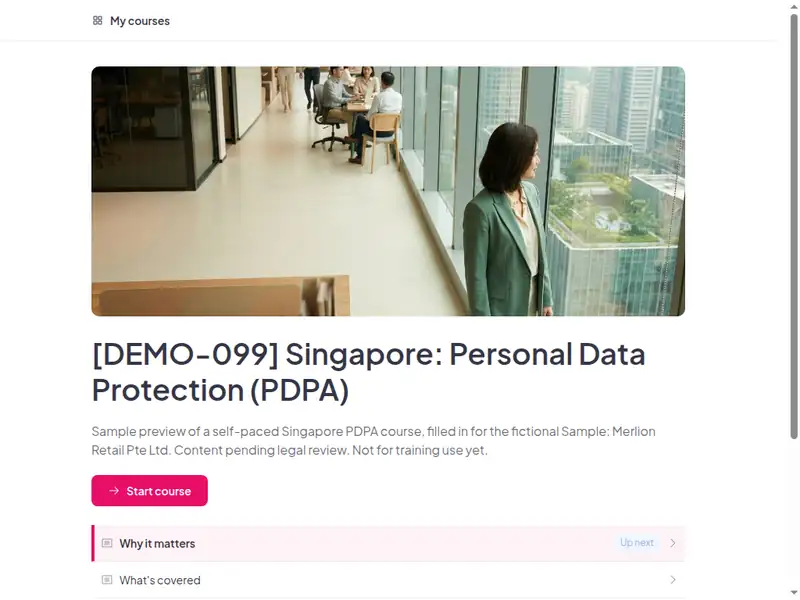
The Singapore: Personal data protection (PDPA) course as a learner first sees it

Completion is tracked for you

Learners sign in to take the course, so every start, finish and score is recorded in AhaSlides. No spreadsheet to keep.

  • Who has finished

    See who has not started, who is in progress and who has completed the course.

  • Every score

    Each learner's result on the 10-question final check, against the 80% pass mark.

  • What landed

    Survey results show what people took away, and the 30-day check-in shows whether they use it.

Claim the template

7 lessons, about 30 minutes

What learners can do at the end of each lesson. Minutes are an estimate.

  • Lesson 1: Why it matters · 7 min

    Explain why the PDPA matters and the PDPC's enforcement powers.

  • Lesson 2: What's covered · 5 min

    Identify personal data, including NRIC numbers and business contact information.

  • Lesson 3: Allowed vs not allowed · 4 min

    Apply the data protection obligations to everyday tasks.

  • Lesson 4: Duties & deadlines · 4 min

    Handle access and correction requests and Do Not Call checks.

  • Lesson 5: Case practice · 4 min

    Report a suspected data breach immediately so assessment (30 days) and PDPC notification (3 calendar days) can be met.

  • Lesson 6: Escalate correctly · 2 min

    Escalate to the DPO.

  • Lesson 7: Final assessment · 4 min

    10 questions, 80% to pass. The result is saved to the learner's record.

Based on: Personal Data Protection Act 2012 (as amended 2020) - Parts 3-6A (consent, purpose limitation, notification, access & co…

Claim the template

Common questions

Yes. The course, the live deck and both surveys are free. Claiming the template into your AhaSlides account is free too.

The course itself is self-paced and online, and the live deck lets you add a live session. Whether online delivery meets your local rules depends on the law that applies to you, so check Personal Data Protection Act 2012 or ask your own counsel.

At induction + annually (accountability - s.12 requires communicating policies to staff).

All staff in Singapore who handle customer, employee or vendor personal data.

Record completion in your own LMS or record system, so you can show who finished the course and when. Check the retention period that applies to you in Personal Data Protection Act 2012.

Yes, everything. Change the wording, swap scenarios for ones from your workplace, add your logo, or remove parts that don't apply. Keep anything your own law requires you to cover.

Your own details, each highlighted inside the course:
  • DPO contact
  • Breach reporting channel
  • Pdpa policy link
  • Retention schedule link
  • Dnc check process
  • When our business is required by law to collect NRIC
  • LMS or record system
Then edit anything else you like: wording, scenarios, your logo.
Visit the help centre (opens in a new tab)