Skip to content
Claim this template

Free course template · Global

ISO/IEC 27001 and the information security management system: What every employee must know

A ready-made course, live deck and two surveys for staff. 40 minutes, 6 lessons. Last reviewed 21 October 2026; not legal advice.

Claim the templatePreview the courseDownload SCORM for your LMS

Free. No credit card. Edit everything.

Play a game from the course

ISO/IEC 27001 and the information security management system: try 3 questions

Three questions from this course. Pick an answer, then see why.

Play the game

Game not loading? Open it in a new tab (opens in a new tab)

Three pieces that work together

Learners sign in, so every finish and score is recorded. 10 fields to fill in with your details.
Claim the template
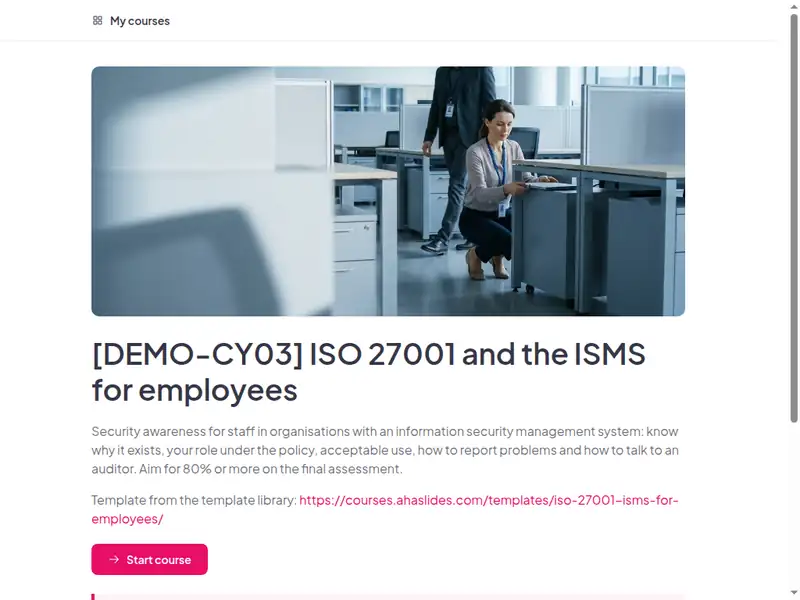
The ISO/IEC 27001 and the information security management system: What every employee must know course as a learner first sees it

6 lessons, about 40 minutes

Minutes are an estimate.

  • Lesson 1: Why we have an ISMS · 7 min

    Before you begin · The surprise audit question · What would help?

  • Lesson 2: What an ISMS is · 7 min

    In plain words · Policy to practice · Check

  • Lesson 3: Your role and the rules · 7 min

    Your part · Acceptable use · Try it

  • Lesson 4: Grey areas: exceptions, weaknesses and records · 7 min

    Exceptions · What would you do? · Check

  • Lesson 5: Talking to an auditor · 7 min

    Principles · Prepare · Try it

  • Lesson 6: Your commitments and the final assessment · 5 min

    Next steps · Practice

Claim the template

Inside this course

Taken from the course itself.

By the end, learners can

  • Explain what an information security management system is and why the organisation has one
  • Describe your role under the organisation's security policy
  • Follow the acceptable use rules and classification labels
  • Report incidents, weaknesses and policy exceptions
  • Prepare for an audit conversation: what you can say and show

Sample questions, with answers

  1. Why did the auditor ask a finance officer about the policy?

    • To check staff know and follow the rules
    • To catch Tom out
    • Because finance is in charge
    • To fill in a form

    Answer: To check staff know and follow the rules. Auditors look for evidence that the rules are part of daily work, not just a document.

    Lesson 1: Why we have an ISMS

  2. A tool is not on the approved list. What is the first step?

    • Ask the security contact
    • Use it for a small file
    • Use it on your phone
    • Tell no one

    Answer: Ask the security contact. Approval comes before use, not after.

    Lesson 3: Your role and the rules

  3. An auditor asks something you do not know. Best reply?

    • I will find out and come back to you
    • A confident guess
    • I cannot help
    • Change the subject

    Answer: I will find out and come back to you. Saying you will find out is honest and keeps the conversation open.

    Lesson 5: Talking to an auditor

A scenario from "Your role and the rules"

You want to use a free online tool to convert a file with client data.

Best response: Check the approved list, ask the security contact.

Weaker responses: Use it anyway; Use a personal account; Ignore the rule.

Common questions

Yes. Claiming the template and editing it are free.

The course itself is self-paced and online, and the live deck lets you add a live session. Whether online delivery meets your local rules depends on the law that applies to you, so check the rules that apply to you or ask your own counsel.

At onboarding, before a certification or surveillance audit, and annually.

Staff in organisations that hold or pursue an ISMS certification; an internal-auditor variant is a note; run by L&D with the information security manager.

Record completion in your own LMS or record system, so you can show who finished the course and when. Check the retention period that applies to you in the rules that apply to you.

Your own details, each highlighted inside the course:
  • Who staff ask about security questions
  • Link to your information security policy
  • The route for reporting a security incident or suspected breach, and the time limit that applies
  • Link to your data classification policy
  • Link to the list of approved tools and services
  • Link to the next course in your security awareness path
  • Where course completions are recorded
  • Link to the self-paced course
Then edit anything else you like: wording, scenarios, your logo.
Visit the help centre (opens in a new tab)