Skip to content
Claim this template

Free course template · US federal

Code of conduct

A ready-made course, live deck and two surveys for all employees. 35 minutes, 6 lessons, 10-question final check. Last reviewed 8 October 2026; not legal advice.

Claim the templatePreview the courseDownload SCORM for your LMS

Free. No credit card. Edit everything.

Play a game from the course

Code of conduct: try 3 questions

Three questions from this course. Pick an answer, then see why.

Play the game

Game not loading? Open it in a new tab (opens in a new tab)

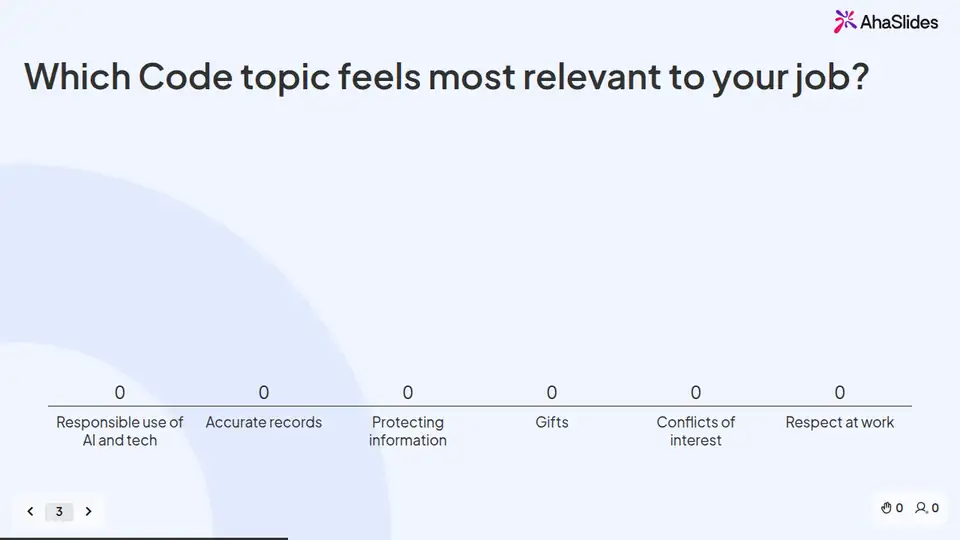
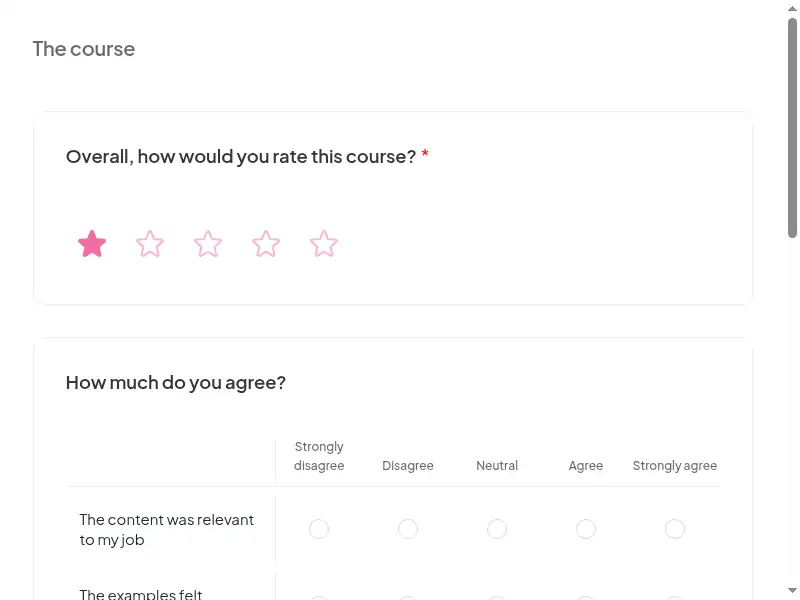
Three pieces that work together

Learners sign in, so every finish and score is recorded. 7 fields to fill in with your details.
Claim the template
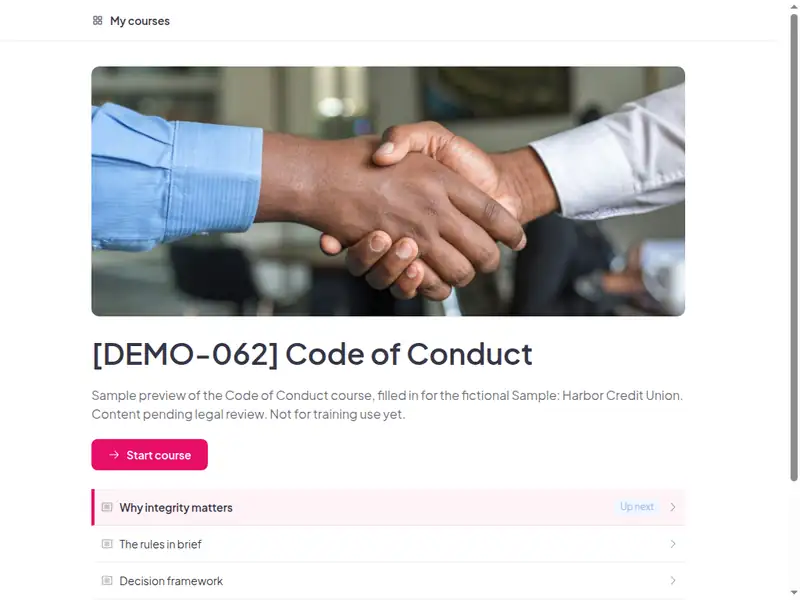
The Code of conduct course as a learner first sees it

6 lessons, about 35 minutes

Minutes are an estimate.

  • Lesson 1: Why integrity matters · 6 min

    Explain why the Code exists and what it covers.

  • Lesson 2: The rules in brief · 6 min

    Locate the key policies behind the Code.

  • Lesson 3: Decision framework · 3 min

    Apply a four-question decision test to ethical dilemmas.

  • Lesson 4: Grey areas · 8 min

    Resolve grey-area situations across topics.

  • Lesson 5: Speak up · 6 min

    Speak up and recognise retaliation.

  • Lesson 6: Final assessment · 6 min

    10 questions, 80% to pass. The result is saved to the learner's record.

Claim the template

Inside this course

Taken from the course itself.

Sample questions, with answers

  1. Where does ethical behaviour mostly show up?

    • In small everyday choices
    • Only in big public decisions
    • Only when someone is watching
    • Only in senior roles

    Answer: In small everyday choices. Most ethical moments are small and happen in ordinary work.

    Lesson 1: Why integrity matters

  2. You answer "not sure" to one of the four questions. What do you do?

    • Go ahead and see what happens
    • Stop and ask
    • Ask a colleague to do it instead
    • Wait until someone complains

    Answer: Stop and ask. "Not sure" is a signal to stop and ask.

    Lesson 3: Decision framework

  3. A colleague who reported a concern is now left out of meetings. What is this?

    • Normal after a report
    • Their own fault
    • Possible retaliation, which should be reported
    • Not a Code issue

    Answer: Possible retaliation, which should be reported. Being treated worse for raising a concern in good faith is retaliation.

    Lesson 5: Speak up

A scenario from "Grey areas"

Marketing coordinator's manager asks to code a team party as "client entertainment".

Legal basis

U.S. Sentencing Guidelines §8B2.1(b)(4) (effective training program for directors, high-level personnel, employees and agents); DOJ Evaluation of Corporate Compliance Programs (rev. Sept 2024); SOX s.406 (code of ethics for senior financial officers); NYSE 303A.10 / Nasdaq 5610 (listed companies).

Related articles

25 articles from the AhaSlides blog that use this course, newest first.

Common questions

Yes. Claiming the template and editing it are free.

The course itself is self-paced and online, and the live deck lets you add a live session. Whether online delivery meets your local rules depends on the law that applies to you, so check U.S. Sentencing Guidelines §8B2.1(b)(4) or ask your own counsel.

At hire + annually with attestation.

All employees, contractors with system access.

Record completion in your own LMS or record system, so you can show who finished the course and when. Check the retention period that applies to you in U.S. Sentencing Guidelines §8B2.1(b)(4).

Your own details, each highlighted inside the course:
  • CEO message
  • Company values
  • Code link
  • Ethics hotline
  • Investigation process
  • LMS or record system
  • Attestation method
Then edit anything else you like: wording, scenarios, your logo.
Visit the help centre (opens in a new tab)