
Lesson 1: Why the rule exists · 5 min
Explain who the CCPA protects, who it covers and who enforces it.
Learners sign in, so every finish and score is recorded. 6 fields to fill in with your details.
Minutes are an estimate.
Explain who the CCPA protects, who it covers and who enforces it.
Identify personal information and sensitive personal information.
Describe consumer rights: know, delete, correct, opt out of sale/sharing, limit SPI, non-discrimination.
Handle a consumer request within required timelines.
Honour opt-out signals and avoid dark patterns.
Direct consumers to the right request method and escalate.
12 questions, 80% to pass. The result is saved to the learner's record.
Taken from the course itself.
Whose personal information can the CCPA protect?
Answer: California residents, including employees and job applicants. The CCPA covers consumers who are California residents. That includes employees and job applicants.
Lesson 1: Why the rule exists
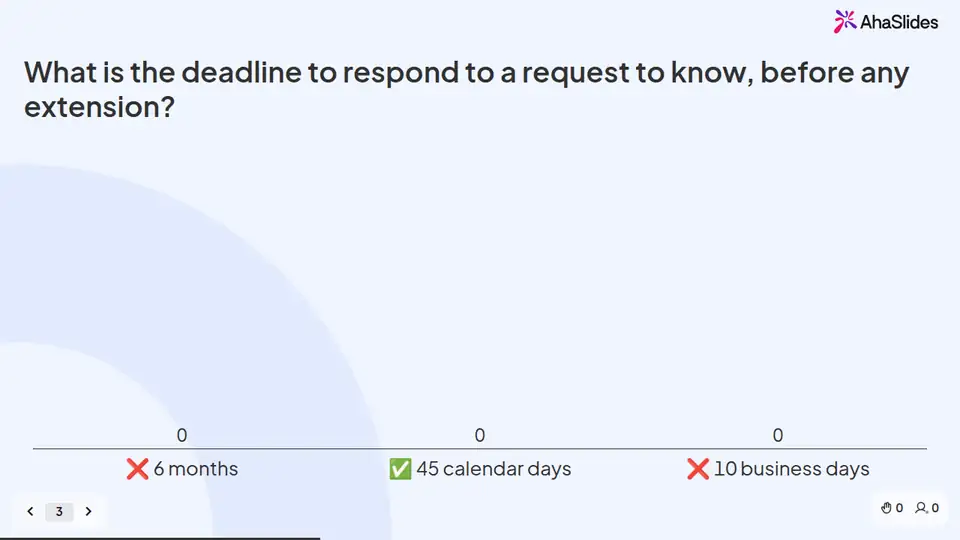
How long do you have to respond to a request to know, before any extension?
Answer: 45 calendar days. 11 CCR 7021 gives 45 calendar days to respond, with one 45-day extension if the consumer is told.
Lesson 3: Rights & timelines
A consumer phones to ask for their data and you are not sure how to handle it. What do you do?
Answer: Log it and send it to the privacy team the same day. Do not guess. Log the request and escalate the same day through the privacy request system.
Lesson 6: Escalate correctly
Support agent gets "delete everything you have on me" in chat.
Best response: Route to request method/system , explain next steps.
Weaker responses: Ignore because it wasn't on the form; Ask for SSN.
Cal. Civ. Code 1798.100-1798.199.100 (CCPA as amended by CPRA); 1798.130(a)(6) and 1798.135(c)(3) (individuals handling consumer inquiries must be informed of requirements); CCPA Regulations, Cal. Code Regs. tit. 11, §7000 et seq., incl. §7100 (training) and §7101 (recordkeeping, 24 months); 2025 regulations on ADMT, risk assessments and cybersecurity audits (effective Jan 1, 2026, phased).
Courses teams often run alongside this one.

Security Awareness Training

Security Awareness Training

Security Awareness Training
An article from the AhaSlides blog that uses this course.

Comments from trainers
No comments yet. Tell other trainers how the course went.
Your comment
Comments are public. We remove spam and personal details.