Skip to content
Claim this template

Free course template · Global

Banking conduct, regulation and prudential risk essentials

A ready-made course, live deck and two surveys for compliance and risk champions. 40 minutes, 6 lessons. Last reviewed 21 October 2026; not legal advice.

Claim the templatePreview the courseDownload SCORM for your LMS

Free. No credit card. Edit everything.

Play a game from the course

Banking conduct, regulation and prudential risk essentials: try 3 questions

Three questions from this course. Pick an answer, then see why.

Play the game

Game not loading? Open it in a new tab (opens in a new tab)

Three pieces that work together

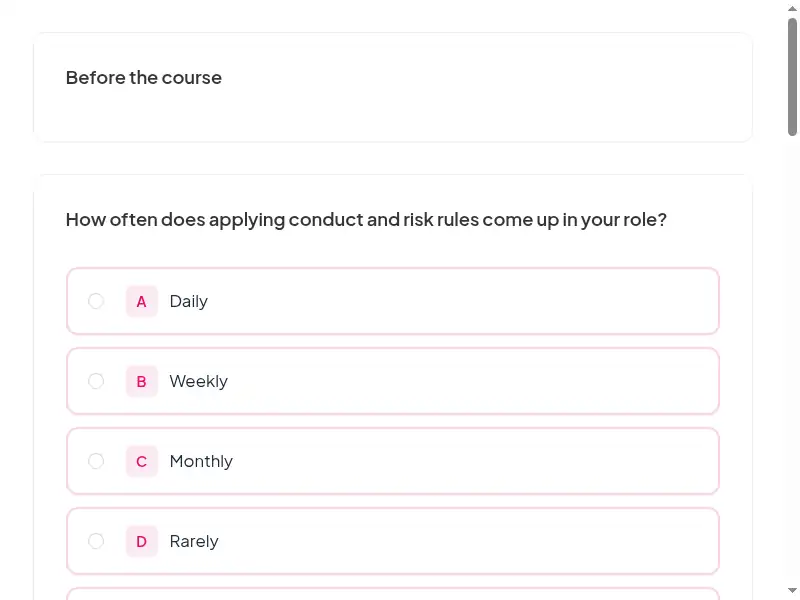
Learners sign in, so every finish and score is recorded. 9 fields to fill in with your details.
Claim the template
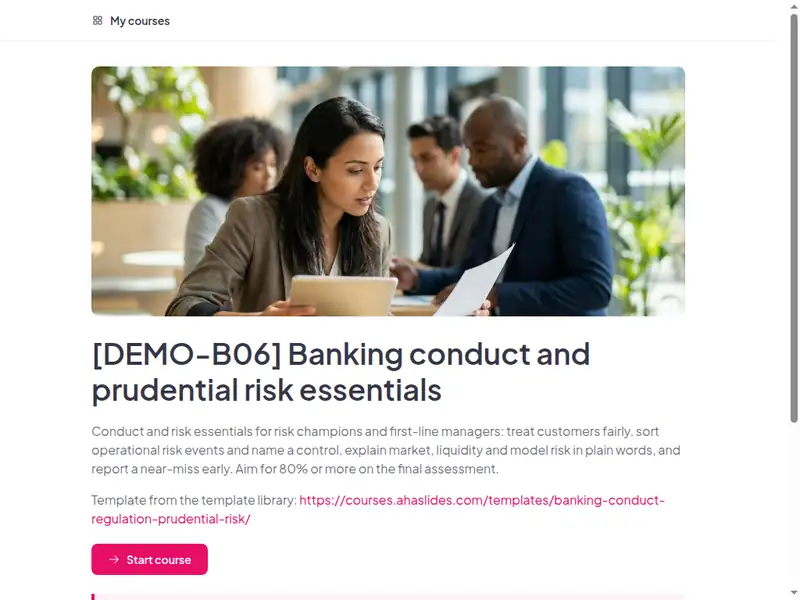
The Banking conduct, regulation and prudential risk essentials course as a learner first sees it

6 lessons, about 40 minutes

Minutes are an estimate.

  • Lesson 1: Why conduct and risk matter · 7 min

    Before you begin · A process change · Three kinds of risk

  • Lesson 2: The framework and fair treatment · 7 min

    Who supervises what · Fair treatment in five habits · Check

  • Lesson 3: Operational, market and liquidity risk · 7 min

    Operational risk categories · Sort the events · Market and liquidity in plain words

  • Lesson 4: Grey areas: which rule applies? · 7 min

    Scenario · Scenario · Which rule applies?

  • Lesson 5: Report, speak up and apply · 7 min

    Report early · Blame-free reporting · Scenario

  • Lesson 6: Final assessment · 5 min

    Practice · Completion

Claim the template

Inside this course

Taken from the course itself.

By the end, learners can

  • Describe the regulatory framework in outline and who supervises what
  • Apply the principle of treating customers fairly in a decision or process
  • Sort operational-risk events by category and name a control that would have helped
  • Explain market, liquidity and model risk in plain words and why they are monitored
  • Report a breach or near-miss through the right route, early and without blame

Sample questions, with answers

  1. Where does conduct risk come from?

    • Our own choices and processes
    • Falling market prices
    • Bad weather
    • A change of exchange rate

    Answer: Our own choices and processes. Conduct risk comes from how we behave and design our processes, so we can change it.

    Lesson 1: Why conduct and risk matter

  2. A firm owns valuable assets but cannot pay bills due tomorrow. Which risk is this?

    • Liquidity risk
    • Market risk
    • Model risk
    • Conduct risk

    Answer: Liquidity risk. Liquidity risk is about having cash when it is needed, not about owning enough in total.

    Lesson 3: Operational, market and liquidity risk

  3. Why report a near-miss when no one was harmed?

    • It shows a cause that can be fixed before harm occurs
    • Someone must be told off
    • It is a way to win points
    • It is never needed

    Answer: It shows a cause that can be fixed before harm occurs. Near-misses are free lessons. Fixing the cause now prevents a real incident later.

    Lesson 4: Grey areas: which rule applies?

A scenario from "Grey areas: which rule applies?"

A sales target pushes a product that does not fit.

Best response: Follow the conduct rule, raise the target conflict.

Weaker responses: Follow the target; Ask a colleague to decide quietly; Drop it.

Related articles

2 articles from the AhaSlides blog that use this course, newest first.

Common questions

Yes. Claiming the template and editing it are free.

The course itself is self-paced and online, and the live deck lets you add a live session. Whether online delivery meets your local rules depends on the law that applies to you, so check the rules that apply to you or ask your own counsel.

At onboarding for risk and finance roles, and yearly for risk champions.

Compliance and risk champions, first-line managers and new joiners in risk and finance functions; run by the learning or compliance owner.

Record completion in your own LMS or record system, so you can show who finished the course and when. Check the retention period that applies to you in the rules that apply to you.

Your own details, each highlighted inside the course:
  • Compliance contact
  • Policy link
  • Speak up route
  • Jurisdiction and regulator
  • LMS or record system
  • Course URL
  • Live session URL
Then edit anything else you like: wording, scenarios, your logo.
Visit the help centre (opens in a new tab)