Skip to content
Claim this template

Free course template · US federal

Bloodborne pathogens - Healthcare

A ready-made course, live deck and two surveys for clinical and support staff. 55 minutes, 9 lessons, 12-question final check. Last reviewed 8 October 2026; not legal advice.

Claim the templatePreview the courseDownload SCORM for your LMS

Free. No credit card. Edit everything.

Play a game from the course

Bloodborne pathogens - Healthcare: try 3 questions

Three questions from this course. Pick an answer, then see why.

Play the game

Game not loading? Open it in a new tab (opens in a new tab)

Three pieces that work together

Learners sign in, so every finish and score is recorded. 15 fields to fill in with your details.
Claim the template
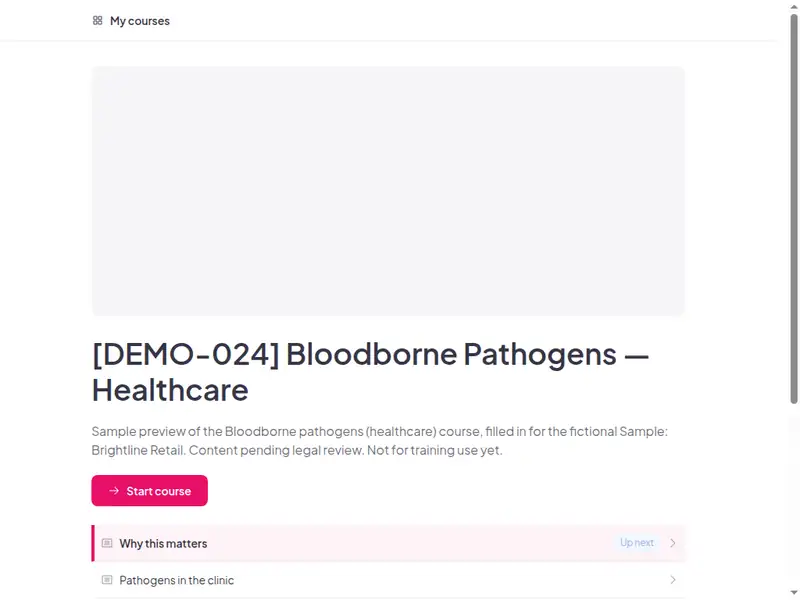
The Bloodborne pathogens - Healthcare course as a learner first sees it

9 lessons, about 55 minutes

Minutes are an estimate.

  • Lesson 1: Why this matters · 7 min

    Explain the BBP standard and the Needlestick Safety and Prevention Act, and where to get a copy.

  • Lesson 2: Pathogens in the clinic · 5 min

    Describe HBV, HCV and HIV, how they spread in clinical work, and which body fluids count as OPIM.

  • Lesson 3: Is my job at risk? · 5 min

    Identify clinical tasks with occupational exposure in your unit.

  • Lesson 4: Safer sharps & engineering controls · 9 min

    Select and correctly activate safer sharps devices and needleless systems.

  • Lesson 5: Work practices, PPE & waste · 7 min

    Describe how front-line staff give input on device selection and the annual ECP review.

  • Lesson 6: Your exposure control plan & vaccine · 5 min

    Apply work practices, PPE and regulated-waste rules in patient care.

  • Lesson 7: When exposure happens · 7 min

    Explain the hepatitis B vaccine and post-vaccination testing for at-risk staff.

  • Lesson 8: Labels & ask a trainer · 5 min

    Follow post-exposure steps and explain what goes in the sharps injury log.

  • Lesson 9: Final assessment · 5 min

    12 questions, 80% to pass. The result is saved to the learner's record.

Claim the template

Inside this course

Taken from the course itself.

Sample questions, with answers

  1. What did the Needlestick Safety and Prevention Act add to the standard?

    • A focus on safer sharps devices and input from front-line staff
    • A ban on all needles
    • A rule that only managers choose devices
    • Nothing: it repeated the old rules

    Answer: A focus on safer sharps devices and input from front-line staff. The Act and the revised standard require employers to consider and use safer devices and to ask front-line staff for input.

    Lesson 1: Why this matters

  2. Which role has exposure when emptying sharps containers and cleaning spills?

    • A receptionist with no clinical duties
    • Environmental services
    • Someone working only from home
    • A visitor

    Answer: Environmental services. Staff who handle sharps containers and clean up spills have occupational exposure.

    Lesson 3: Is my job at risk?

  3. Where should a used needle go?

    • Back in its cap
    • On the tray for later
    • In the sharps container at the point of use
    • In the regular bin

    Answer: In the sharps container at the point of use. Dispose of sharps at the point of use in a puncture-resistant sharps container.

    Lesson 4: Safer sharps & engineering controls

A scenario from "When exposure happens"

Dental assistant cut by a used scaler while cleaning trays at end of day.

Best response: Wash → tell supervisor → occupational health same day → incident report.

Weaker responses: Finish the patients first; It didn't bleed so skip it.

Legal basis

29 CFR 1910.1030(g)(2); (c)(1)(iv)-(v) and (d)(2) as amended by the Needlestick Safety and Prevention Act (Pub. L. 106-430, 2000); (h)(5) sharps injury log.

Plain-English requirement guide:

Common questions

Yes. Claiming the template and editing it are free.

The course itself is self-paced and online, and the live deck lets you add a live session. Whether online delivery meets your local rules depends on the law that applies to you, so check 29 CFR 1910.1030(g)(2) or ask your own counsel. The law flagged for this template expects learners to be able to ask a qualified trainer questions while they train: run the live deck, or give a phone or chat line that is answered during the course. Email answered later doesn't count.

At initial assignment + annually + when tasks/procedures change; training records kept 3 years.

Clinical and support staff in hospitals, clinics, dental offices, labs, EMS, long-term care (nurses, phlebotomists, techs, EVS/housekeeping, sterile processing).

Record completion in your own LMS or record system, so you can show who finished the course and when. From the template notes: records kept 3 years.

Your own details, each highlighted inside the course:
  • BBP standard copy location
  • Job classifications with exposure
  • Tasks with exposure
  • Brands/models stocked on each unit
  • How staff join product trials / give feedback
  • PPE locations
  • Spill kit location
  • ECP location and how to request
  • ECP coordinator name contact
  • HBV vaccine how to get
  • Who to report exposure
  • Occ health provider and hours
  • Trainer contact
  • Live session URL
  • LMS or record system
Then edit anything else you like: wording, scenarios, your logo.
Visit the help centre (opens in a new tab)