Skip to content
Claim this template

Free course template · Global

Capital markets, securities and derivatives: Desk readiness for New starters

A ready-made course, live deck and two surveys for trainee traders and analysts. 45 minutes, 6 lessons. Last reviewed 21 October 2026; not legal advice.

Claim the templatePreview the courseDownload SCORM for your LMS

Free. No credit card. Edit everything.

Play a game from the course

Capital markets, securities and derivatives: Desk readiness for New starters: try 3 questions

Three questions from this course. Pick an answer, then see why.

Play the game

Game not loading? Open it in a new tab (opens in a new tab)

Three pieces that work together

Learners sign in, so every finish and score is recorded. 10 fields to fill in with your details.
Claim the template
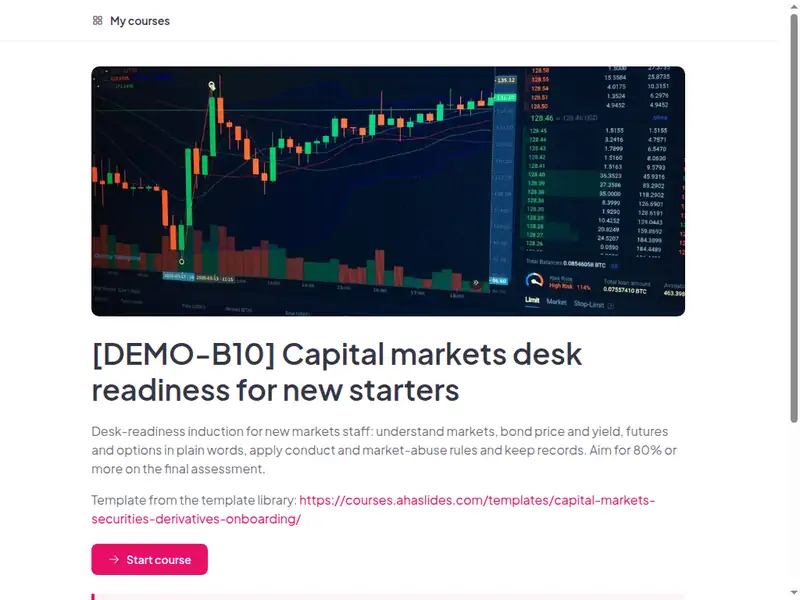
The Capital markets, securities and derivatives: Desk readiness for New starters course as a learner first sees it

6 lessons, about 45 minutes

Minutes are an estimate.

  • Lesson 1: Why desk readiness matters · 8 min

    Before you begin · Day one on the desk · Markets run on rules

  • Lesson 2: Equity, debt and bond maths · 8 min

    Who is in the market · Equity and debt · Price and yield with round numbers

  • Lesson 3: Derivatives in plain words · 8 min

    Futures and options · What is it used for? · Risks in one page

  • Lesson 4: Grey areas: conduct on the desk · 8 min

    Scenario · Scenario · Allowed or not?

  • Lesson 5: Records, speak up and readiness · 8 min

    Records and controls · Readiness and any licensing assessment · Scenario

  • Lesson 6: Final assessment · 5 min

    Practice · Completion

Claim the template

Inside this course

Taken from the course itself.

By the end, learners can

  • Describe equity and debt markets, who the participants are and how orders reach the market
  • Explain how bond price, yield and interest-rate risk are related, using illustrative numbers
  • Explain futures and options in plain words and what each is used for, with their main risks
  • Apply trading-conduct and market-abuse rules in typical desk situations
  • Prepare to work on the desk: controls, records and escalation, and how to approach any licensing assessment the employer requires

Sample questions, with answers

  1. What does every trade need?

    • Authority, a record and a check against limits
    • Speed only
    • A friend's tip
    • A guess about tomorrow's price

    Answer: Authority, a record and a check against limits. Authority, a record and a limit check make a trade safe to stand behind.

    Lesson 1: Why desk readiness matters

  2. Why is leverage risky?

    • It magnifies losses as well as gains
    • It removes risk
    • It guarantees profit
    • It stops margin calls

    Answer: It magnifies losses as well as gains. Leverage makes small price moves matter more, in both directions.

    Lesson 3: Derivatives in plain words

  3. You are not sure whether news is public. What should you do?

    • Do not trade, and ask compliance
    • Trade a small amount
    • Ask a friend
    • Check social media and trade if it is there

    Answer: Do not trade, and ask compliance. When unsure, ask before acting. That is the safe route.

    Lesson 4: Grey areas: conduct on the desk

A scenario from "Grey areas: conduct on the desk"

A colleague hints at a large client order and suggests trading ahead of it.

Best response: Refuse, record and report.

Weaker responses: Trade a small amount; Tell a friend; Ignore it.

Common questions

Yes. Claiming the template and editing it are free.

Yes. The course is self-paced and online, and the live deck lets you add a live session in the room or online.

In the first weeks for graduate and new desk staff, and before any licensing assessment the firm requires.

Trainee traders and analysts, treasury and sales staff and securities-licence candidates in their first months on a desk; run by the learning or compliance owner.

Record completion in your own LMS or record system, so you can show who finished the course and when.

Your own details, each highlighted inside the course:
  • Compliance contact
  • Policy link
  • Speak up route
  • Jurisdiction and regulator
  • LMS or record system
  • Approved product list
  • Course URL
  • Live session URL
Then edit anything else you like: wording, scenarios, your logo.
Visit the help centre (opens in a new tab)