Skip to content
Claim this template

Free course template · US federal

Conflicts of interest

A ready-made course, live deck and two surveys for all employees. 25 minutes, 6 lessons, 8-question final check. Last reviewed 8 October 2026; not legal advice.

Claim the templatePreview the courseDownload SCORM for your LMS

Free. No credit card. Edit everything.

Play a game from the course

Conflicts of interest: try 3 questions

Three questions from this course. Pick an answer, then see why.

Play the game

Game not loading? Open it in a new tab (opens in a new tab)

Three pieces that work together

Learners sign in, so every finish and score is recorded. 6 fields to fill in with your details.
Claim the template
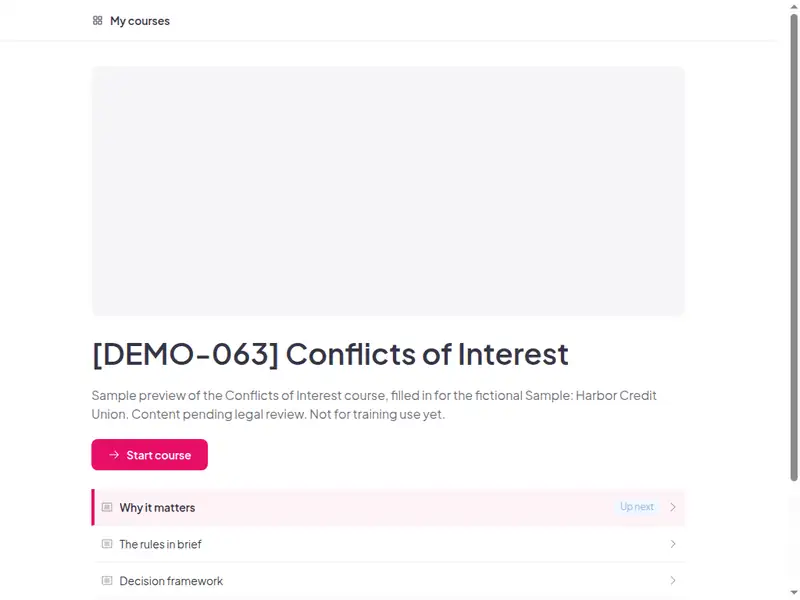
The Conflicts of interest course as a learner first sees it

6 lessons, about 25 minutes

Minutes are an estimate.

  • Lesson 1: Why it matters · 4 min

    Define actual, potential and perceived conflicts.

  • Lesson 2: The rules in brief · 4 min

    Identify common conflict types: financial, family/relationships, outside work, gifts, corporate opportunity.

  • Lesson 3: Decision framework · 2 min

    Apply "disclose, then decide" to grey-area situations.

  • Lesson 4: Grey areas · 7 min

    Complete and update a conflict disclosure.

  • Lesson 5: Speak up & disclose · 4 min

    How to disclose · Report someone else's conflict

  • Lesson 6: Final assessment · 4 min

    8 questions, 80% to pass. The result is saved to the learner's record.

Claim the template

Inside this course

Taken from the course itself.

Sample questions, with answers

  1. What was the main problem in the catering story?

    • She did not tell anyone about the link
    • The cousin's company was too small
    • The price was too low
    • The conference was too big

    Answer: She did not tell anyone about the link. The link was never disclosed, so nobody could judge whether it affected the decision.

    Lesson 1: Why it matters

  2. You suspect a colleague has an undisclosed conflict. What is the best step?

    • Confront them in front of the team
    • Report it through the usual channel
    • Do nothing
    • Ask them to hide it better

    Answer: Report it through the usual channel. You do not need proof. Report your concern and let the reviewer look into it.

    Lesson 5: Speak up & disclose

  3. Is having a conflict of interest always a violation?

    • Yes, always
    • Only for managers
    • No, but hiding one, or acting on it before review, is a problem
    • Only if money changed hands

    Answer: No, but hiding one, or acting on it before review, is a problem. Having a conflict is not automatically wrong. Hiding it, or acting on it before it is reviewed, is. Some conflicts are not allowed at all.

    Final check

A scenario from "Grey areas"

Software engineer builds weekend apps; one competes with a company product feature.

Legal basis

Best practice; related: SOX s.402 (loans to executives) and s.406; NYSE/Nasdaq code-of-conduct listing rules; Reg S-K Item 404 (related-party transactions); sector rules (e.g. FAR 3.104 procurement integrity for government contractors).

Related articles

15 articles from the AhaSlides blog that use this course, newest first.

Common questions

Yes. Claiming the template and editing it are free.

The course itself is self-paced and online, and the live deck lets you add a live session. Whether online delivery meets your local rules depends on the law that applies to you, so check the rules that apply to you or ask your own counsel.

At hire + annually with disclosure refresh.

All employees.

Record completion in your own LMS or record system, so you can show who finished the course and when. Check the retention period that applies to you in the rules that apply to you.

Your own details, each highlighted inside the course:
  • Leader quote
  • COI policy link
  • COI disclosure form
  • COI reviewer
  • Ethics hotline
  • LMS or record system
Then edit anything else you like: wording, scenarios, your logo.
Visit the help centre (opens in a new tab)