
Lesson 1: Why speaking up matters · 5 min
Explain why speaking up matters and who the Directive protects.
Learners sign in, so every finish and score is recorded. 8 fields to fill in with your details.
Minutes are an estimate.
Explain why speaking up matters and who the Directive protects.
Identify what can be reported and when you're protected.
Choose the right channel - internal, external or public disclosure.
Make sound calls in grey-area reporting situations.
Recognise retaliation and know the protections, timelines and support.
10 questions, 80% to pass. The result is saved to the learner's record.
Taken from the course itself.
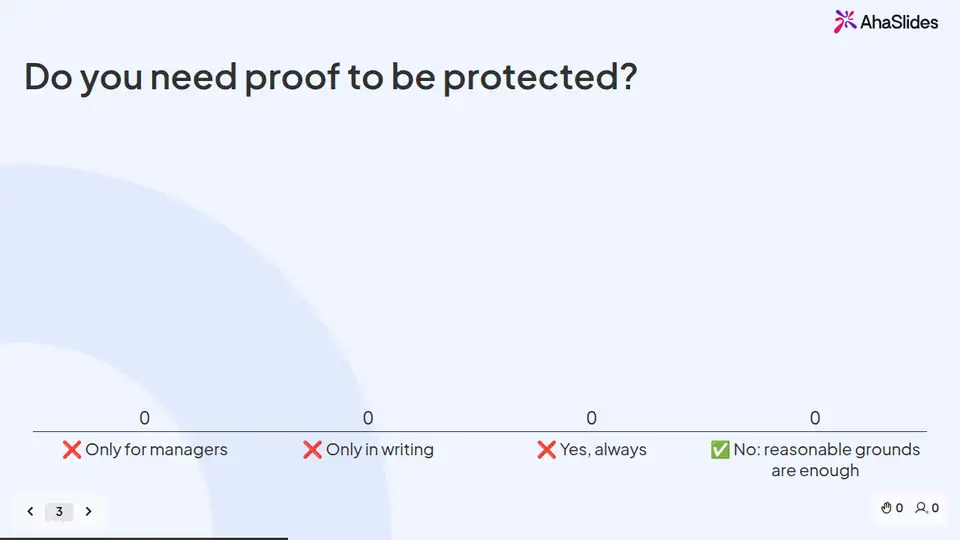
Which is true about reporting under the Directive?
Answer: You need reasonable grounds to believe the information was true when you reported it. Protection depends on reasonable grounds, not on proof. If you had reasonable grounds to believe the information was true when you reported, you can be protected even if it turns out to be wrong. Your motives do not matter. Honest mistakes are protected; knowingly reporting false information is not, and can lead to penalties.
Lesson 1: Why speaking up matters
You copied hundreds of files from the company server to support your concern. What is the safest approach?
Answer: Stop and get advice: only keep what you lawfully had access to, and do not remove data unlawfully. Reporting is protected. Hacking systems or removing data unlawfully may not be. Seek advice and keep only what you lawfully accessed.
Lesson 3: Decision framework
A job applicant learned about a breach during recruitment. Are they protected?
Answer: Yes, job applicants are covered. The personal scope includes job applicants and people whose relationship has ended.
Lesson 4: Grey areas
Lisbon finance officer Inês sees transactions she believes breach anti-money-laundering rules; her line manager is involved.
Best response: Use the independent internal channel or go directly to the competent authority - both are protected.
Weaker response: Confront the manager first.
Directive (EU) 2019/1937 - Arts. 2 (material scope), 4 (personal scope), 6 (conditions for protection), 7-9 (internal channels; required for employers with 50+ workers), 10-12 (external reporting), 15 (public disclosure), 19-21 (prohibition of retaliation and protective measures), 23 (penalties); national law.
Courses teams often run alongside this one.

Security Awareness Training

AI Training for Employees

Workplace Safety Training
An article from the AhaSlides blog that uses this course.

Comments from trainers
No comments yet. Tell other trainers how the course went.
Your comment
Comments are public. We remove spam and personal details.