Skip to content
Claim this template

Free course template · Global

Financial literacy quiz: Money basics

A ready-made course, live deck and a survey for members. 20 minutes, 4 lessons, 7-question final check. Last reviewed 22 October 2026; not legal advice.

Claim the templatePreview the courseDownload SCORM for your LMS

Free. No credit card. Edit everything.

Play a game from the course

Financial literacy quiz: Money basics: try 3 questions

Three questions from this course. Pick an answer, then see why.

Play the game

Game not loading? Open it in a new tab (opens in a new tab)

Three pieces that work together

Learners sign in, so every finish and score is recorded. 6 fields to fill in with your details.
Claim the template
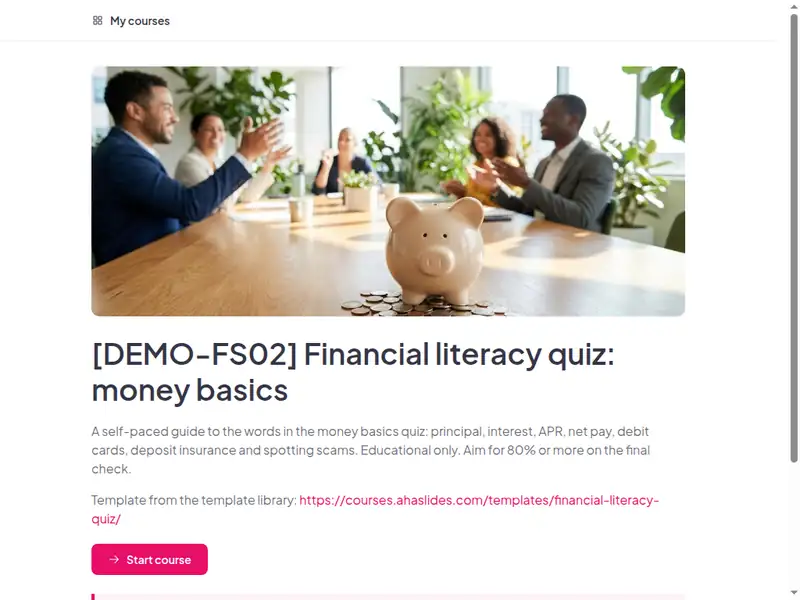
The Financial literacy quiz: Money basics course as a learner first sees it

4 lessons, about 20 minutes

Minutes are an estimate.

  • Lesson 1: Borrowing and saving words · 7 min

    Before you begin · Principal, interest and APR · Earn or pay?

  • Lesson 2: Everyday money · 5 min

    Net pay and debit cards · Emergency fund or debt first?

  • Lesson 3: Staying safe · 4 min

    Deposit insurance · Spotting a scam

  • Lesson 4: Check and next steps · 4 min

    Final check · You have finished

Claim the template

Inside this course

Taken from the course itself.

By the end, learners can

  • Define interest, APR, APY, principal and net pay in plain words
  • Recognise the difference between saving and investing and between a debit and a credit card
  • Identify how deposits at a federally insured institution are protected
  • Spot the better choice in three everyday money scenarios

Sample questions, with answers

  1. What is the principal on a loan?

    • The amount you originally borrow
    • The fee for applying
    • The monthly payment

    Answer: The amount you originally borrow. The principal is the amount you originally borrow. Interest is the cost of borrowing it.

    Lesson 1: Borrowing and saving words

  2. A debit card spends...

    • Money already in your account
    • Money the bank lends you
    • Money from next month's pay

    Answer: Money already in your account. A debit card takes money straight from your account. If your account allows overdrafts, spending past your balance is borrowing, and usually costs a fee.

    Lesson 2: Everyday money

  3. Where do you check the current deposit insurance limit?

    • The insuring agency's official website
    • A social media post
    • An old brochure

    Answer: The insuring agency's official website. The insuring agency publishes the current limit. Never rely on an unsourced figure.

    Lesson 3: Staying safe

A scenario from "Everyday money"

You have a little spare each month and a high-interest debt.

Best response: Build a small starter fund, then tackle the debt.

Weaker responses: Put everything into the debt and keep no cushion; Spend it, since neither seems urgent.

Common questions

Yes. Claiming the template and editing it are free.

Yes. The course is self-paced and online, and the live deck lets you add a live session in the room or online.

Live quiz round (20 min).

Members, school and community groups, new hires; run by educators and branch teams.

Record completion in your own LMS or record system, so you can show who finished the course and when.

Your own details, each highlighted inside the course:
  • Organisation name
  • Deposit insurance agency and current limit
  • Learn more resource
  • Course URL
  • Reporting channel
Then edit anything else you like: wording, scenarios, your logo.
Visit the help centre (opens in a new tab)