Skip to content
Claim this template

Free course template · Global

Financial literacy workshop for members

A ready-made course, live deck and a survey for members. 60 minutes, 3 lessons, 7-question final check. Last reviewed 22 October 2026; not legal advice.

Claim the templatePreview the courseDownload SCORM for your LMS

Free. No credit card. Edit everything.

Play a game from the course

Financial literacy workshop for members: try 3 questions

Three questions from this course. Pick an answer, then see why.

Play the game

Game not loading? Open it in a new tab (opens in a new tab)

Three pieces that work together

Learners sign in, so every finish and score is recorded. 9 fields to fill in with your details.
Claim the template
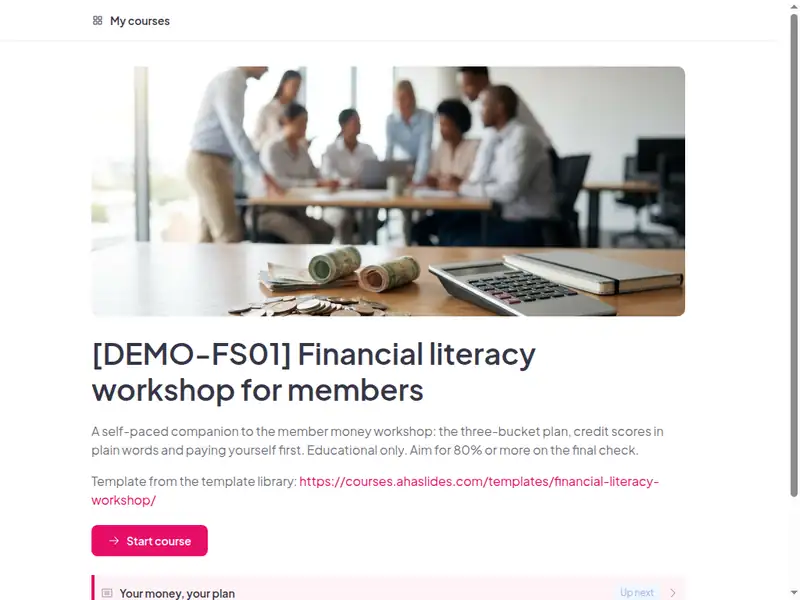
The Financial literacy workshop for members course as a learner first sees it

3 lessons, about 60 minutes

Minutes are an estimate.

  • Lesson 1: Your money, your plan · 30 min

    Before you begin · Needs, wants and savings · Where does it belong? · Scenario

  • Lesson 2: Credit scores and saving · 15 min

    Credit scores in plain words · Pay yourself first

  • Lesson 3: Check and next steps · 15 min

    Final check · You have finished

Claim the template

Inside this course

Taken from the course itself.

By the end, learners can

  • Name two or three personal money goals and say which matters most right now
  • Sort everyday spending into needs, wants and savings and explain why the split is a personal choice
  • Explain in plain words what a credit score is used for and name the habits that influence it
  • Choose one next step for this week and know where to get free help

Sample questions, with answers

  1. Which of these is usually a need rather than a want?

    • Rent or mortgage
    • A streaming subscription
    • A new phone every year

    Answer: Rent or mortgage. Housing is usually a need. The others are wants for most people, though the line is personal.

    Lesson 1: Your money, your plan

  2. What do lenders mostly use a credit score for?

    • Judging how likely you are to repay on time
    • Deciding your job title
    • Checking where you shop

    Answer: Judging how likely you are to repay on time. A credit score helps a lender judge how likely you are to repay on time.

    Lesson 2: Credit scores and saving

  3. What is the three-bucket plan?

    • A way to look at income as needs, wants and savings
    • A rule that fixes your split for life
    • A loan product

    Answer: A way to look at income as needs, wants and savings. It is a way to look at money, not a rule. Your split is yours.

    Lesson 3: Check and next steps

A scenario from "Your money, your plan"

Your income drops 10% next month. You have a streaming plan, a gym membership, a phone plan and rent.

Best response: Review wants such as streaming and the gym, and keep rent and the phone plan.

Weaker responses: Stop paying the phone plan to save money; Ignore it and hope it passes.

Common questions

Yes. Claiming the template and editing it are free.

Yes. The course is self-paced and online, and the live deck lets you add a live session in the room or online.

Member workshop (60 min).

Members, customers or community groups; run by a credit union, bank or community educator.

Record completion in your own LMS or record system, so you can show who finished the course and when.

Your own details, each highlighted inside the course:
  • Organisation name
  • Host name and role
  • Local cost of living examples
  • Savings products to mention
  • Follow up contact
  • Free counselling resource
  • Course URL
  • Reporting channel
Then edit anything else you like: wording, scenarios, your logo.
Visit the help centre (opens in a new tab)