
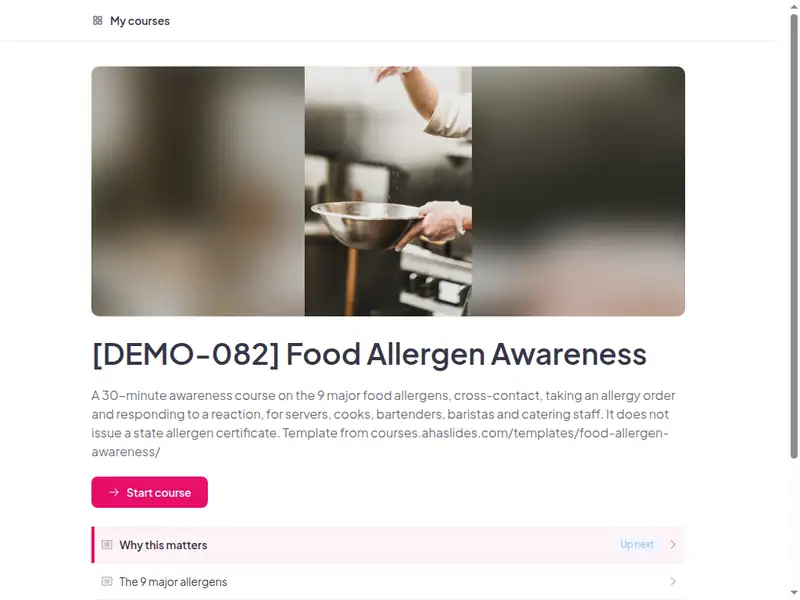
Lesson 1: Why this matters · 5 min
Explain what a food allergy is, how it differs from intolerance, and why a trace can be dangerous.
Learners sign in, so every finish and score is recorded. 5 fields to fill in with your details.
Minutes are an estimate.
Explain what a food allergy is, how it differs from intolerance, and why a trace can be dangerous.
Name the 9 major food allergens and where they hide in menu items.
Prevent allergen cross-contact in prep, cooking, service and delivery.
Take an allergen order accurately and communicate it from front to back of house.
Recognise anaphylaxis and follow the emergency procedure.
10 questions, 80% to pass. The result is saved to the learner's record.
Awareness only: this template does not issue an official card or certificate.
Taken from the course itself.
A guest says, "I'm allergic to nuts." What should you do?
Answer: Treat it as an allergy and check before you answer. Always treat an allergy request as serious. You cannot tell an allergy from an intolerance or a preference by looking, so check the matrix and tell the chef.
Lesson 1: Why this matters
Why is picking an allergen off a dish unsafe?
Answer: Traces of the allergen remain on the food. Traces stay behind, and a trace can cause a reaction. Remake the dish with clean tools instead.
Lesson 3: Stop cross-contact
The matrix has not been updated after a supplier change. What is the safest answer to a guest with an allergy?
Answer: "I can't confirm that yet. Let me check the label or ask the chef.". Be honest. If you cannot confirm a dish is safe, check the real label or ask, and offer another dish.
Lesson 4: Front of house
Server Aiyana: guest with sesame allergy orders a burger; the new bun supplier changed and the matrix isn't updated.
Best response: Tell guest you can't confirm, check bun label/ask PIC, offer an alternative.
Weaker response: Our buns never have sesame.
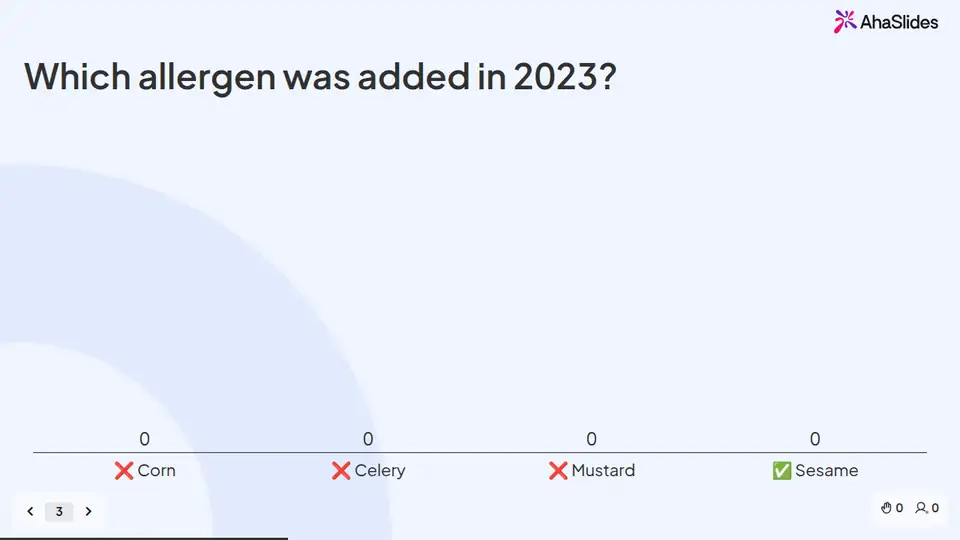
FALCPA 2004 (21 U.S.C. 343(qq)); FASTER Act 2021 (sesame = 9th major allergen, effective 1 Jan 2023); FDA Food Code 2022 §2-102.11(C)(4)-(5) (PIC allergen knowledge), §2-103.11(M) (staff trained in allergen awareness), §3-602.12 (written allergen notification for unpackaged food - verify state adoption); state rules: MA 105 CMR 590 (Food Allergy Awareness Act 2009), RI Gen. Laws 21-33.1, MI Food Law of 2000 as amended 2014 (allergen training for certified food safety managers - verify section), IL 410 ILCS 625/3.06 (allergen training for CFPMs), VA 12VAC5-421-55/-70 (CFPM + staff allergen awareness); FDA 2026 Food Code.
Courses teams often run alongside this one.

Professional Development for Teachers
Workplace Safety Training

Workplace Safety Training
3 articles from the AhaSlides blog that use this course, newest first.



Comments from trainers
No comments yet. Tell other trainers how the course went.
Your comment
Comments are public. We remove spam and personal details.