Skip to content
Claim this template

Free course template · US federal

Workplace violence prevention in healthcare

A ready-made course, live deck and two surveys for all hospital/clinic staff and licensed practitioners. 40 minutes, 7 lessons, 12-question final check. Last reviewed 8 October 2026; not legal advice.

Claim the templatePreview the courseDownload SCORM for your LMS

Free. No credit card. Edit everything.

Play a game from the course

Workplace violence prevention in healthcare: try 3 questions

Three questions from this course. Pick an answer, then see why.

Play the game

Game not loading? Open it in a new tab (opens in a new tab)

Three pieces that work together

Learners sign in, so every finish and score is recorded. 11 fields to fill in with your details.
Claim the template
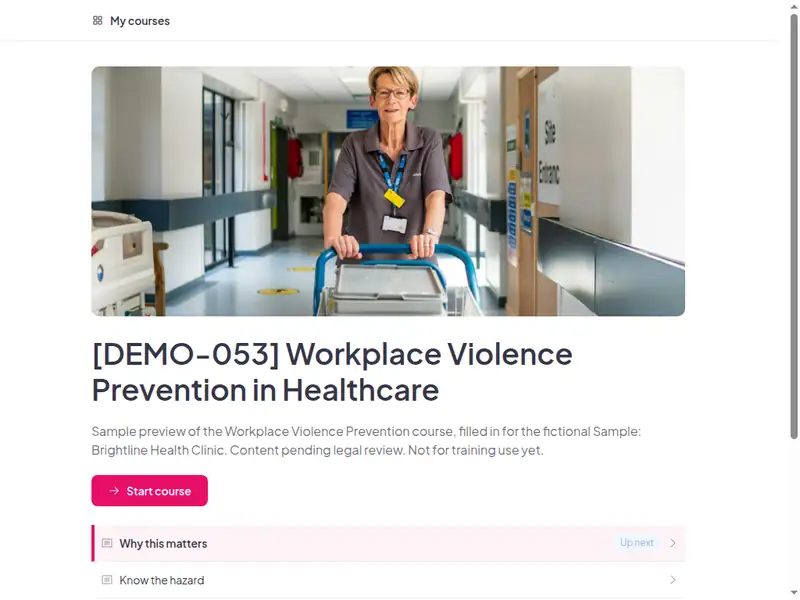
The Workplace violence prevention in healthcare course as a learner first sees it

7 lessons, about 40 minutes

Minutes are an estimate.

  • Lesson 1: Why this matters · 7 min

    Explain the organisation's WPV program, definitions and leadership.

  • Lesson 2: Know the hazard · 7 min

    Recognise early warning signs of escalation in patients and visitors.

  • Lesson 3: Controls · 4 min

    Use verbal and non-verbal de-escalation techniques.

  • Lesson 4: De-escalate · 7 min

    Use environmental and procedural controls and call for help early.

  • Lesson 5: Community & home visits · 4 min

    Report every incident, including verbal abuse, and access post-incident support.

  • Lesson 6: Report & recover · 7 min

    Stay safe in home and community visits.

  • Lesson 7: Final assessment · 4 min

    12 questions, 80% to pass. The result is saved to the learner's record.

Claim the template

Inside this course

Taken from the course itself.

Sample questions, with answers

  1. Why should the nurse report even though "it happens every shift"?

    • Reports show the pattern, so leaders can fix the causes
    • Reporting is only for serious injuries
    • Patients who are confused cannot be reported
    • Nobody reads reports

    Answer: Reports show the pattern, so leaders can fix the causes. Unreported incidents hide the problem. Reports let leaders see the pattern and make changes.

    Lesson 1: Why this matters

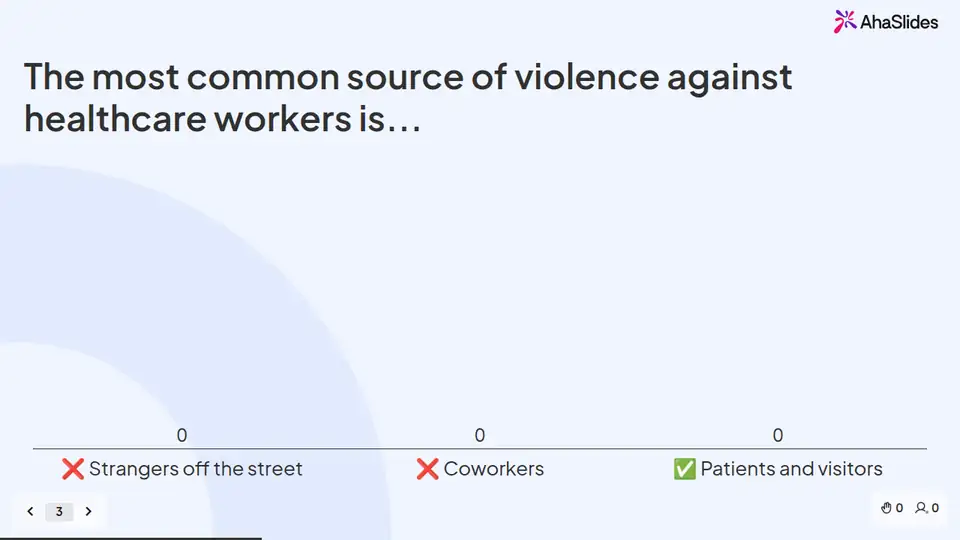
  2. Which type of violence is the most common in healthcare?

    • Criminal (Type 1)
    • Coworker (Type 3)
    • Patient or visitor (Type 2)
    • Personal relationship (Type 4)

    Answer: Patient or visitor (Type 2). In healthcare, violence from patients and visitors is the most common source.

    Lesson 2: Know the hazard

  3. Which is an engineering control?

    • A panic alarm at the front desk
    • A visitor policy
    • A staffing plan
    • A training slide

    Answer: A panic alarm at the front desk. Engineering controls change the workplace itself, such as alarms, secure entries and furniture.

    Lesson 3: Controls

A scenario from "De-escalate"

Behavioural health tech: a patient denied a smoke break throws a chair.

Best response: Create distance, call your code for behavioural emergency, team response.

Weaker responses: Block the door; Argue rules.

Legal basis

The Joint Commission workplace violence requirements (effective Jan 1, 2022: LD.03.01.01, EC.02.01.01, HR.01.05.03 and others; consolidated into National Performance Goal 2a / NPG.02.04.01 from Jan 2026 - verify numbering); OSHA Guidelines for Preventing Workplace Violence for Healthcare and Social Service Workers (OSHA 3148); OSH Act §5(a)(1); state laws (e.g. CA 8 CCR §3342).

Common questions

Yes. Claiming the template and editing it are free.

The course itself is self-paced and online, and the live deck lets you add a live session. Whether online delivery meets your local rules depends on the law that applies to you, so check The Joint Commission workplace violence or ask your own counsel.

At hire + annually + when the WPV program changes (Joint Commission); state rules.

All hospital/clinic staff and licensed practitioners - ED, behavioral health, med-surg, home health, security, front desk; leader page in Lesson 6.

Record completion in your own LMS or record system, so you can show who finished the course and when. Check the retention period that applies to you in The Joint Commission workplace violence.

Your own details, each highlighted inside the course:
  • WPV program leader
  • Site controls
  • Code for behavioral emergency
  • Security contact
  • Check in procedure
  • Incident reporting system
  • EAP contact
  • State WPV law
  • Reporting channel
  • LMS or record system
Then edit anything else you like: wording, scenarios, your logo.
Visit the help centre (opens in a new tab)