Skip to content
Claim this template

Free course template · Global

Insurance claims handling and underwriting decisions

A ready-made course, live deck and two surveys for claims handlers. 40 minutes, 6 lessons. Last reviewed 21 October 2026; not legal advice.

Claim the templatePreview the courseDownload SCORM for your LMS

Free. No credit card. Edit everything.

Play a game from the course

Insurance claims handling and underwriting decisions: try 3 questions

Three questions from this course. Pick an answer, then see why.

Play the game

Game not loading? Open it in a new tab (opens in a new tab)

Three pieces that work together

Learners sign in, so every finish and score is recorded. 11 fields to fill in with your details.
Claim the template
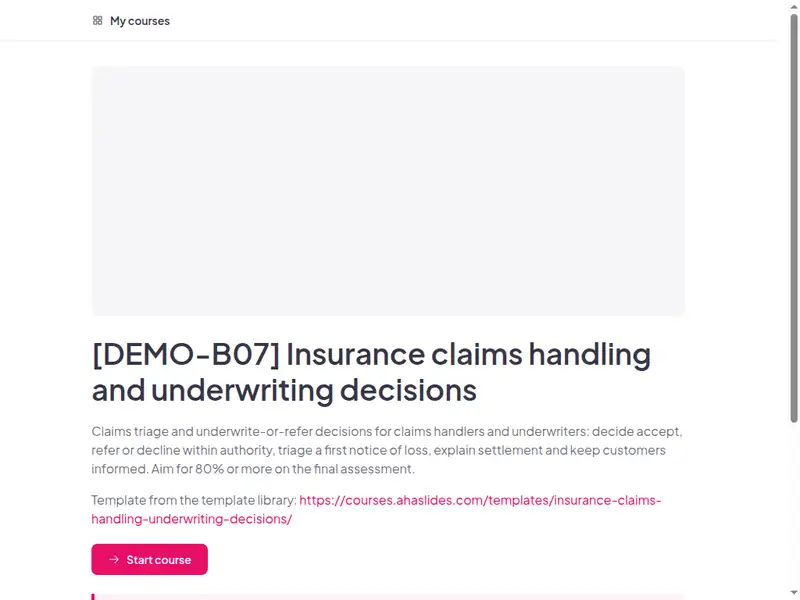
The Insurance claims handling and underwriting decisions course as a learner first sees it

6 lessons, about 40 minutes

Minutes are an estimate.

  • Lesson 1: Why careful claims and underwriting matter · 7 min

    Before you begin · A busy morning · Two sides of one promise

  • Lesson 2: Underwriting: appetite and terms · 7 min

    Risk selection · Terms that change cover · Accept, refer or decline

  • Lesson 3: Claims: from first notice to settlement · 7 min

    First notice of loss · Put the claim steps in order · Settlement and recovery in outline

  • Lesson 4: Grey areas: accept, refer or decline · 7 min

    Scenario · Scenario · Decide

  • Lesson 5: Communicate, speak up and apply · 7 min

    Talk to the customer · Who to tell · Scenario

  • Lesson 6: Final assessment · 5 min

    Practice · Completion

Claim the template

Inside this course

Taken from the course itself.

By the end, learners can

  • Explain risk selection and underwriting appetite and decide accept, refer or decline within authority
  • Apply policy terms on endorsements, cancellation and renewal correctly
  • Triage a first notice of loss: gather facts, check cover, set priority and next steps
  • Describe settlement, subrogation and third-party claims in outline and know when to refer
  • Communicate with a customer during a claim clearly, kindly and on time

Sample questions, with answers

  1. How does underwriting affect claims?

    • The quality of underwriting shapes the claims that follow
    • It does not affect claims
    • It only sets the price
    • It decides who handles complaints

    Answer: The quality of underwriting shapes the claims that follow. Good risk selection and clear terms mean fewer disputes later, and claims experience informs underwriting.

    Lesson 1: Why careful claims and underwriting matter

  2. Who do you refer a complex third-party claim to?

    • The person with authority for it
    • Nobody, settle it fast
    • The customer
    • The broker alone

    Answer: The person with authority for it. Complex third-party claims need someone with the right authority. Referring is normal practice.

    Lesson 3: Claims: from first notice to settlement

  3. A claim shows possible fraud indicators. What is a fair response?

    • Neutral questions and referral through the agreed route
    • Telling the customer you suspect fraud
    • Closing the claim
    • Paying quickly to avoid conflict

    Answer: Neutral questions and referral through the agreed route. Indicators are not proof. Stay neutral and let the right team assess.

    Lesson 4: Grey areas: accept, refer or decline

A scenario from "Grey areas: accept, refer or decline"

A customer mentions a prior loss after a claim starts.

Best response: Record it, check what the policy terms say and refer to the right authority.

Weaker responses: Deny at once; Ignore it; Tell the customer you will not pay.

Common questions

Yes. Claiming the template and editing it are free.

Yes. The course is self-paced and online, and the live deck lets you add a live session in the room or online.

At onboarding for claims and underwriting roles, and yearly or when appetite or rules change.

Claims handlers, underwriters, underwriting assistants and broker service teams; run by the learning or compliance owner.

Record completion in your own LMS or record system, so you can show who finished the course and when.

Your own details, each highlighted inside the course:
  • Compliance contact
  • Policy link
  • Speak up route
  • Jurisdiction and regulator
  • LMS or record system
  • Underwriting guide link
  • Claims procedure link
  • Course URL
  • Live session URL
Then edit anything else you like: wording, scenarios, your logo.
Visit the help centre (opens in a new tab)