Skip to content
Claim this template

Free course template · Global

Nursing assistant and care aide competency checks: Daily living, vital signs and safe care

A ready-made course, live deck and two surveys for nursing assistants. 40 minutes, 6 lessons. Last reviewed 21 October 2026; not legal advice.

Claim the templatePreview the courseDownload SCORM for your LMS

Free. No credit card. Edit everything.

Play a game from the course

Nursing assistant and care aide competency checks: try 3 questions

Three questions from this course. Pick an answer, then see why.

Play the game

Game not loading? Open it in a new tab (opens in a new tab)

Three pieces that work together

Learners sign in, so every finish and score is recorded. 14 fields to fill in with your details.
Claim the template
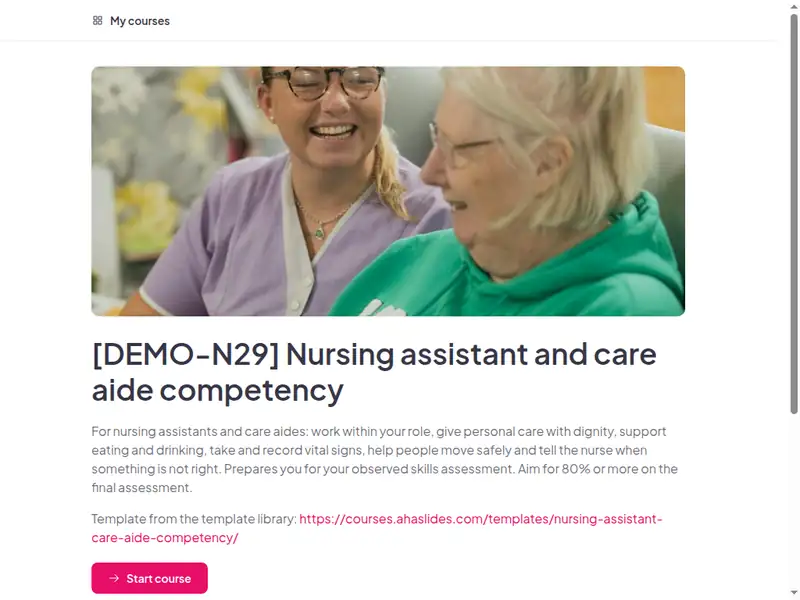
The Nursing assistant and care aide competency checks: Daily living, vital signs and safe care course as a learner first sees it

6 lessons, about 40 minutes

Minutes are an estimate.

  • Lesson 1: Your role and why it matters · 7 min

    Before you begin · Morning on Ward 5 · You are the eyes and ears

  • Lesson 2: Personal care with dignity · 7 min

    The principles in brief · Order a bed bath · Report or record?

  • Lesson 3: Eating, drinking and vital signs: a routine · 7 min

    Safe eating and drinking · Vital signs routine · Check

  • Lesson 4: Moving safely and grey areas · 7 min

    Scenario · Scenario · Match the concern to the action

  • Lesson 5: Infection prevention, records and speaking up · 7 min

    Habits that protect · Who to tell · Scenario

  • Lesson 6: Final assessment · 5 min

    Practice · Completion

Claim the template

Inside this course

Taken from the course itself.

By the end, learners can

  • Achieve ≥ 80% on the final assessment, then book the observed skills assessment
  • Describe your role, work within it and tell the nurse when something is outside it
  • Give personal care with dignity, check skin and report changes
  • Support eating and drinking safely and report swallowing or intake concerns
  • Take and record vital signs using the correct technique and report concerns using your local chart
  • Support mobility, positioning and transfers safely, use infection prevention habits and record care accurately

Sample questions, with answers

  1. You notice a change but are not sure what it means. What do you do?

    • Tell the nurse what you saw
    • Wait until you know the cause
    • Mention it to a visitor

    Answer: Tell the nurse what you saw. Report changes you notice to the nurse. You do not need to know the cause to pass on what you saw.

    Lesson 1: Your role and why it matters

  2. A reading worries you and you are not sure what it means. What do you do?

    • Tell the nurse straight away
    • Take it again later and wait
    • Record it only

    Answer: Tell the nurse straight away. Report a concerning result or a person who looks unwell at once, even if you are not sure what it means.

    Lesson 3: Eating, drinking and vital signs: a routine

  3. Why does working within your role matter?

    • It keeps people safe and shows who is accountable
    • It is only about paperwork
    • It means you never help

    Answer: It keeps people safe and shows who is accountable. Working within your role keeps people safe and makes clear who is accountable.

    Lesson 4: Moving safely and grey areas

A scenario from "Moving safely and grey areas"

A busy colleague asks you to change a dressing, which is not on your task list.

Best response: Say kindly that it is outside your role, tell the nurse in charge and offer other help.

Weaker responses: Do it; Ignore the request; Do it and say nothing.

Common questions

Yes. Claiming the template and editing it are free.

Yes. The course is self-paced and online, and the live deck lets you add a live session in the room or online.

At onboarding before any observed skills sign-off, annually for competency validation, and when a role or task list changes.

Nursing assistants, care aides, care assistants and healthcare assistants in hospitals and care homes, plus the nurse educators who validate them; run by the nurse educator or clinical education lead responsible for aide onboarding and annual competency validation.

Record completion in your own LMS or record system, so you can show who finished the course and when.

Your own details, each highlighted inside the course:
  • Clinical education contact
  • Local policy link
  • Incident reporting route
  • Escalation route
  • Regulator and standards
  • LMS or record system
  • Aide skills checklist
  • Local observation chart
  • Local nutrition record
  • Moving and handling plan
  • Course URL
  • Live session URL
Then edit anything else you like: wording, scenarios, your logo.
Visit the help centre (opens in a new tab)