Skip to content
Claim this template

Free course template · Global

Psychosocial risks, mental health at work and workplace violence

A ready-made course, live deck and two surveys for managers. 45 minutes, 6 lessons. Last reviewed 21 October 2026; not legal advice.

Claim the templatePreview the courseDownload SCORM for your LMS

Free. No credit card. Edit everything.

Play a game from the course

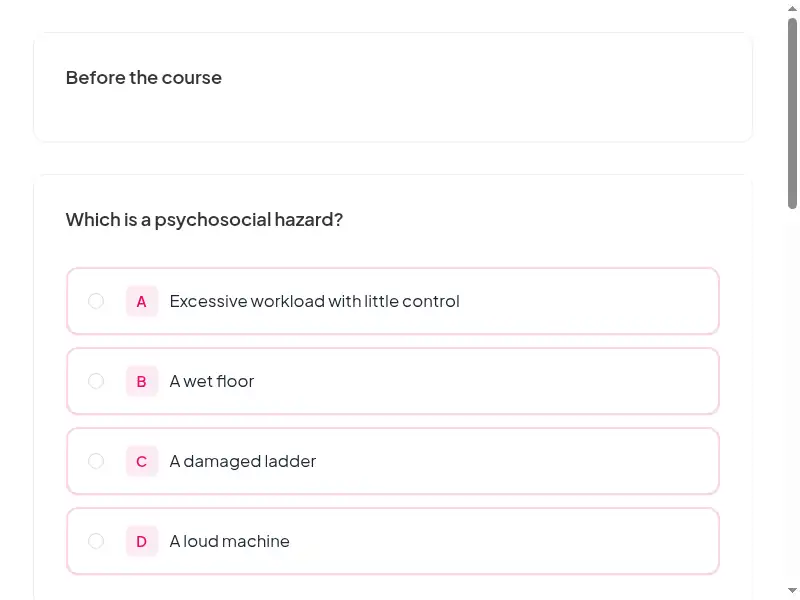
Psychosocial risks, mental health at work and workplace violence: try 3 questions

Three questions from this course. Pick an answer, then see why.

Play the game

Game not loading? Open it in a new tab (opens in a new tab)

Three pieces that work together

Learners sign in, so every finish and score is recorded. 11 fields to fill in with your details.
Claim the template
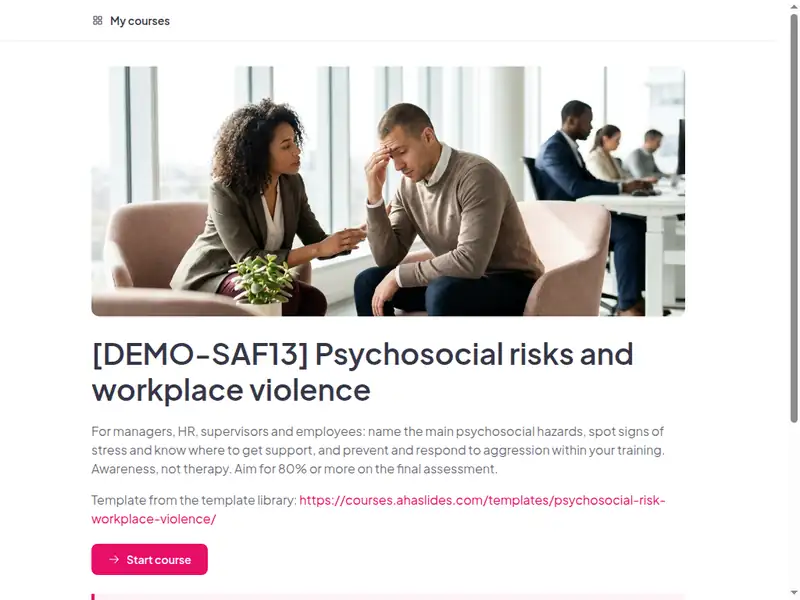
The Psychosocial risks, mental health at work and workplace violence course as a learner first sees it

6 lessons, about 45 minutes

Minutes are an estimate.

  • Lesson 1: Psychosocial hazards: workload, control, support, role clarity, violence · 9 min

    Before you begin · Alder Hotels reception · Five hazard families

  • Lesson 2: Spotting signs of stress in yourself and others · 6 min

    What you might notice · Where to turn

  • Lesson 3: Managers: preventing and responding to psychosocial risk · 6 min

    Preventing · Responding

  • Lesson 4: Workplace violence and aggression: prevention and de-escalation · 9 min

    Early warnings · De-escalate · Check

  • Lesson 5: Reporting, support routes and mental health first aid · 6 min

    Reporting · Mental health first aid

  • Lesson 6: Consultation, the risk-assessment cycle and next steps · 9 min

    Include psychosocial risk · Next steps · Practice

Claim the template

Inside this course

Taken from the course itself.

By the end, learners can

  • Name psychosocial hazards: workload, control, support, role clarity and violence
  • Spot signs of stress in yourself and others and know the support routes
  • Managers: prevent and respond to psychosocial risk
  • Prevent workplace violence and use de-escalation within your training
  • Report, use support routes and take part in consultation and the risk-assessment cycle

Sample questions, with answers

  1. What are signs of stress?

    • Proof of a condition
    • Clues to check in, not a diagnosis
    • A reason to blame
    • A performance fault

    Answer: Clues to check in, not a diagnosis. Signs are a reason to ask kindly.

    Lesson 2: Spotting signs of stress in yourself and others

  2. What is the best first response to a struggling team member?

    • A private, kind check-in
    • A public warning
    • A team discussion about them
    • Waiting for the annual review

    Answer: A private, kind check-in. Start privately and kindly.

    Lesson 3: Managers: preventing and responding to psychosocial risk

  3. An aggressive person is shouting at the counter. Your first move is to...

    • shout back
    • stay calm and keep a safe distance
    • block the exit
    • follow them

    Answer: stay calm and keep a safe distance. Calm and distance lower the temperature.

    Lesson 4: Workplace violence and aggression: prevention and de-escalation

A scenario from "Managers: preventing and responding to psychosocial risk"

A team member seems exhausted and snaps at colleagues.

Best response: A private, kind check-in, listen, agree adjustments and signpost support.

Weaker responses: Tell them to pull themselves together; Discuss it with the team; Ignore it.

Related articles

2 articles from the AhaSlides blog that use this course, newest first.

Common questions

Yes. Claiming the template and editing it are free.

Yes. The course is self-paced and online, and the live deck lets you add a live session in the room or online.

As a manager workshop, an all-staff awareness session, and yearly alongside the risk-assessment review.

Managers, HR, supervisors and all employees; run by HR, EHS and wellbeing teams.

Record completion in your own LMS or record system, so you can show who finished the course and when.

Your own details, each highlighted inside the course:
  • Safety contact
  • Incident report route
  • Safety policy link
  • Emergency number
  • Local ohs law
  • Risk assessment register
  • First aid contacts
  • Support service
  • LMS or record system
  • Course URL
Then edit anything else you like: wording, scenarios, your logo.
Visit the help centre (opens in a new tab)