Skip to content
Claim this template

Free course template · Global

Resilience, stress and wellbeing at work

A ready-made course, live deck and two surveys for all staff. 35 minutes, 6 lessons. Last reviewed 21 October 2026; not legal advice.

Claim the templatePreview the courseDownload SCORM for your LMS

Free. No credit card. Edit everything.

Play a game from the course

Resilience, stress and wellbeing at work: try 3 questions

Three questions from this course. Pick an answer, then see why.

Play the game

Game not loading? Open it in a new tab (opens in a new tab)

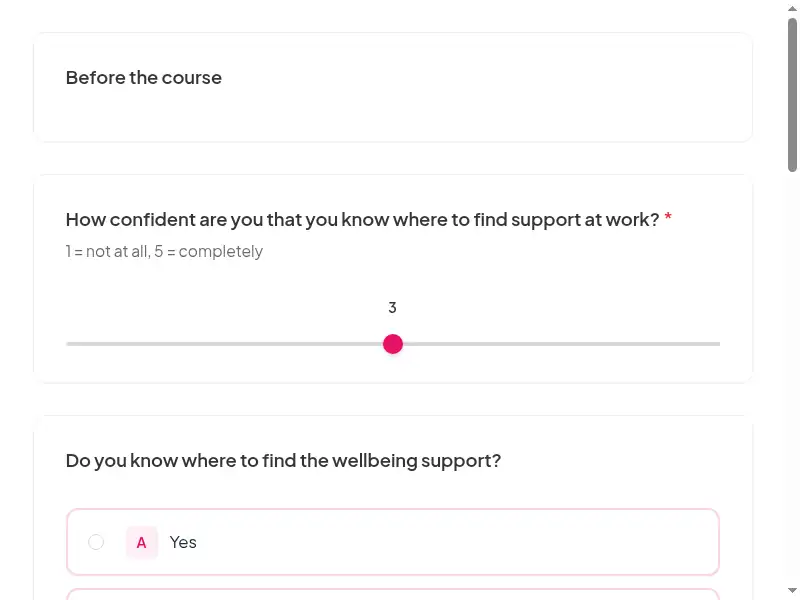
Three pieces that work together

Learners sign in, so every finish and score is recorded. 11 fields to fill in with your details.
Claim the template
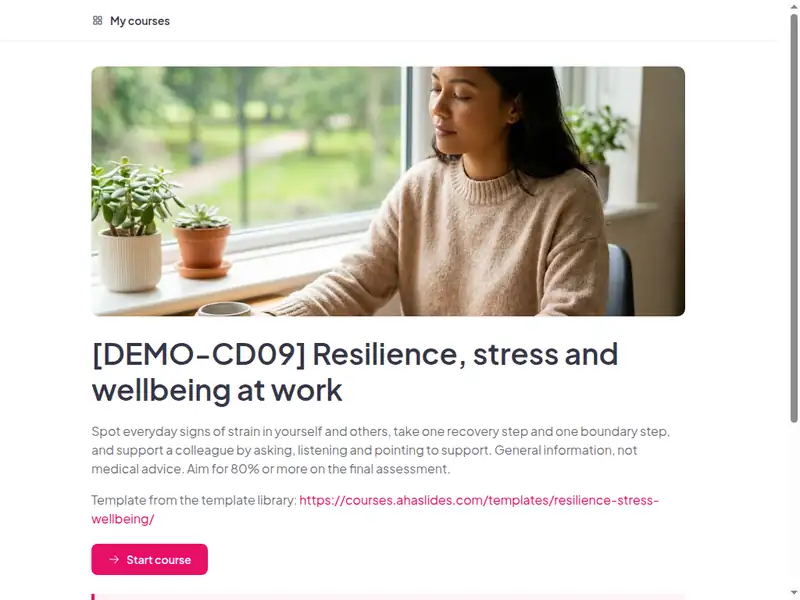
The Resilience, stress and wellbeing at work course as a learner first sees it

6 lessons, about 35 minutes

Minutes are an estimate.

  • Lesson 1: What resilience is, and why it matters at work · 7 min

    Before you begin · The week after the surge · What would you say?

  • Lesson 2: Recognising stress and strain in yourself and others · 7 min

    Four places it shows · Everyday pressure or worth a conversation? · Terms

  • Lesson 3: Coping strategies and recovery: a simple process · 7 min

    Five steps · Helpful or not? · Check

  • Lesson 4: Workload and boundaries: grey areas · 6 min

    The 10pm message · Too much on the plate · "I am fine"

  • Lesson 5: Where to get support, and supporting a colleague · 4 min

    Supporting someone · What would you say?

  • Lesson 6: Final assessment and completion · 4 min

    Your next steps · Practice

Claim the template

Inside this course

Taken from the course itself.

By the end, learners can

  • Describe resilience as something that depends on the person, the work and the support around them, not on toughness alone
  • Recognise everyday signs of strain in yourself and others, without diagnosing
  • Choose one small coping or recovery step and one workload or boundary step
  • Respond to a colleague who is struggling by asking, listening and pointing to support
  • Say where to get support at work and when to use it

Sample questions, with answers

  1. What helps most when someone seems under strain?

    • A private, kind check-in
    • Waiting until it gets worse
    • A comment in the team chat

    Answer: A private, kind check-in. Asking early and in private is better than waiting for a crisis.

    Lesson 1: What resilience is, and why it matters at work

  2. A colleague confides they are struggling. What should you do?

    • Listen and point to support
    • Keep it secret from everyone no matter what
    • Tell them to push through
    • Try to treat it yourself

    Answer: Listen and point to support. Listening and pointing to support is the right role for a colleague.

    Lesson 5: Where to get support, and supporting a colleague

  3. Resilience at work depends on…

    • The person, the work and the support around them
    • Toughness alone
    • Never showing stress
    • Working longer

    Answer: The person, the work and the support around them. Resilience is not toughness alone. The work and the support matter too.

    Lesson 6: Final assessment and completion

A scenario from "Workload and boundaries: grey areas"

Sofia receives a non-urgent message from a client at 10pm and feels she should reply.

Best response: Leave it until working hours unless your agreed on-call rules say otherwise your policy link.

Weaker responses: Reply every time; Stew about it silently; Switch off from the whole team.

Common questions

Yes. Claiming the template and editing it are free.

Yes. The course is self-paced and online, and the live deck lets you add a live session in the room or online.

At onboarding, ahead of a known busy period, after a restructure, and during a wellbeing week.

All staff, managers supporting teams under pressure, and customer-facing and care teams; run by L&D with HR or the wellbeing lead.

Record completion in your own LMS or record system, so you can show who finished the course and when.

Your own details, each highlighted inside the course:
  • Where employees get wellbeing support, such as an employee assistance programme or HR contact
  • Who to contact if someone is in immediate danger
  • The organisation's wellbeing, workload or working-hours policy
  • How to raise a workload concern
  • Help contact
  • Next course link
  • LMS or record system
  • Course URL
  • Live session URL
Then edit anything else you like: wording, scenarios, your logo.
Visit the help centre (opens in a new tab)