Skip to content
Claim this template

Free course template · Global

Safe medication administration and high-alert medicines for registered nurses

A ready-made course, live deck and two surveys for registered nurses. 40 minutes, 6 lessons. Last reviewed 21 October 2026; not legal advice.

Claim the templatePreview the courseDownload SCORM for your LMS

Free. No credit card. Edit everything.

Play a game from the course

Safe medication administration and high-alert medicines for registered nurses: try 3 questions

Three questions from this course. Pick an answer, then see why.

Play the game

Game not loading? Open it in a new tab (opens in a new tab)

Three pieces that work together

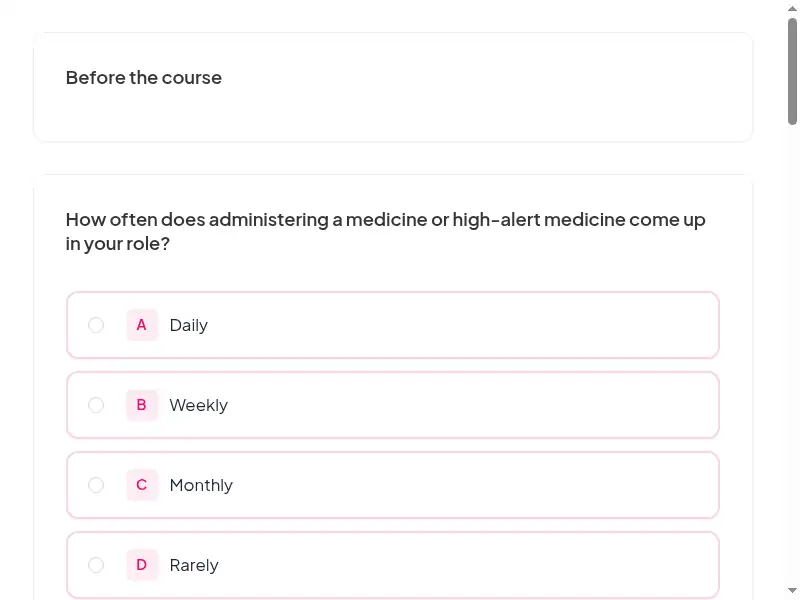
Learners sign in, so every finish and score is recorded. 13 fields to fill in with your details.
Claim the template
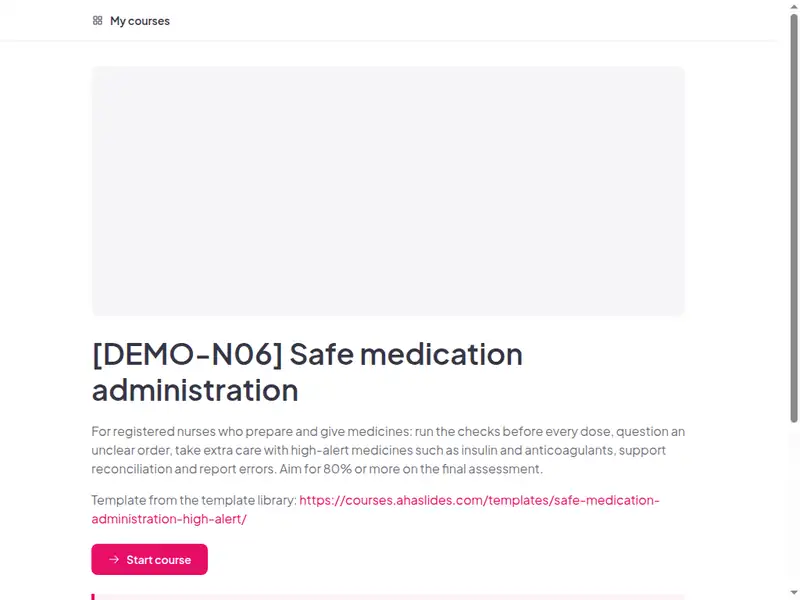
The Safe medication administration and high-alert medicines for registered nurses course as a learner first sees it

6 lessons, about 40 minutes

Minutes are an estimate.

  • Lesson 1: Why a dose goes wrong · 7 min

    Before you begin · The 2 pm round on Ward 9 · What makes errors happen?

  • Lesson 2: The checks before every dose · 7 min

    Rights of administration · Reading an order · Check

  • Lesson 3: A safe administration routine · 7 min

    The routine · Put it in order · Spot the problem

  • Lesson 4: High-alert medicines and grey areas · 7 min

    What high alert means · Scenario · Scenario

  • Lesson 5: Reconciliation, reporting and speaking up · 7 min

    Reconciliation in brief · Who to tell · Scenario

  • Lesson 6: Final assessment · 5 min

    Practice · Completion

Claim the template

Inside this course

Taken from the course itself.

By the end, learners can

  • Carry out the checks before every dose in the right order and know when to stop and ask
  • Read an order for missing or ambiguous parts and clarify before giving
  • Explain what makes a medicine high alert and apply the extra safeguards in local policy
  • Describe the safety points for insulin and anticoagulants without relying on memory for doses
  • Support medication reconciliation at admission, transfer and discharge, and report errors and near misses

Sample questions, with answers

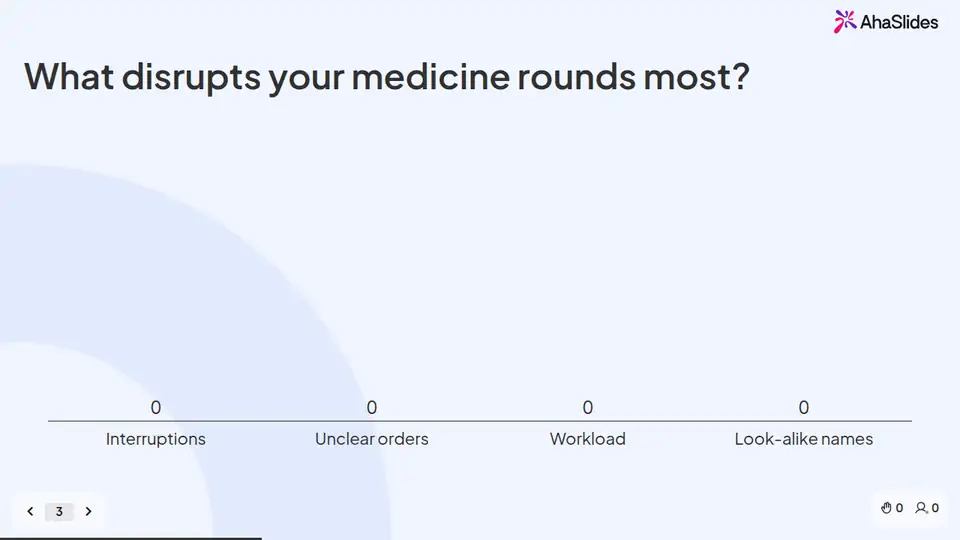
  1. You are interrupted while preparing a dose. What is the safest step?

    • Pause and restart the check
    • Carry on from memory
    • Ask someone to finish it

    Answer: Pause and restart the check. When interrupted, pause and restart the check rather than carry on from memory.

    Lesson 1: Why a dose goes wrong

  2. When is the best time to document a dose?

    • Straight after giving it
    • At the end of the shift
    • When someone asks

    Answer: Straight after giving it. Document straight away so nobody gives it twice.

    Lesson 3: A safe administration routine

  3. Why does a high-alert medicine need extra care?

    • Errors can cause serious harm
    • It always costs more
    • It is only for children

    Answer: Errors can cause serious harm. High alert describes the size of the harm if it goes wrong, not the cost.

    Lesson 4: High-alert medicines and grey areas

A scenario from "High-alert medicines and grey areas"

The dose written for an anticoagulant is hard to read and the prescriber is in theatre.

Best response: Do not guess, ask a second nurse or pharmacist, contact the prescriber or covering clinician and document.

Weaker responses: Give the usual dose; Ask the patient what they normally take; Give half and wait.

Related articles

An article from the AhaSlides blog that uses this course.

Common questions

Yes. Claiming the template and editing it are free.

Yes. The course is self-paced and online, and the live deck lets you add a live session in the room or online.

At onboarding, annually, and after a medication incident theme is identified.

Registered nurses, newly qualified nurses and care-home nurses who prepare and administer medicines, including insulin and anticoagulants; run by the nurse educator or clinical education lead (with the medication safety officer where there is one).

Record completion in your own LMS or record system, so you can show who finished the course and when.

Your own details, each highlighted inside the course:
  • Clinical education contact
  • Local policy link
  • Incident reporting route
  • Escalation route
  • Regulator and standards
  • LMS or record system
  • Medication policy link
  • High alert medicines list
  • Do not use abbreviations list
  • Course URL
  • Live session URL
Then edit anything else you like: wording, scenarios, your logo.
Visit the help centre (opens in a new tab)