Skip to content
Claim this template

Free course template · Global

Safety culture, speaking up and stop-work authority

A ready-made course, live deck and two surveys for frontline workers. 35 minutes, 6 lessons. Last reviewed 21 October 2026; not legal advice.

Claim the templatePreview the courseDownload SCORM for your LMS

Free. No credit card. Edit everything.

Play a game from the course

Safety culture, speaking up and stop-work authority: try 3 questions

Three questions from this course. Pick an answer, then see why.

Play the game

Game not loading? Open it in a new tab (opens in a new tab)

Three pieces that work together

Learners sign in, so every finish and score is recorded. 8 fields to fill in with your details.
Claim the template
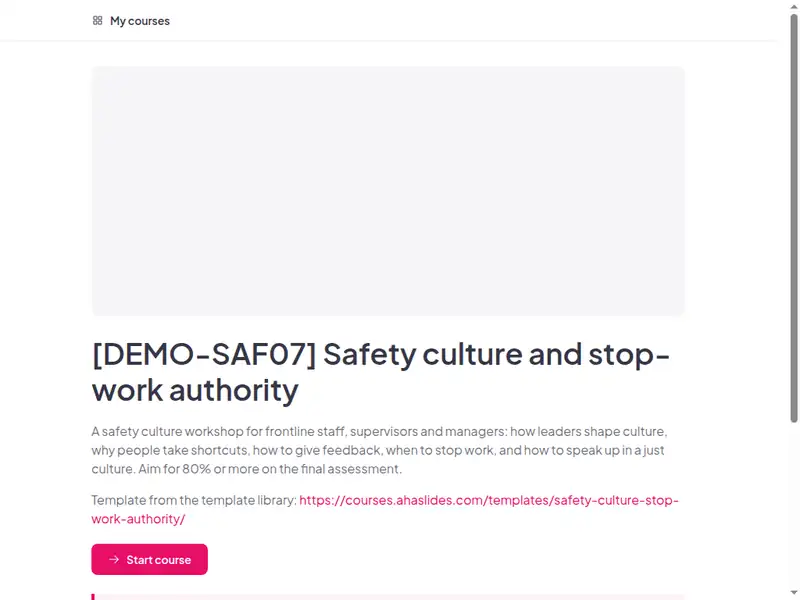
The Safety culture, speaking up and stop-work authority course as a learner first sees it

6 lessons, about 35 minutes

Minutes are an estimate.

  • Lesson 1: What safety culture is and how leaders shape it · 7 min

    Before you begin · Harbourview Depot, a Friday afternoon · Culture in one line

  • Lesson 2: Why people take shortcuts: human factors and normalisation of deviance · 5 min

    Why shortcuts happen · Myth or fact

  • Lesson 3: Observing and giving feedback on safe and unsafe behaviour · 5 min

    Feedback in four steps · Try it

  • Lesson 4: Stop-work authority and the right to withdraw · 7 min

    You can stop the job · Stop or carry on? · After a stop

  • Lesson 5: Speaking up, just culture and psychological safety · 4 min

    What a just culture means · How to speak up

  • Lesson 6: Making a personal safety commitment and next steps · 7 min

    My commitment · Next steps · Practice

Claim the template

Inside this course

Taken from the course itself.

By the end, learners can

  • Explain what safety culture is and how leaders' actions shape it
  • Describe why people take shortcuts: human factors and normalisation of deviance
  • Observe safe and unsafe behaviour and give respectful feedback
  • Use stop-work authority and the right to withdraw from dangerous work
  • Speak up in a just culture and make a personal safety commitment

Sample questions, with answers

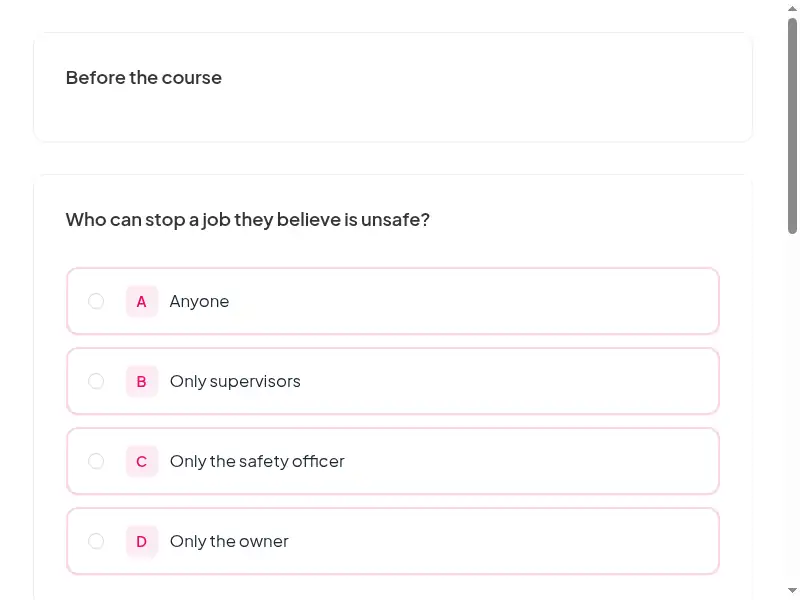
  1. Which has the strongest effect on culture?

    • A poster in the canteen
    • A yearly slogan
    • A longer rule book
    • What leaders do and tolerate

    Answer: What leaders do and tolerate. People copy what leaders do, not what they say.

    Lesson 1: What safety culture is and how leaders shape it

  2. A shortcut has worked ten times. What does that tell you?

    • Nothing about whether it is safe
    • That it is now safe
    • That the rule is wrong
    • That it is allowed

    Answer: Nothing about whether it is safe. Past luck is not proof of safety.

    Lesson 2: Why people take shortcuts: human factors and normalisation of deviance

  3. Which opening works best when giving feedback?

    • "You never follow the rules"
    • "I saw the guard off and I am worried someone could be hurt"
    • "Everyone talks about you"
    • "I will report you"

    Answer: "I saw the guard off and I am worried someone could be hurt". Specific, calm and about the risk.

    Lesson 3: Observing and giving feedback on safe and unsafe behaviour

A scenario from "Observing and giving feedback on safe and unsafe behaviour"

You see a co-worker bypass a guard.

Best response: Ask them to stop if safe, explain the risk, tell the supervisor.

Weaker responses: Ignore it; Shout across the floor; Take photos and post them.

Related articles

An article from the AhaSlides blog that uses this course.

Common questions

Yes. Claiming the template and editing it are free.

Yes. The course is self-paced and online, and the live deck lets you add a live session in the room or online.

At induction for frontline staff and supervisors, as a yearly safety-culture workshop, and again 90 days after the first perception survey.

Frontline workers, supervisors, managers and site leadership; run by EHS, operations excellence and HR.

Record completion in your own LMS or record system, so you can show who finished the course and when.

Your own details, each highlighted inside the course:
  • Safety contact
  • Incident report route
  • Safety policy link
  • Local ohs law
  • Observation route
  • LMS or record system
  • Course URL
Then edit anything else you like: wording, scenarios, your logo.
Visit the help centre (opens in a new tab)