Skip to content
Claim this template

Free course template · Global

Safety leadership: Visible commitment from supervisors and managers

A ready-made course, live deck and two surveys for supervisors and managers on operational sites. 35 minutes, 6 lessons. Last reviewed 21 October 2026; not legal advice.

Claim the templatePreview the courseDownload SCORM for your LMS

Free. No credit card. Edit everything.

Play a game from the course

Safety leadership: Visible commitment from supervisors and managers: try 3 questions

Three questions from this course. Pick an answer, then see why.

Play the game

Game not loading? Open it in a new tab (opens in a new tab)

Three pieces that work together

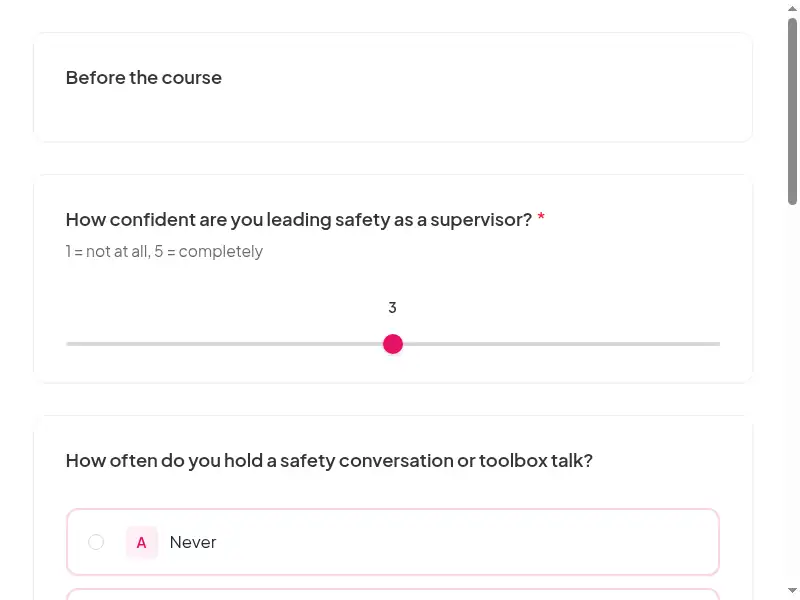
Learners sign in, so every finish and score is recorded. 9 fields to fill in with your details.
Claim the template
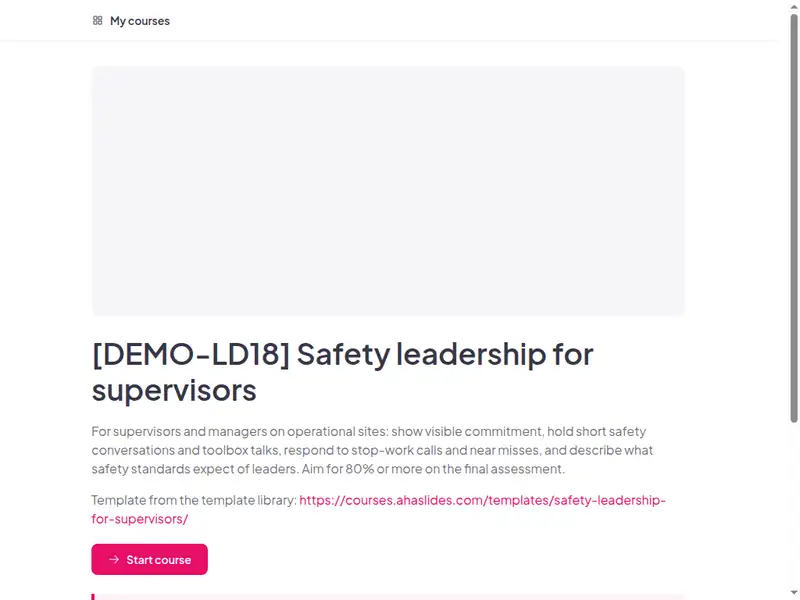
The Safety leadership: Visible commitment from supervisors and managers course as a learner first sees it

6 lessons, about 35 minutes

Minutes are an estimate.

  • Lesson 1: Why leader behaviour matters · 7 min

    Before you begin · The skipped check · What did the team learn?

  • Lesson 2: Visible commitment · 6 min

    Four visible habits · Words and actions · Check

  • Lesson 3: Safety conversations and toolbox talks · 6 min

    A short conversation · Toolbox talk · Try it

  • Lesson 4: Grey areas: schedule pressure, near misses and stop-work · 6 min

    Stop-work authority · What would you do? · Check

  • Lesson 5: Leadership expectations in safety standards · 6 min

    What standards expect · Your site · Try it

  • Lesson 6: Your safety leadership plan and the final assessment · 4 min

    Next steps · Practice

Claim the template

Inside this course

Taken from the course itself.

By the end, learners can

  • Describe how supervisors and managers shape safety behaviour on site
  • Show visible commitment through conversations, walkarounds and follow-through
  • Hold a short safety conversation and a toolbox talk
  • Respond to stop-work calls, near misses and concerns
  • Describe leadership expectations in safety management standards

Sample questions, with answers

  1. Sam lets a team member skip a pre-use check. What does the team learn?

    • That checks are always optional
    • That the check was never needed
    • Nothing, because nothing happened
    • That shortcuts are tolerated when time is short

    Answer: That shortcuts are tolerated when time is short. Nothing happening this time still teaches people that schedule can beat safety.

    Lesson 1: Why leader behaviour matters

  2. A supervisor skips a check to save time. The team is most likely to conclude that...

    • checks can be skipped when time is short
    • the supervisor trusts them more
    • the check is now stricter
    • the check was never in the plan

    Answer: checks can be skipped when time is short. People read actions as the real rule.

    Lesson 2: Visible commitment

  3. You see a team member working without the agreed guard. Your first action is to...

    • note it for the weekly report
    • stop the task calmly and discuss it
    • wait until the task is finished
    • tell the team member's colleagues

    Answer: stop the task calmly and discuss it. Stopping calmly removes the risk straight away and keeps the conversation respectful.

    Lesson 3: Safety conversations and toolbox talks

A scenario from "Safety conversations and toolbox talks"

You see a team member working without the agreed guard.

Best response: Stop the task calmly, discuss and fix it before restart.

Weaker responses: Walk past; Shout in front of others; Report only later.

Related articles

An article from the AhaSlides blog that uses this course.

Common questions

Yes. Claiming the template and editing it are free.

Yes. The course is self-paced and online, and the live deck lets you add a live session in the room or online.

In a supervisor programme and before a site safety campaign.

Supervisors and managers on operational sites; run by L&D with the health and safety lead.

Record completion in your own LMS or record system, so you can show who finished the course and when.

Your own details, each highlighted inside the course:
  • The confidential route for raising a conduct or safety concern
  • Link to the next course in your leadership path
  • Where course completions are recorded
  • Link to the self-paced course
  • How to report an incident or near miss
  • The site safety lead or health and safety adviser
  • The site safety procedures and stop-work rule
Then edit anything else you like: wording, scenarios, your logo.
Visit the help centre (opens in a new tab)