
Lesson 1: Why it matters · 7 min
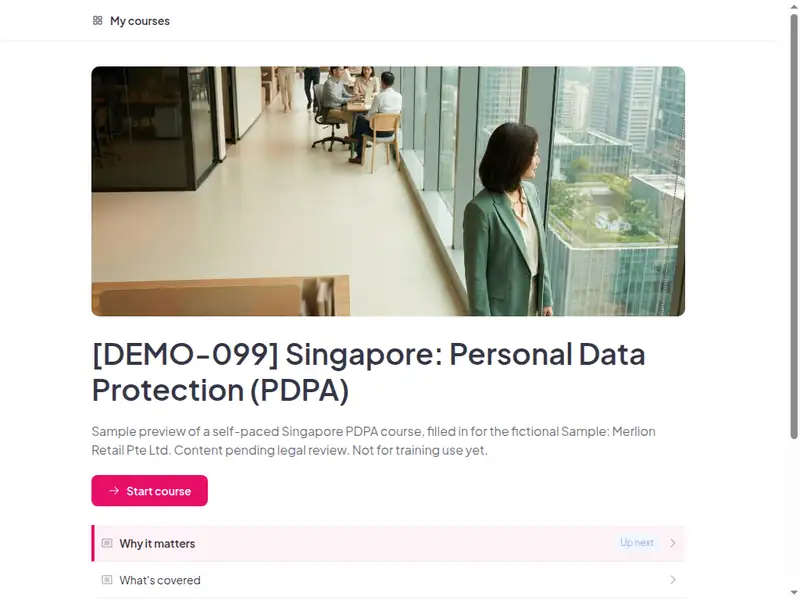
Explain why the PDPA matters and the PDPC's enforcement powers.
Learners sign in, so every finish and score is recorded. 7 fields to fill in with your details.
Minutes are an estimate.
Explain why the PDPA matters and the PDPC's enforcement powers.
Identify personal data, including NRIC numbers and business contact information.
Apply the data protection obligations to everyday tasks.
Handle access and correction requests and Do Not Call checks.
Report a suspected data breach immediately so assessment (30 days) and PDPC notification (3 calendar days) can be met.
Escalate to the DPO.
10 questions, 80% to pass. The result is saved to the learner's record.
Taken from the course itself.
A payroll company processes salaries for another business, following its instructions. In PDPA terms, what is the payroll company?
Answer: A data intermediary. An organisation that processes personal data on behalf of another organisation is a data intermediary. It still has duties, such as protecting the data.
Lesson 1: Why it matters
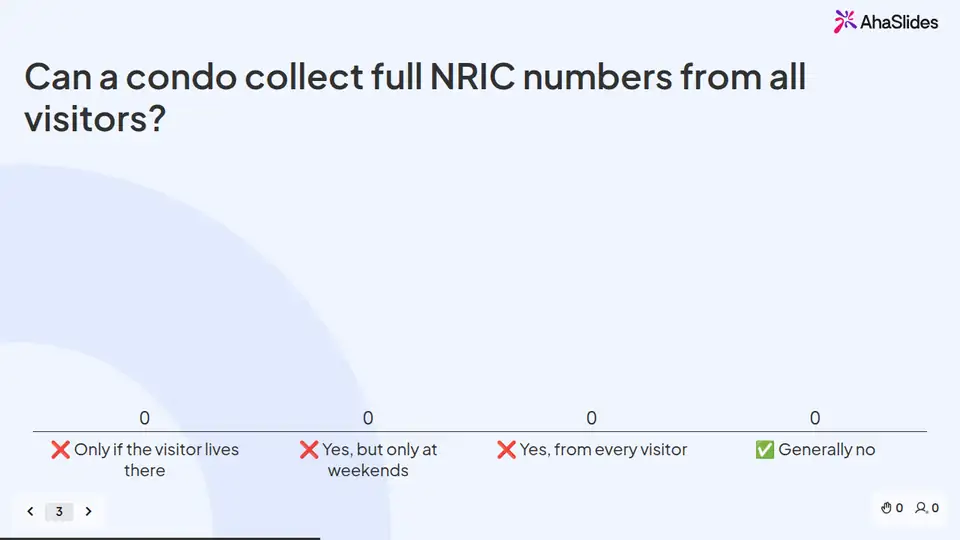
A gym wants to check that a member is who they say they are at sign-up. What is the best approach under PDPC guidance?
Answer: Use a mobile number or membership ID instead of the full NRIC where possible. PDPC guidance asks organisations to use alternatives to NRIC numbers where they can. Copying or keeping the card is generally not allowed without a legal need.
Lesson 3: Allowed vs not allowed
A breach exposes the details of 600 customers, sent to an outside company by mistake, with no financial or health data. Is it notifiable?
Answer: Yes, because it affects 500 or more individuals. A breach affecting 500 or more individuals is of significant scale and is notifiable, even without significant harm. Accidents count too. Breaches that stay entirely within the organisation are an exception; the DPO decides.
Lesson 4: Duties & deadlines
Jurong logistics coordinator Wei Ming emails a spreadsheet with 800 customers' names, addresses and NRIC numbers to the wrong vendor.
Best response: Report to DPO immediately, request deletion, DPO assesses - scale suggests notifiable.
Weaker responses: Ask vendor to delete and say nothing; Wait till Monday.
Personal Data Protection Act 2012 (as amended 2020) - Parts 3-6A (consent, purpose limitation, notification, access & correction, accuracy, protection, retention limitation, transfer limitation, accountability incl. DPO s.11(3), data breach notification ss.26A-26E), Part 9 (Do Not Call); s.48J (financial penalty up to 10% of Singapore annual turnover for organisations with turnover > S$10m, otherwise up to S$1m); ss.48D-48F (offences by individuals for egregious mishandling); PDPC Advisory Guidelines (incl. NRIC and key concepts); Personal Data Protection Commission (PDPC).
Courses teams often run alongside this one.

Sexual Harassment Prevention Training

Workplace Safety Training

Sexual Harassment Prevention Training
An article from the AhaSlides blog that uses this course.

Comments from trainers
No comments yet. Tell other trainers how the course went.
Your comment
Comments are public. We remove spam and personal details.