
Lesson 1: Why it matters · 7 min
Define modern slavery and its forms under the Modern Slavery Act 2015.
Learners sign in, so every finish and score is recorded. 6 fields to fill in with your details.
Minutes are an estimate.
Define modern slavery and its forms under the Modern Slavery Act 2015.
Recognise indicators in workplaces, supply chains and the community.
Respond safely - what to do and not do.
Apply indicators in realistic UK settings, including labour providers.
Report to the right internal and external channel.
10 questions, 80% to pass. The result is saved to the learner's record.
Taken from the course itself.
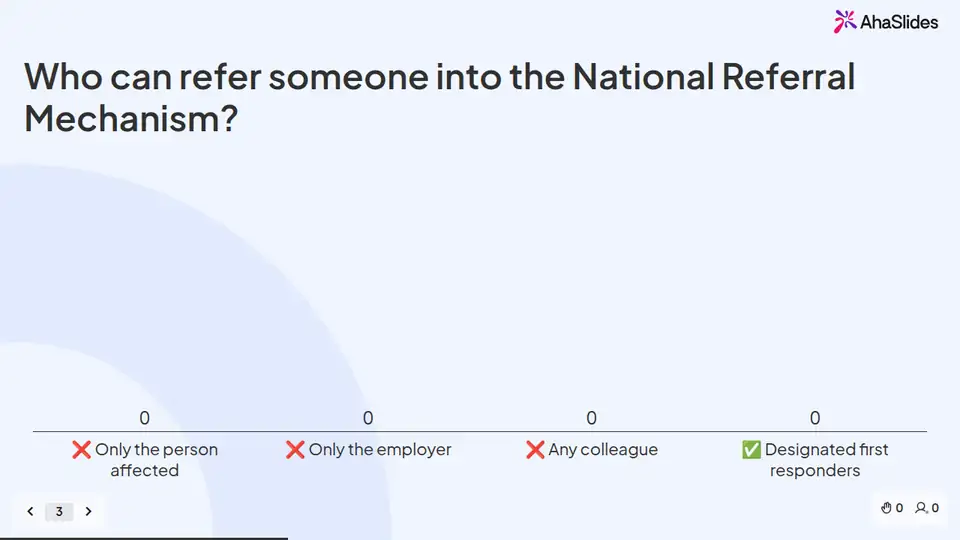
Which of these is a form of modern slavery under the Act?
Answer: Being made to work under threat, with no real choice. Forced or compulsory labour means work done under threat or pressure when the person has not freely chosen it. A low wage alone is not modern slavery, though it can sit alongside other indicators.
Lesson 1: Why it matters
You see something worrying at a supplier site. What is the safest first step?
Answer: Note what you saw and report it through the internal channel. Noting facts and reporting through the proper channel protects everyone. Confronting people or posting online can put victims at greater risk.
Lesson 3: What to do (and not do)
In the supplier audit, what is the best outcome to aim for?
Answer: Repayment of fees and safer recruitment. Remediation means putting things right for workers, for example repaying fees. It is a core part of supply-chain due diligence.
Lesson 4: Practice
Northampton shift manager Hannah notices five new agency workers arrive in one van, have no PPE and say the driver keeps their ID "for safety".
Best response: Record, raise with HR/compliance, contact labour provider and GLAA via policy.
Weaker responses: Send them home; Ask the driver to explain.
Modern Slavery Act 2015 s.1 (slavery, servitude, forced or compulsory labour), s.2 (human trafficking), s.3 (exploitation), s.54 (transparency in supply chains - organisations with turnover ≥ £36m, Home Office statutory guidance updated 2025 - verify); Human Trafficking and Exploitation (Scotland) Act 2015; Human Trafficking and Exploitation (Criminal Justice and Support for Victims) Act (NI) 2015.
Courses teams often run alongside this one.

Security Awareness Training

Ethics & Compliance Training

Workplace Safety Training
2 articles from the AhaSlides blog that use this course, newest first.


Comments from trainers
No comments yet. Tell other trainers how the course went.
Your comment
Comments are public. We remove spam and personal details.