
Lesson 1: Why it matters · 5 min
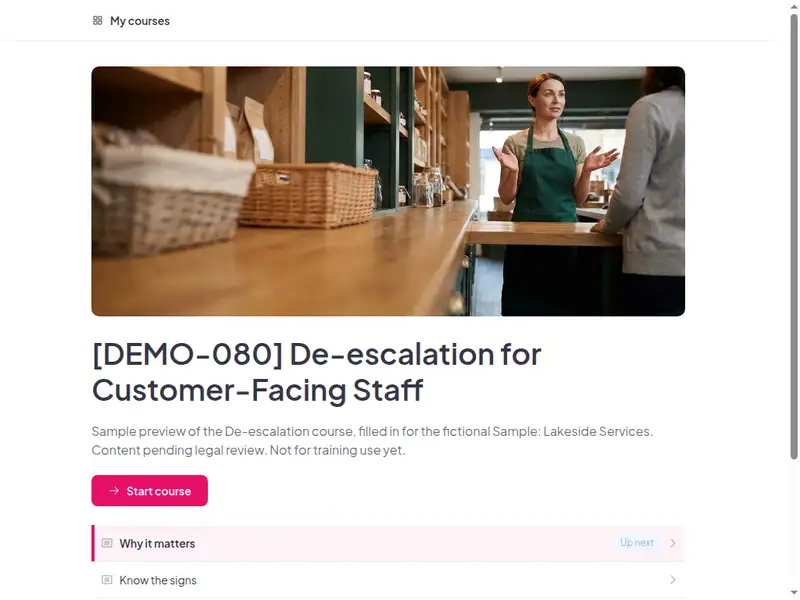
Explain why customer aggression happens and how your response can escalate or calm it.
Learners sign in, so every finish and score is recorded. 8 fields to fill in with your details.
Minutes are an estimate.
Explain why customer aggression happens and how your response can escalate or calm it.
Recognise the stages of escalation and the warning signs that a situation may turn violent.
Use verbal and non-verbal de-escalation techniques and keep a safe position.
Apply techniques to realistic counter, phone and floor situations.
Know when to disengage, get help and report an incident.
10 questions, 80% to pass. The result is saved to the learner's record.
Taken from the course itself.
A customer is shouting at you. What is the best first move?
Answer: Stay calm and acknowledge how they feel. Staying calm and naming the feeling gives the person a way to settle. Matching their energy usually makes it worse.
Lesson 1: Why it matters
Which phrase is most likely to escalate the situation?
Answer: "Calm down". Telling someone to calm down often makes them angrier. Name the feeling instead.
Lesson 3: What to do (and not do)
What is the most important thing for Priya to keep between herself and the man?
Answer: The barrier. Stay behind the barrier and get help. Do not try to win the argument.
Lesson 4: Practice
Pharmacy tech Luis: customer's prescription isn't ready after 40 minutes, voice rising, others watching.
Best response: Acknowledge, explain specific next step and time, offer a seat.
Weaker response: It's not my fault.
Best practice; OSHA General Duty Clause 29 U.S.C. 654(a)(1) and OSHA workplace violence guidance (e.g. OSHA 3148 for healthcare/social service, late-night retail recommendations); CA Lab. Code 6401.9 (SB 553 - training on the workplace violence prevention plan, annually).
Courses teams often run alongside this one.

Professional Development for Teachers

Workplace Safety Training

Workplace Safety Training
7 articles from the AhaSlides blog that use this course, newest first.







Comments from trainers
No comments yet. Tell other trainers how the course went.
Your comment
Comments are public. We remove spam and personal details.