Skip to content
Claim this template

Free course template · US federal

Ladder safety

A ready-made course, live deck and two surveys for employees. 25 minutes, 7 lessons, 10-question final check. Last reviewed 8 October 2026; not legal advice.

Claim the templatePreview the courseDownload SCORM for your LMS

Free. No credit card. Edit everything.

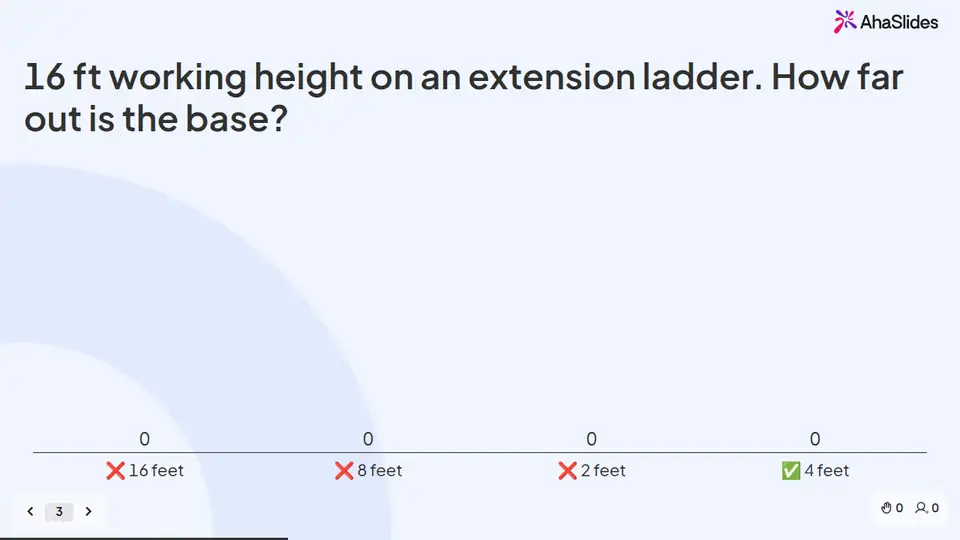
Play a game from the course

Ladder safety: try 3 questions

Three questions from this course. Pick an answer, then see why.

Play the game

Game not loading? Open it in a new tab (opens in a new tab)

Three pieces that work together

Learners sign in, so every finish and score is recorded. 6 fields to fill in with your details.
Claim the template
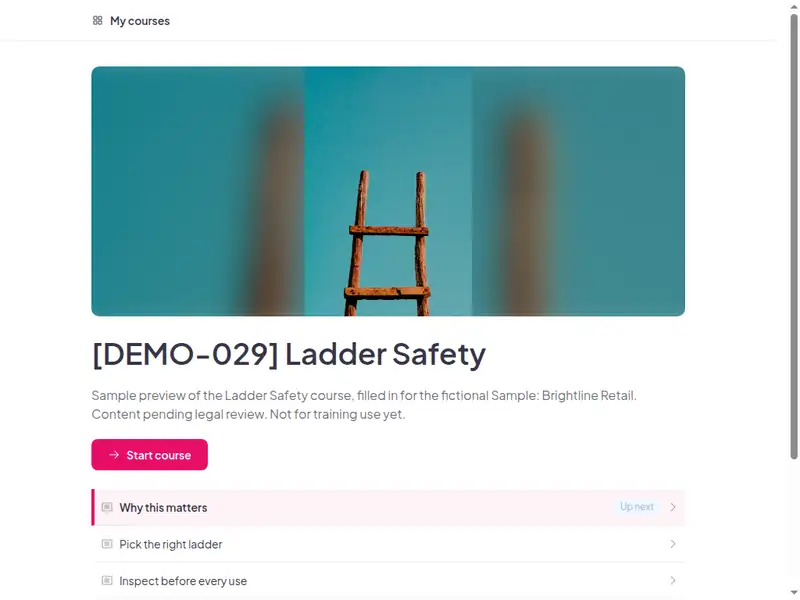
The Ladder safety course as a learner first sees it

7 lessons, about 25 minutes

Minutes are an estimate.

  • Lesson 1: Why this matters · 4 min

    Explain why ladder falls cause serious injuries even from low heights.

  • Lesson 2: Pick the right ladder · 4 min

    Choose the right ladder type, length and duty rating for the job.

  • Lesson 3: Inspect before every use · 4 min

    Inspect a ladder before first use each shift and tag damaged ladders out of service.

  • Lesson 4: Set up & climb safely · 5 min

    Set up a portable ladder correctly (footing, angle, 3 ft above landing, locks).

  • Lesson 5: Fixed ladders & your workplace · 3 min

    Climb and work safely: face the ladder, keep contact, no heavy loads.

  • Lesson 6: When things go wrong · 2 min

    Know fixed-ladder fall protection and where your site's ladders are kept.

  • Lesson 7: Final assessment · 3 min

    10 questions, 80% to pass. The result is saved to the learner's record.

Claim the template

Inside this course

Taken from the course itself.

Sample questions, with answers

  1. A technician falls from a stepladder at about six feet. What is the safest conclusion?

    • Low heights can still cause serious injury
    • Falls under ten feet are harmless
    • Only extension ladders are risky
    • The floor does not matter

    Answer: Low heights can still cause serious injury. Serious injuries and deaths happen from ladder falls at modest heights. Treat every ladder job with care.

    Lesson 1: Why this matters

  2. Which ladder is the better choice near overhead power lines?

    • Aluminum
    • Fiberglass, and keep clear of the lines
    • Any ladder if you are quick
    • A wet wooden ladder

    Answer: Fiberglass, and keep clear of the lines. Fiberglass does not conduct like aluminum, but you should still stay at least 10 feet from overhead power lines (more for high-voltage lines).

    Lesson 2: Pick the right ladder

  3. You find a loose rung on a ladder. What do you do?

    • Use it carefully
    • Tape the rung
    • Tag it out and report it
    • Skip that rung

    Answer: Tag it out and report it. A defective ladder must be removed from service until it is repaired or replaced.

    Lesson 3: Inspect before every use

A scenario from "When things go wrong"

Retail stockroom: you need to reach a box on the top shelf, the only stepladder has a cracked rail and the shift ends in 10 minutes.

Best response: Tag it out, report, get another ladder or help.

Weaker responses: Climb carefully; Stand on a shelf.

Legal basis

29 CFR 1910.23 (ladders); 1910.30(b) (training on equipment hazards, incl. ladders); 1910.28(b)(9) (fixed ladders > 24 ft).

Related articles

An article from the AhaSlides blog that uses this course.

Common questions

Yes. Claiming the template and editing it are free.

The course itself is self-paced and online, and the live deck lets you add a live session. Whether online delivery meets your local rules depends on the law that applies to you, so check 29 CFR 1910.23 (ladders) or ask your own counsel.

Before first ladder use + retraining when conditions/equipment change or knowledge is inadequate (1910.30(c)).

Employees who use portable or fixed ladders (maintenance, retail stocking, warehouse, facilities, custodial, telecom).

Record completion in your own LMS or record system, so you can show who finished the course and when. Check the retention period that applies to you in 29 CFR 1910.23 (ladders).

Your own details, each highlighted inside the course:
  • Damaged ladder tagout process
  • Fixed ladder locations and systems
  • Ladder storage locations
  • Tasks requiring ladder or lift
  • First aid contact
  • LMS or record system
Then edit anything else you like: wording, scenarios, your logo.
Visit the help centre (opens in a new tab)