Skip to content
Claim this template

Free course template · US federal

Slips, trips & falls (walking-working surfaces)

A ready-made course, live deck and two surveys for all employees. 25 minutes, 7 lessons, 10-question final check. Last reviewed 8 October 2026; not legal advice.

Claim the templatePreview the courseDownload SCORM for your LMS

Free. No credit card. Edit everything.

Play a game from the course

Slips, trips & falls (walking-working surfaces): try 3 questions

Three questions from this course. Pick an answer, then see why.

Play the game

Game not loading? Open it in a new tab (opens in a new tab)

Three pieces that work together

Learners sign in, so every finish and score is recorded. 6 fields to fill in with your details.
Claim the template
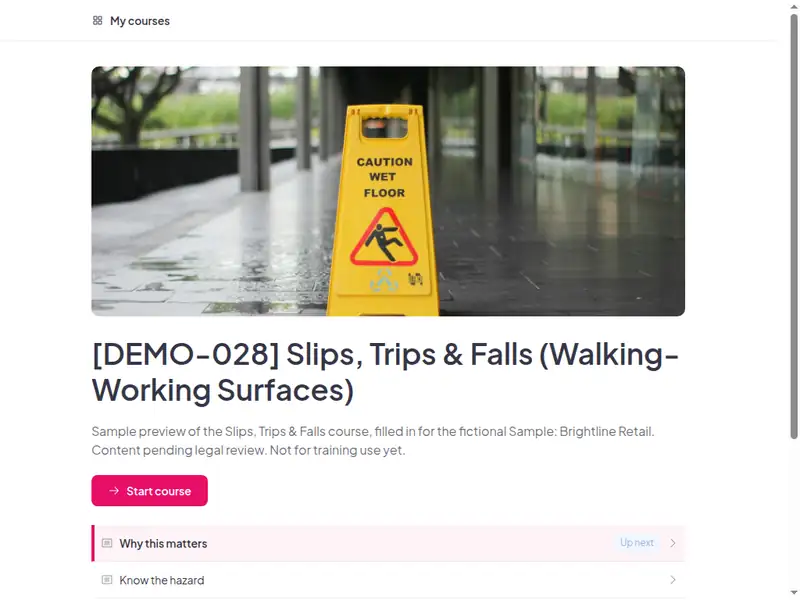
The Slips, trips & falls (walking-working surfaces) course as a learner first sees it

7 lessons, about 25 minutes

Minutes are an estimate.

  • Lesson 1: Why this matters · 4 min

    Explain why same-level falls are a leading cause of workplace injury.

  • Lesson 2: Know the hazard · 5 min

    Distinguish slip, trip and fall-from-height hazards and their causes.

  • Lesson 3: Control the hazard · 5 min

    Apply housekeeping and surface-condition rules (clean, dry, free of hazards).

  • Lesson 4: Edges, holes & docks · 3 min

    Use safe walking habits, footwear and stairs.

  • Lesson 5: Your workplace · 2 min

    Recognise unprotected edges, holes and openings and stay away from them.

  • Lesson 6: When things go wrong · 3 min

    Report and control hazards in your area, including spills and weather.

  • Lesson 7: Final assessment · 3 min

    10 questions, 80% to pass. The result is saved to the learner's record.

Claim the template

Inside this course

Taken from the course itself.

Sample questions, with answers

  1. A small drip is on the floor of an aisle and you have no mop nearby. What do you do first?

    • Guard the spot or put up a sign, then report it
    • Step around it and keep walking
    • Wait for someone to complain
    • Cover it with a loose paper towel

    Answer: Guard the spot or put up a sign, then report it. If you see a hazard, act: make it safe for others if you can do so safely, then report it so it gets fixed.

    Lesson 1: Why this matters

  2. Which of these is a trip hazard?

    • A freshly mopped floor
    • A cord across a walkway
    • Ice in the parking lot
    • A wet loading dock

    Answer: A cord across a walkway. A cord on the floor is something a foot can hit. Wet and icy surfaces are slip hazards.

    Lesson 2: Know the hazard

  3. When you walk on an icy surface, what helps most?

    • Long, quick strides
    • Hands in your pockets
    • Short, flat-footed steps
    • Looking at your phone

    Answer: Short, flat-footed steps. A short, slow, flat-footed step keeps your weight over your feet.

    Lesson 3: Control the hazard

A scenario from "When things go wrong"

Hospital corridor: you notice a spilled cup of coffee near patient rooms while carrying linens.

Best response: Stay with spill or place sign, call EVS, then continue.

Weaker response: Someone else will report it.

Legal basis

29 CFR 1910 Subpart D - esp. 1910.22 (general requirements), 1910.28 (duty to have fall protection), 1910.30(a)-(c) (training).

Related articles

3 articles from the AhaSlides blog that use this course, newest first.

Common questions

Yes. Claiming the template and editing it are free.

The course itself is self-paced and online, and the live deck lets you add a live session. Whether online delivery meets your local rules depends on the law that applies to you, so check 29 CFR 1910 Subpart D or ask your own counsel.

At hire + when hazards/equipment change or retraining is needed (1910.30(c)); annual refresher best practice.

All employees; examples drawn from retail floors, warehouses, commercial kitchens, hospitals and parking lots.

Record completion in your own LMS or record system, so you can show who finished the course and when. Check the retention period that applies to you in 29 CFR 1910 Subpart D.

Your own details, each highlighted inside the course:
  • Spill kit and sign locations
  • Site slip trip hot spots
  • Footwear policy
  • Hazard reporting method
  • First aid contact
  • LMS or record system
Then edit anything else you like: wording, scenarios, your logo.
Visit the help centre (opens in a new tab)