Picking the topic is the hardest part of a technology presentation. Choose something too broad and you skim the surface; choose something too niche and half the room switches off. This guide gives you 20 technology topics for a presentation, each with an angle you can take, and a four-question method to choose the one that suits your audience.
Whether you are a student giving a first class talk or a professional presenting to colleagues, the steps are the same: know who is listening, define the topic tightly, be clear about why it matters, and plan when and where you will deliver it.
Step 1: who is your target audience?
The right technology topic depends on who is in the room. Check three things:
- Ιστορικό. A room of engineers can take a specialised topic such as edge computing. A mixed audience needs a broader topic with plain-language examples.
- Τα ενδιαφέροντα. Do they care about business results, ethics, or how the technology works? A topic about AI suits all three, but the angle changes each time.
- Τεχνική γνώση. If most people are beginners, define each term once and use one running example. If they are experts, skip the basics and go straight to trade-offs.
A quick way to find out is to ask. Send a one-question poll before the session, or open with a live poll and adapt your talk to the result (see the interactive section below).
Step 2: what is your technology topic?
Start broad, then narrow it in four moves:
- Pick a technology area you find interesting, such as artificial intelligence, cybersecurity or renewable energy.
- Read recent coverage to see what is changing. IEEE Spectrum και MIT Technology Review both cover new technology in plain language, and the Δείκτης Τεχνητής Νοημοσύνης Στάνφορντ tracks artificial intelligence in detail each year.
- Narrow to one question the audience can answer by the end, for example "How can small teams protect themselves from phishing?" rather than "Cybersecurity".
- Check the time. Ten minutes covers one idea well; thirty minutes can cover three.
Step 3: why this topic?
Know your purpose before you build slides. It decides what you include:
- Για να εκπαιδεύσει: explain how the technology works and where it is used.
- To persuade: argue that your audience should adopt it, or avoid it, and back each point with evidence.
- To inspire: tell the story of a team or product that changed something.
- To raise awareness: cover the risks and ethical questions, such as privacy or bias.
Step 4: when and where will you present?
The setting shapes the talk. For an in-person event, check the room, the screen and the sound. For an online session, check your connection, camera and a quiet space. In both cases, have a backup of your slides and keep demos short, because live demos are the part most likely to fail.
20 technology topics for presentation
Each topic below comes with an angle. Pick one, then find two or three credible sources before you write the slides.
Artificial intelligence and data
- Γενετική Τεχνητή Νοημοσύνη στην εργασία. Where it saves time (drafting, summarising, coding help) and where a human still has to check the output.
- AI in healthcare. Applications such as image analysis and note-taking, with the benefits and the risks of errors and privacy.
- πράκτορες AI. Software that plans and carries out several steps on its own. What should it be allowed to do without asking?
- Data science and predictive analytics. How organisations turn data into decisions, and why the quality of the data matters more than the model.
- Deepfakes and synthetic media. How fake audio and video are made, and practical ways to spot and respond to them.
Security and identity
- Cybersecurity basics. Phishing, weak passwords and unpatched software. The NIST Framework Cybersecurity gives a structure you can borrow.
- Passkeys and biometric authentication. Why logging in with your face, fingerprint or a passkey can be both easier and safer than a password.
- Blockchain beyond cryptocurrency. Supply chains, records and digital identity, and where a plain database would do the job better.
Infrastructure and devices
- Cloud computing The main models (public, private, hybrid) and how to choose between them.
- Υπολογισμός ακμών. Processing data close to where it is created to cut delay, for example in factories and vehicles.
- The Internet of Things and smart homes. Convenience against security, and what happens when a connected device stops being updated.
- 5G and faster networks. What a faster connection makes possible, and where it matters less than people expect.
- Κβαντική Υπολογιστική. What it is, why it is hard to build, and why it is already a topic in security planning.
Making and moving things
- Robotics and automation in manufacturing. What robots do well, what people still do better, and how jobs change.
- Τρισδιάστατη εκτύπωση. From prototypes to custom medical parts and homes. Which uses have really taken off?
- Αυτόνομα οχήματα. The levels of automation, and what is holding back fully driverless cars.
- Renewable energy technologies. Solar, wind and storage. Frame it around a decision, such as what a university campus should install first.
People and experiences
- Augmented reality in education. How overlaying digital models on the real world can help students understand shapes, anatomy or machines.
- Virtual reality for training and simulation. Safe practice for high-risk jobs, and how to measure whether it works.
- Digital payments and e-commerce. How tap-to-pay, wallets and buy-now-pay-later changed how people spend, and the risks that came with them.
Structure your technology presentation
A simple structure works for almost any of these topics:
- Hook (1 to 2 minutes). A question, a surprising fact or a short story.
- The problem or opportunity (2 to 3 minutes). Why this technology matters to this audience.
- How it works (3 to 5 minutes). One diagram and one example.
- Benefits and risks (2 to 3 minutes). Be fair to both sides.
- What to do next (1 minute). One action the audience can take.
Make your technology presentation interactive
A technology talk can easily become a stream of terms. A few interactive moments keep the audience involved and tell you what they already know.
- Open with a poll to find out what people use or worry about, then adjust your examples to the answer.
- Use a word cloud to collect first reactions, for example "Describe AI in one word".
- Finish with questions. An anonymous Q&A lets people ask what they were afraid to ask out loud.
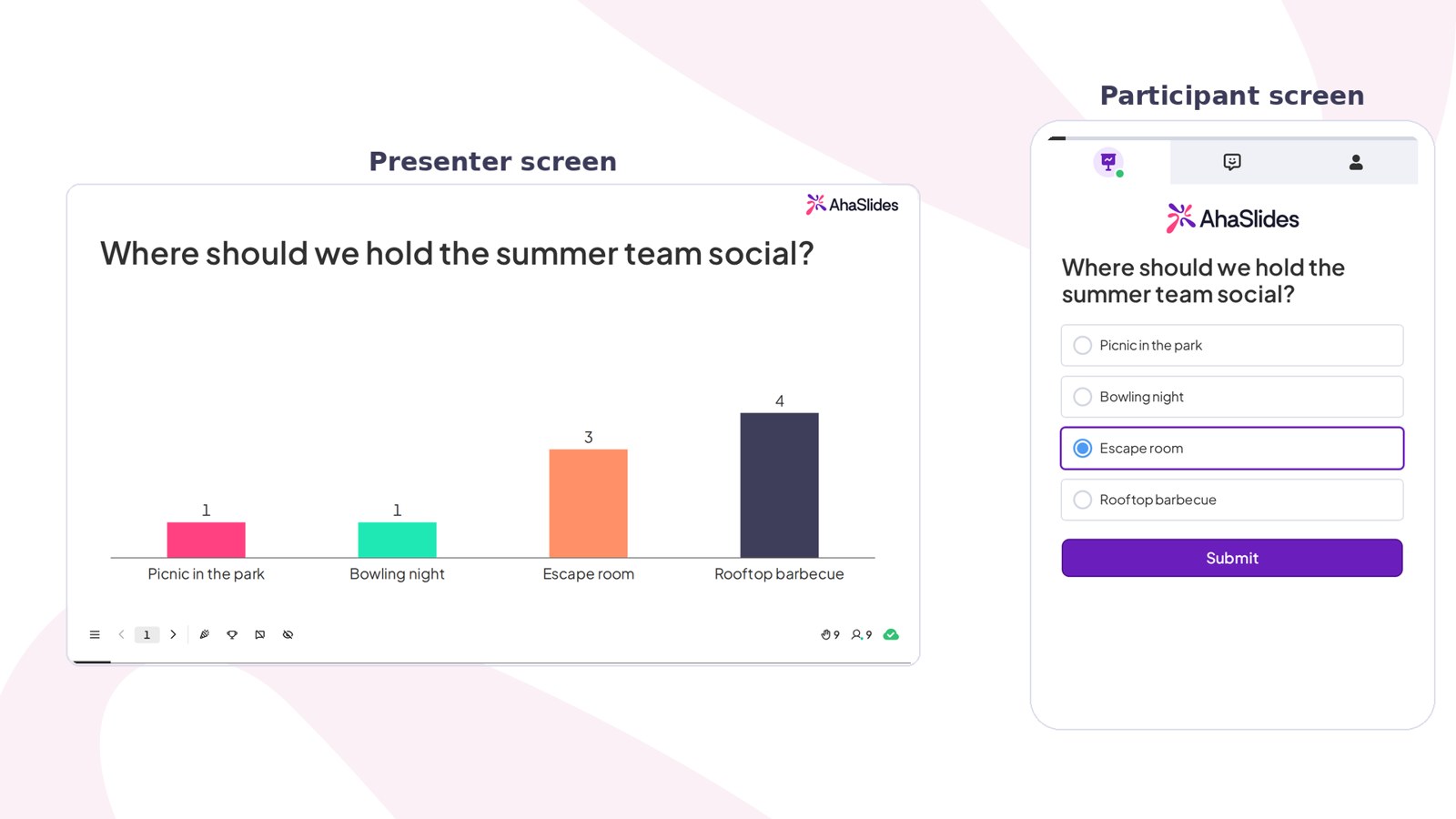
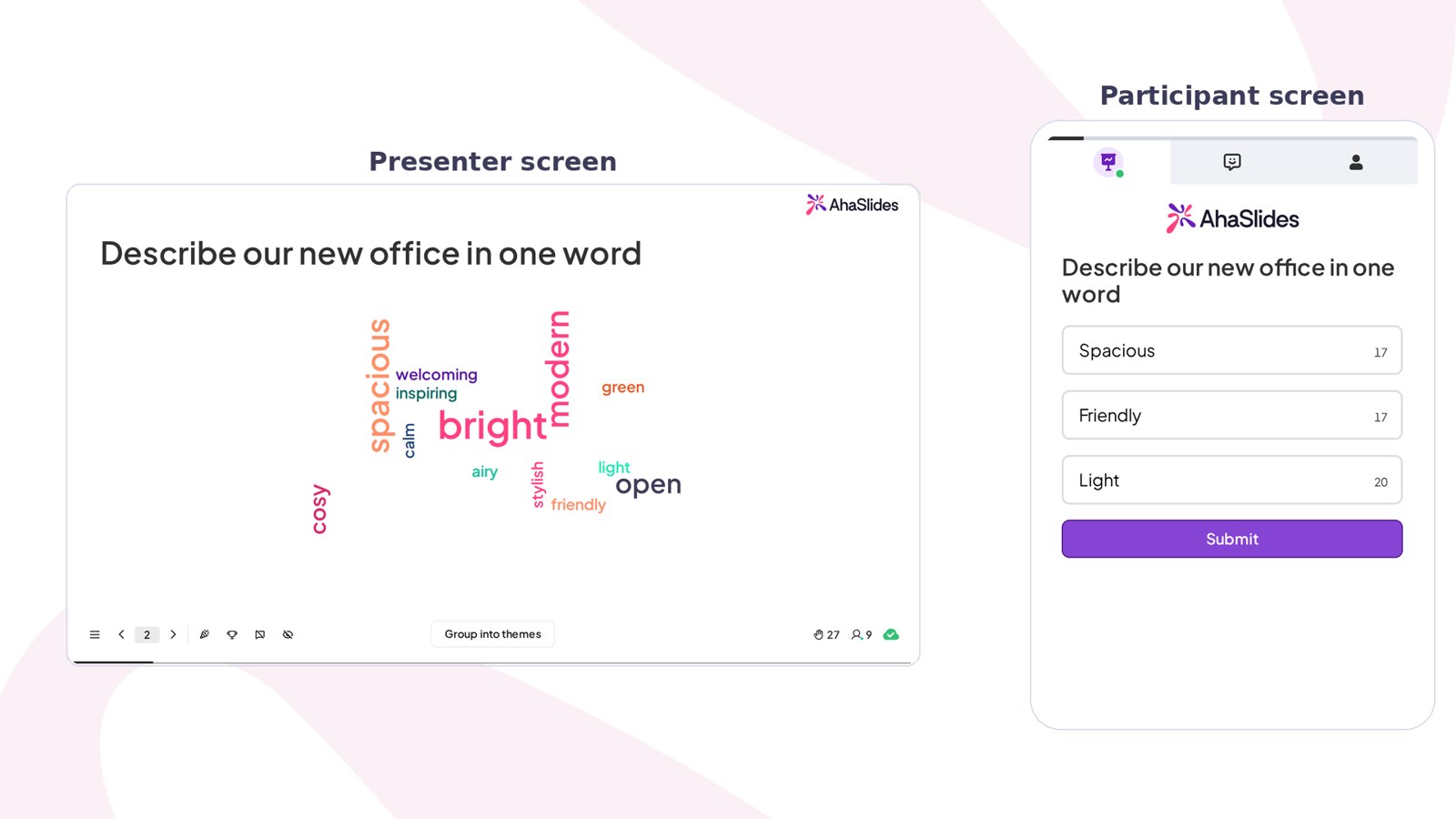
Both are quick to set up with the live poll maker και την γεννήτρια σύννεφων λέξεων. Participants join from their phones with a code, and the free plan allows up to 50 participants.
Βασικά καραβάνια
- Choose the topic after you know your audience, not before.
- Narrow a broad area to one question the audience can answer.
- Know your purpose: educate, persuade, inspire or raise awareness.
- Back every point with a credible source, and keep demos short.
- Add a poll, word cloud or Q&A so the audience takes part.
Συχνές ερωτήσεις
What is a good technology topic for a presentation?
A good topic is narrow enough to cover in your time slot, relevant to your audience, and has credible sources you can cite. "How passkeys replace passwords" works better than "Cybersecurity".
How long should a technology presentation be?
Match the time you are given. For a 10-minute slot, cover one idea; for 30 minutes, three ideas with a short interactive moment between them.
How do I explain a complex technology to beginners?
Define each term once, use one running example from everyday life, and show a single diagram rather than several. Check understanding with a quick poll.
Where can I find reliable sources for a technology talk?
Start with standards bodies and research groups, such as NIST για την ασφάλεια και την Δείκτης Τεχνητής Νοημοσύνης Στάνφορντ for AI, and with technology publications such as IEEE Spectrum.