
Great ideas rarely arrive fully formed. Most come from a repeatable process: define the problem, produce many options, then narrow them down. The good news is that the middle step, generating ideas, can be practised like any other skill.
This guide explains what the idea generation process is, why it matters at work, and ten techniques you can use alone or with a team, with notes on when each one fits.
What is the idea generation process?
The idea generation process (often called ideation) is the stage of innovation where you produce as many possible ideas as you can before judging any of them. It sits between understanding a problem and choosing a solution. Keeping generation and evaluation apart is the point: if people criticise ideas as they appear, fewer ideas appear.
A simple version has four steps:
- Define the challenge as a clear question, such as How might we make our Monday meeting 15 minutes shorter?
- Tuottaa a large number of ideas with one or more techniques below.
- Group and select the strongest ideas, using votes or agreed criteria.
- Testi the best ones in small steps before committing.
Why the idea generation process matters
New products, campaign angles, service improvements and team names all start as ideas. Teams that generate ideas on purpose, rather than waiting for inspiration, tend to find options they would otherwise miss. Some common places it shows up:
- Markkinointi: campaign concepts, ad angles and blog aiheista.
- Product and startups: new features, brand names and positioning.
- operaatiot: ways to remove waste or speed up a process.
- Koulutus: project topics, discussion prompts and class activities. For classroom-ready formats, see our brainstorming activities for students.
10 idea generation techniques
1. Mind mapping and concept maps
Write the central topic in the middle of a page, then branch out into sub-topics, adding colours or small images as you go. A mind map shows the big picture and the detail at once, which makes gaps easy to spot. A concept map is a close cousin: it labels the lines between ideas (such as ‘causes’ or ‘is part of’), so it suits topics where the relationships matter more than the hierarchy.
Paras: planning, studying and untangling a broad topic.
2. Attribute listing
Break a product, service or problem into its parts, such as size, price, materials, users and delivery. Then ask how each part could change. Listing attributes turns one vague challenge into many small, workable ones.
Paras: improving something that already exists.
3. Reverse brainstorming
Flip the question. Instead of ‘How can we get more people to subscribe?’, ask ‘How could we make sure nobody subscribes?’ List every answer, then turn each one around into a fix. Looking at a problem from the other side often surfaces causes the usual question hides.
Paras: stuck projects and risk checks.
4. Aivokirjoitus
Brainwriting is brainstorming on paper. Everyone writes ideas down silently, then shares or passes them on. This matters because spoken brainstorming has a known weakness. In a classic set of experiments, psychologists Michael Diehl and Wolfgang Stroebe reviewed 22 studies comparing interactive brainstorming groups with the same number of people working alone: in 18, the individuals working alone came out ahead. Their own experiments pointed to ‘production blocking’, the fact that only one person can speak at a time, as the main cause (Diehl and Stroebe, Journal of Personality ja sosiaalipsykologian laitos, 1987). Writing removes that bottleneck and gives quieter people the same space as confident speakers.
Paras: mixed groups and teams where a few voices dominate.
5. KILPAILU
SCAMPER is a checklist of seven prompts you apply to an existing idea:
- korvike a part, material or person.
- Yhdistää it with something else.
- sopeuttaa it to a new setting.
- Muuttaa its size, shape or frequency.
- Käytä muuhun käyttöön for a different audience.
- Poistaa whatever is not essential.
- Reverse or rearrange the order or roles.
Run through the prompts one at a time and write at least one idea per letter.
Paras: improving products, lessons and processes.
6. Roolileikki
Ask people to take on a role, such as a first-time customer, a sceptical manager or a competitor, and respond to the challenge from that point of view. Stepping into someone else’s shoes brings out needs and objections you would not think of speaking as yourself.
Paras: customer-facing work and service design.
7. ‘How might we’ questions
Good ideas follow good questions. Rewrite the problem as ‘How might we…?’, which is open enough to invite many answers but specific enough to act on. If people hesitate to ask questions in front of colleagues, collect them anonymously first. Questions also make useful warm-ups: a short sana pilvi asking for one word that describes the challenge gets everyone typing within seconds.
Paras: framing a problem before you generate answers.
8. Live collaborative brainstorming
When the team is remote or the group is large, collect ideas on a shared board in real time. In AhaSlides, an idea board slide lets participants post ideas from their phones, sort them into groups you set up in advance, and then vote for their favourites. Submitting and voting are separate steps, so early ideas do not anchor everyone else.
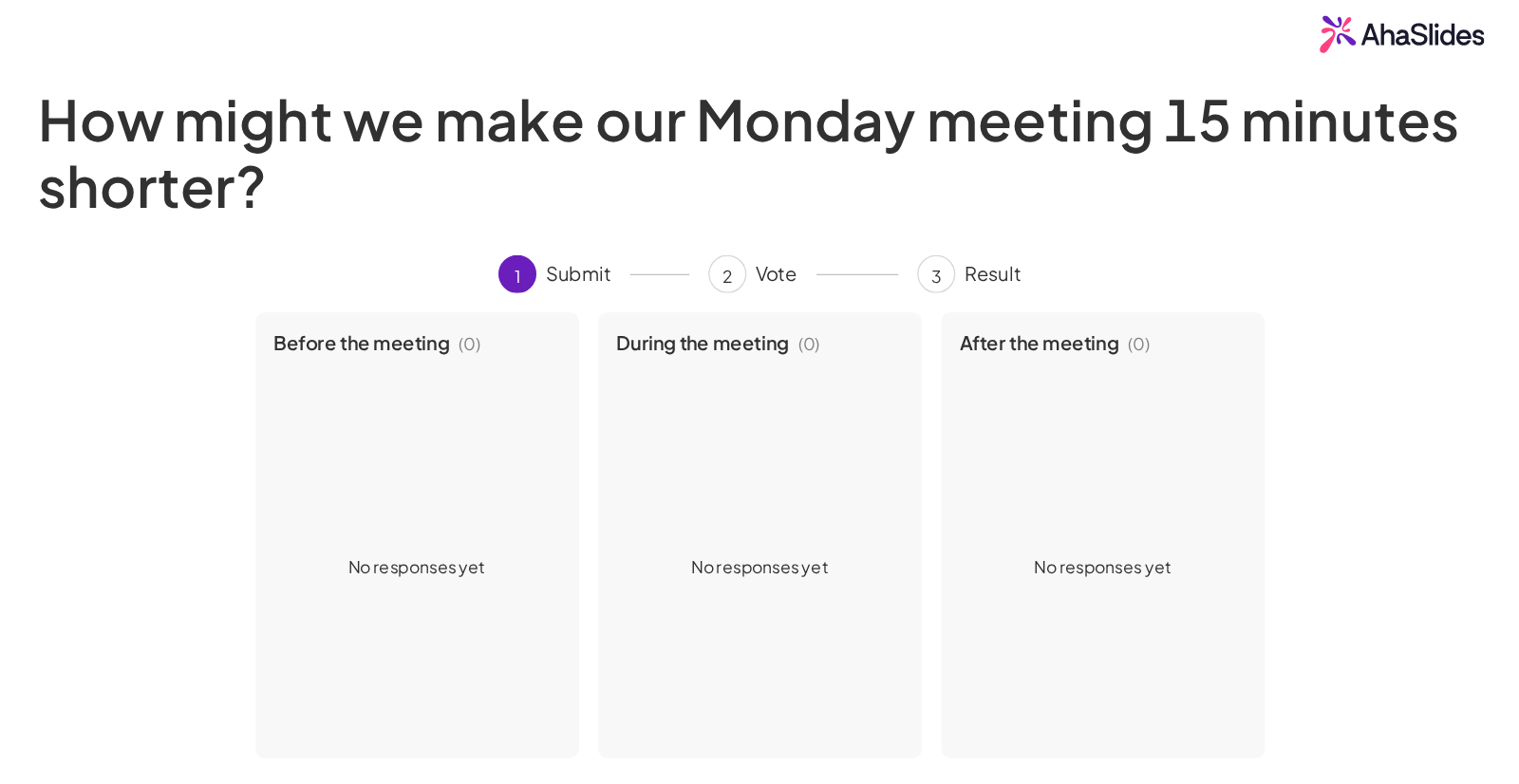
To run one, create an idea board slide, type your ‘How might we’ question as the title, add groups if you want ideas sorted as they arrive, and switch on voting. Our guide to online brainstorming kattaa laajemman asetelman.
Paras: distributed teams, workshops and large groups.
9. Synectics
Synectics uses analogy to solve problems. Participants compare the problem with something unrelated, such as a beehive, an airport or a river, and borrow ideas from the comparison. The method was developed by William J. J. Gordon and George Prince while they worked together at Arthur D. Little, and set out in Gordon’s 1961 book (Synectics World). It works best with a facilitator and a group of people from different backgrounds.
Paras: hard problems that need a fresh angle.
10. Kuusi ajatteluhattua
Edward de Bono’s method gives each person, or each round of discussion, one thinking mode at a time. White is facts, red is feelings and hunches, black is risks, yellow is benefits, green is new ideas and blue manages the process (De Bono Group). Because everyone wears the same hat at once, the group stops arguing across modes. Use green-hat time to generate and the other hats to test.
Paras: structuring a discussion and stopping early criticism.
How to choose a technique
| Jos sinun täytyy… | Yrittää |
|---|---|
| Make sense of a broad topic | Mind mapping or concept maps |
| Improve something that exists | Attribute listing or SCAMPER |
| Get past a stuck point | Reverse brainstorming or synectics |
| Include quieter people | Brainwriting or an anonymous idea board |
| Work with a remote or large group | Live collaborative brainstorming |
| Structure a heated discussion | Kuusi ajattelua |
Tips for a better session
- Separate generating from judging. Collect first, evaluate later.
- Set a number target. Asking for 20 ideas in 10 minutes pushes people past the obvious ones.
- Mix techniques. Start alone (brainwriting), then share on a board, then vote.
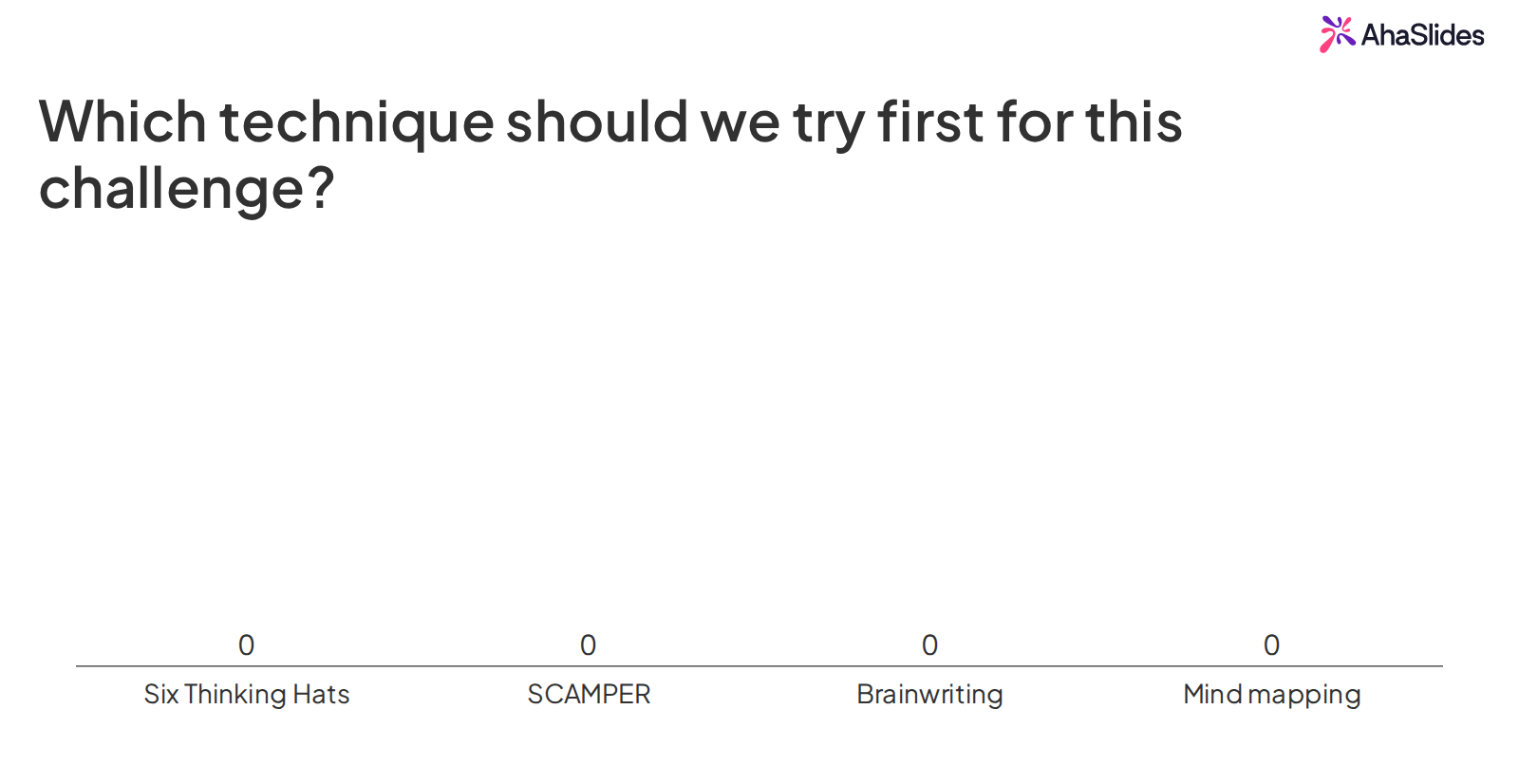
- Narrow with votes. A short poll turns a long list into a shortlist in one click.
Avaimet
- The idea generation process is define, generate, select and test. Keep generating and judging apart.
- Writing ideas down before sharing them avoids the one-speaker-at-a-time limit of spoken brainstorming.
- Pick the technique to fit the problem: SCAMPER for existing things, reverse brainstorming for stuck ones, an idea board for remote groups.
- Finish with a vote so the session ends with a shortlist, not a pile of notes.
Usein kysyttyjä kysymyksiä
What are the four ways of generating ideas?
Four dependable ways are asking questions, writing ideas down, making connections between unrelated things (analogy and mind mapping), and experimenting with the ideas you already have.
Mikä on suosituin ideointitekniikka?
Brainstorming is the best known and the most widely used, in business and in education. Brainwriting, SCAMPER and mind mapping are common alternatives when spoken brainstorming stalls.
How many ideas should a session produce?
Aim for quantity first. There is no fixed number, but setting a target such as 20 ideas in 10 minutes keeps people moving past the obvious answers.
Can I run idea generation online?
Kyllä. An online idea board lets people submit and vote from their phones, in the room or remotely.