Science trivia is the round that turns a quiz into a conversation. One question about octopus hearts or how fat leaves your body, and suddenly the whole room is debating biology. Whether you are a teacher looking for a lesson starter, a quizmaster building a pub round or a parent planning a family game night, these science trivia questions cover space, the human body, chemistry, physics and the natural world.
We have split the 60 questions into an easy round of 25, a hard round of 25 and a fill-in-the-blank bonus round of 10, with every answer right beneath its question. Science moves on (Saturn keeps gaining moons, for one), so we re-checked every answer in September 2026 against sources such as NASA and NOAA, and corrected a few that older quiz lists still get wrong.
Easy science trivia questions
Start here with younger players or a mixed crowd. Most of these come up in school science lessons. Our pick: “How many hearts does an octopus have?”, because hardly anyone believes the answer the first time.
Space and astronomy7 kysymykset
1Which Apollo mission was the first to carry a lunar rover to the Moon?
VastausApollo 15, in 1971.
2What was the name of the first artificial satellite, launched by the Soviet Union in 1957?
VastausSputnik 1.
3Which dog, launched on Sputnik 2 on 3 November 1957, became the first animal to orbit the Earth?
VastausLaika.
4Kuka oli ensimmäinen nainen avaruudessa?
VastausValentina Tereshkova, in 1963.
5Which astronomer proposed that the Sun, not the Earth, sits at the centre of our solar system?
VastausNikolaus Kopernikus.
6Which planet spins the fastest, completing one rotation in about 10 hours?
VastausJupiter.
7Roughly how long does sunlight take to reach Earth: 8 minutes, 8 hours or 8 days?
VastausNoin 8 minuuttia.
Ihmisruumis7 kysymykset
8Of the eight main blood types, which is the rarest worldwide?
VastausAB negative.
9Where in the human body are the smallest bones?
VastausThe middle ear.
10How many teeth does a full adult set have, including wisdom teeth?
Vastaus32.
11True or false: your hair and your nails are made from the same protein.
VastausTrue. Both are made of keratin.
12Where on the body is skin most densely packed with sweat glands?
VastausThe soles of the feet.
13How many bones are in the adult human body?
Vastaus206.
14What is the process of breaking down food in the body called?
VastausRuoansulatus.
Animals and the Earth5 kysymykset
15What are the three main layers of the Earth?
VastausThe crust, the mantle and the core.
16Mihin eläinryhmään sammakot kuuluvat?
VastausAmphibians.
17How many bones does a shark have?
VastausNone. A shark’s skeleton is made of cartilage.
18Kuinka monta sydäntä mustekalalla on?
VastausKolme.
19Voiko salama iskeä samaan paikkaan kahdesti?
VastausYes. Tall buildings are struck many times a year.
Physics, chemistry and inventions6 kysymykset
20Mitä optiikka tutkii?
VastausValo.
21Mitä DNA tarkoittaa?
VastausDeoxyribonucleic acid.
22Who is usually credited with inventing the telephone?
VastausAlexander Graham Bell.
23True or false: sound travels faster in air than in water.
VastausFalse. Sound travels about four times faster in water.
24Mikä on maapallon kovin luonnollinen aine?
VastausTimantti.
25What is the scientific word for a push or a pull?
VastausVahvuus.
Hard science trivia questions
Ready for a challenge? These difficult science questions suit older students, science fans and competitive quiz teams. Our pick: “When you lose body fat, how does most of it leave your body?”, a question most adults get wrong.
Space and the planet5 kysymykset
26Which planet has the most confirmed moons?
VastausSaturn. NASA lists 293 vahvistettua kuuta as of August 2026, far more than any other planet.
27Space travellers from the United States are called astronauts, and from Russia, cosmonauts. Where do taikonauts come from?
VastausKiina.
28Olympus Mons, the tallest volcano in the solar system, is on which planet?
VastausMaaliskuu.
29What is the deepest known point in the Earth’s oceans?
VastausThe Challenger Deep, in the Mariana Trench, about 10,935 metres deep.
30Which gas makes up most of the Earth’s atmosphere?
VastausNitrogen, at about 78%.
The body and medicine8 kysymykset
31Which bone in the human body is not joined to any other bone?
VastausThe hyoid bone, in the neck.
32Which part of the human body is the axilla?
VastausThe armpit.
33When you lose body fat, how does most of it leave your body?
VastausThrough your breath. Research in the BMJ found around 84% is breathed out as carbon dioxide, and the rest leaves as water.
34Which lobe of the brain deals mainly with hearing and language?
VastausThe temporal lobe.
35Bright’s disease affects which organ?
VastausThe kidneys.
36What is a muscle called when it assists the movement of another muscle?
VastausA synergist.
37Which ancient Greek physician is often called the father of medicine?
VastausHippokrates.
38What is the largest part of the human brain?
VastausThe cerebrum.
Animals and life science6 kysymykset
39Animals that are most active at dawn and dusk are called what?
VastausCrepuscular.
40A group of which big cat is called an “ambush”?
VastausTiikerit.
41Which North American canine is known for climbing trees?
VastausThe grey fox.
42True or false: chameleons change colour only to blend into their surroundings.
VastausFalse. They also change colour to communicate and to control their body temperature.
43Which islands did Charles Darwin famously study?
VastausGalápagossaaret.
44What do you call a scientist who studies fossils and prehistoric life, such as dinosaurs?
VastausA palaeontologist.
Fysiikka ja kemia6 kysymykset
45Missä lämpötilassa Celsius ja Fahrenheit ovat yhtä suuret?
Vastaus-40 astetta.
46Which four precious metals are most widely traded?
VastausGold, silver, platinum and palladium.
47What name is given to the claim that hot water can sometimes freeze faster than cold water?
VastausThe Mpemba effect. Scientists still debate when, and whether, it reliably happens.
48Which colour has the longest wavelength in the visible spectrum?
VastausPunainen.
49Which American scientist built an early electromagnetic telegraph in 1831 and gave his name to the SI unit of inductance?
VastausJoseph Henry.
50Which is the only metal that is liquid at room temperature?
VastausElohopeaa.
Bonus round: fill-in-the-blank science questions
Not enough science yet? Try these fill-in-the-blank questions as a tie-breaker or a quick-fire final round. Players have to recall the word rather than recognise it, which makes them harder than they look.
Physics and the Earth4 kysymykset
51The Earth takes about _ hours to spin once on its axis relative to the Sun.
Vastaus24.
52The speed of light in a vacuum is about _ kilometres per second.
Vastaus299,792.
53The force that opposes motion between two surfaces is called _.
VastausKitka.
54The coldest air temperature ever officially recorded on Earth is _.
Vastaus-89.2°C (-128.6°F), at Vostok Station, Antarctica, on 21 July 1983, according to the Maailman ilmatieteen järjestön.
Chemistry and life6 kysymykset
55The chemical formula for carbon dioxide is _.
VastausCO2
56The process plants use to turn sunlight, water and carbon dioxide into food is called _.
VastausFotosynteesi.
57The three everyday states of matter are _, _ and _.
VastausSolid, liquid and gas.
58A chemical reaction that releases heat is called an _ reaction.
VastausExothermic.
59A mixture in which one substance dissolves evenly into another is called a _.
VastausRatkaisu.
60A substance’s ability to resist changes in pH is called its _ _.
VastausPuskurikapasiteetti.
How to make a free science trivia quiz
A quick quiz at the start or end of a lesson is one of the easiest ways to help students recall what they have learnt. Here is how to turn these questions into a live game on AhaSlides.
- Hanki ilmainen AhaSlides -tili.
- Create a new presentation, or start from a science quiz in the template library.
- Add quiz slides and paste in the questions above. Pick Answer slides work well for multiple choice and true or false, and Short Answer slides suit the fill-in-the-blank round, because players type the word instead of choosing it.
- Click Present. Students join by scanning the QR code or entering the join code on their phones, and answer in real time. You can also switch the quiz to self-paced so they can play in their own time.
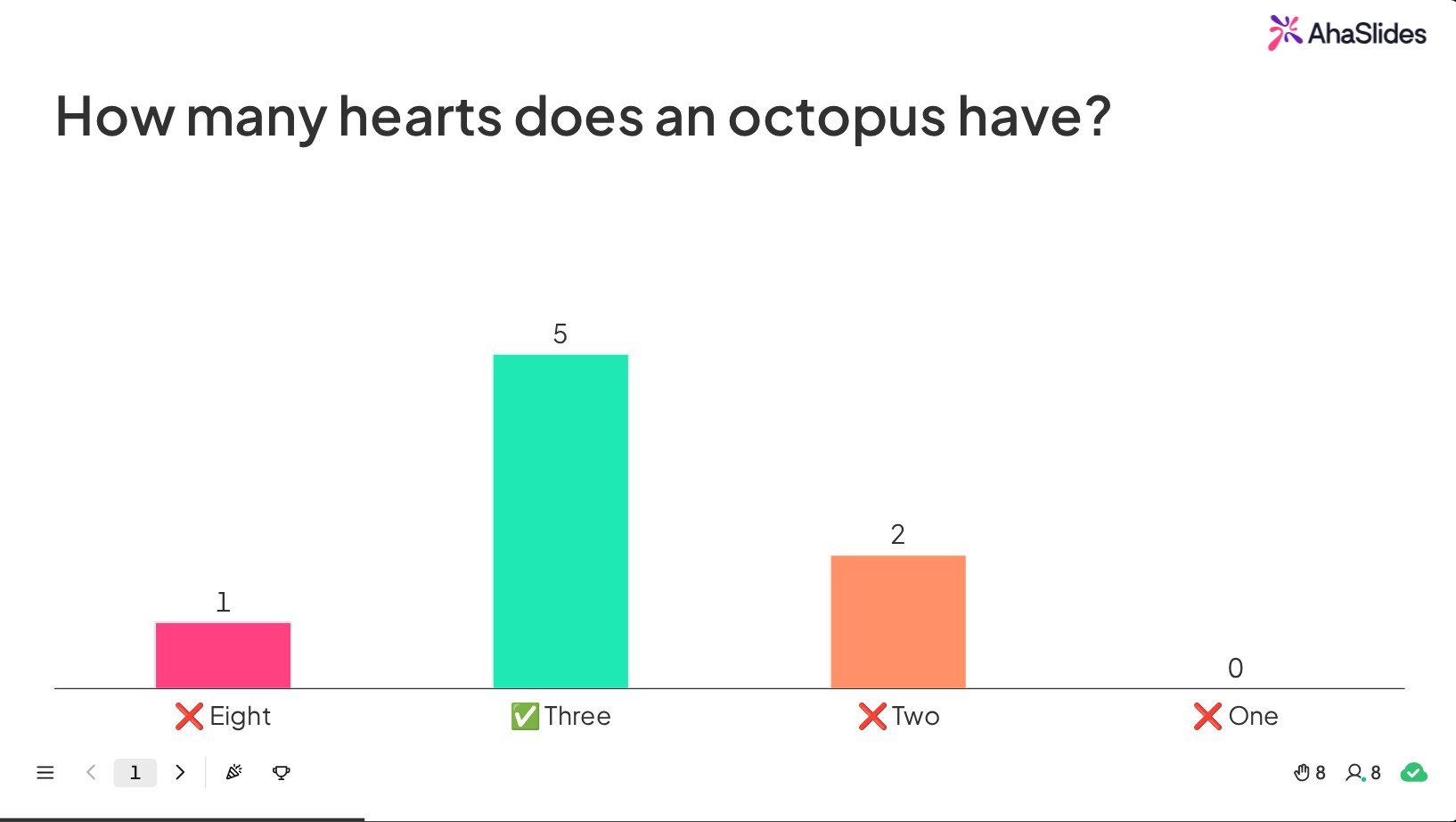
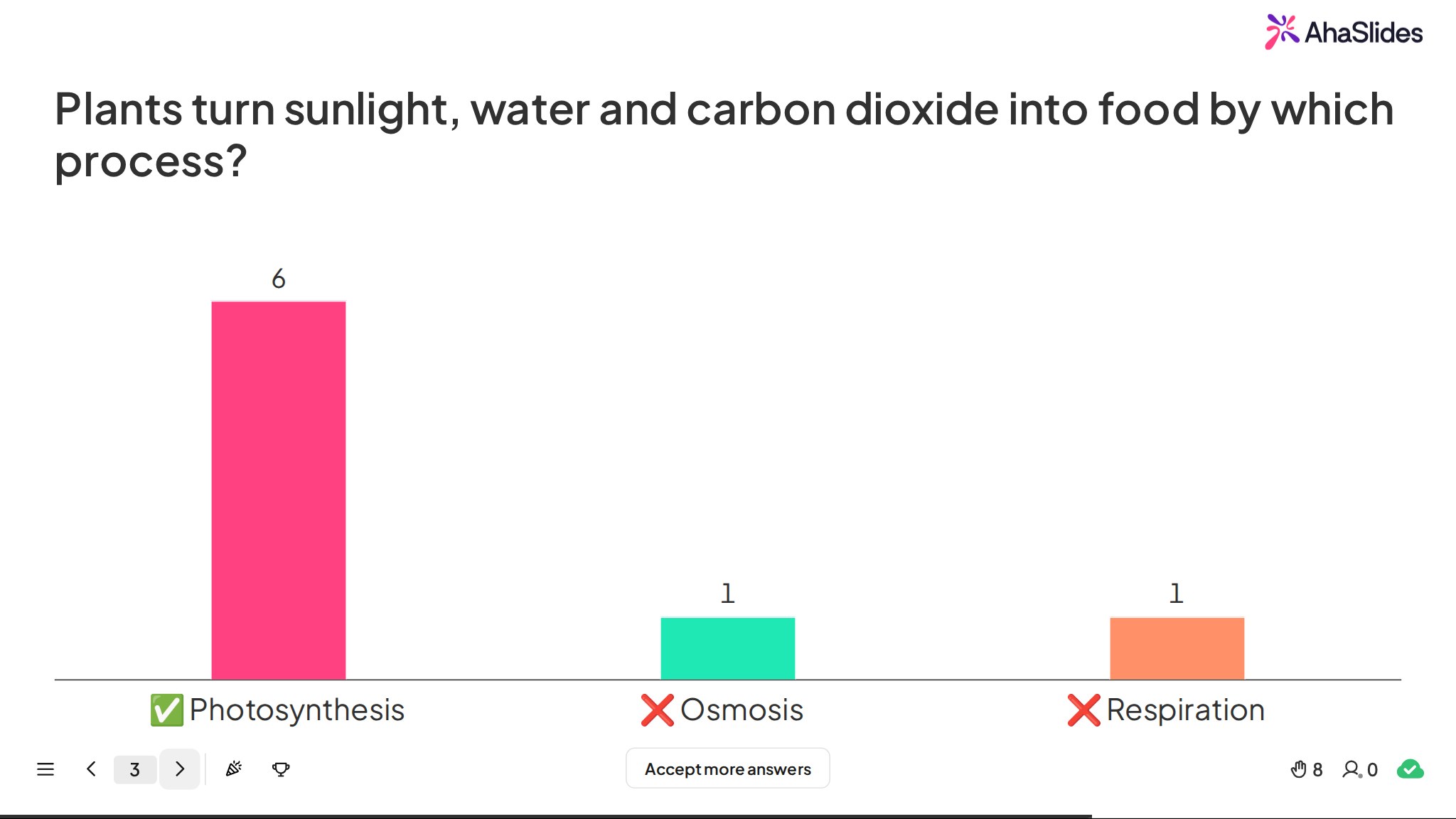
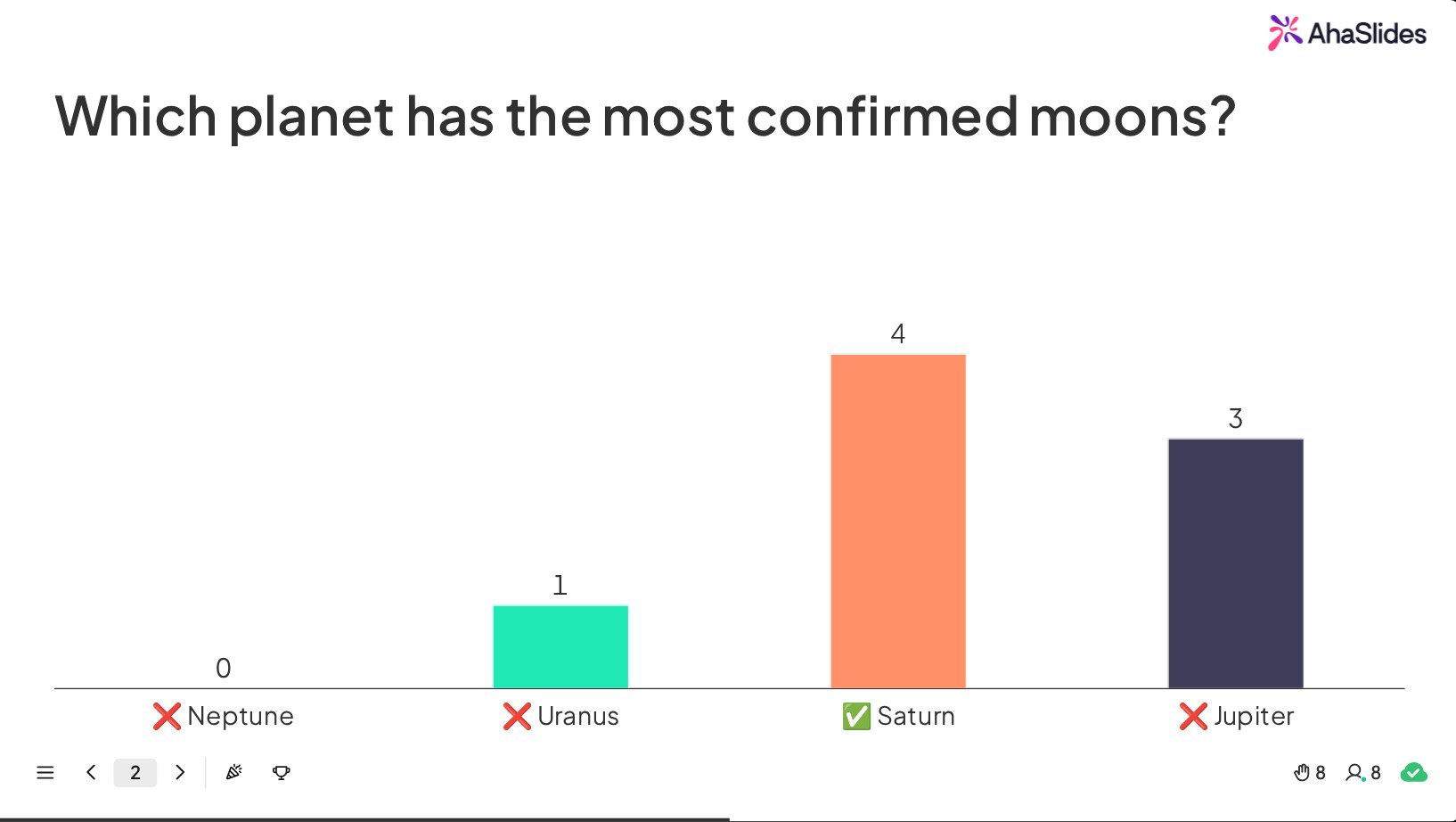
When we run science rounds in our own live sessions, the questions that overturn something people learnt years ago, such as how fat leaves the body or which planet has the most moons, spark the most discussion once the answer appears. Reveal the results chart before you give the answer, and let the room argue for a moment first.
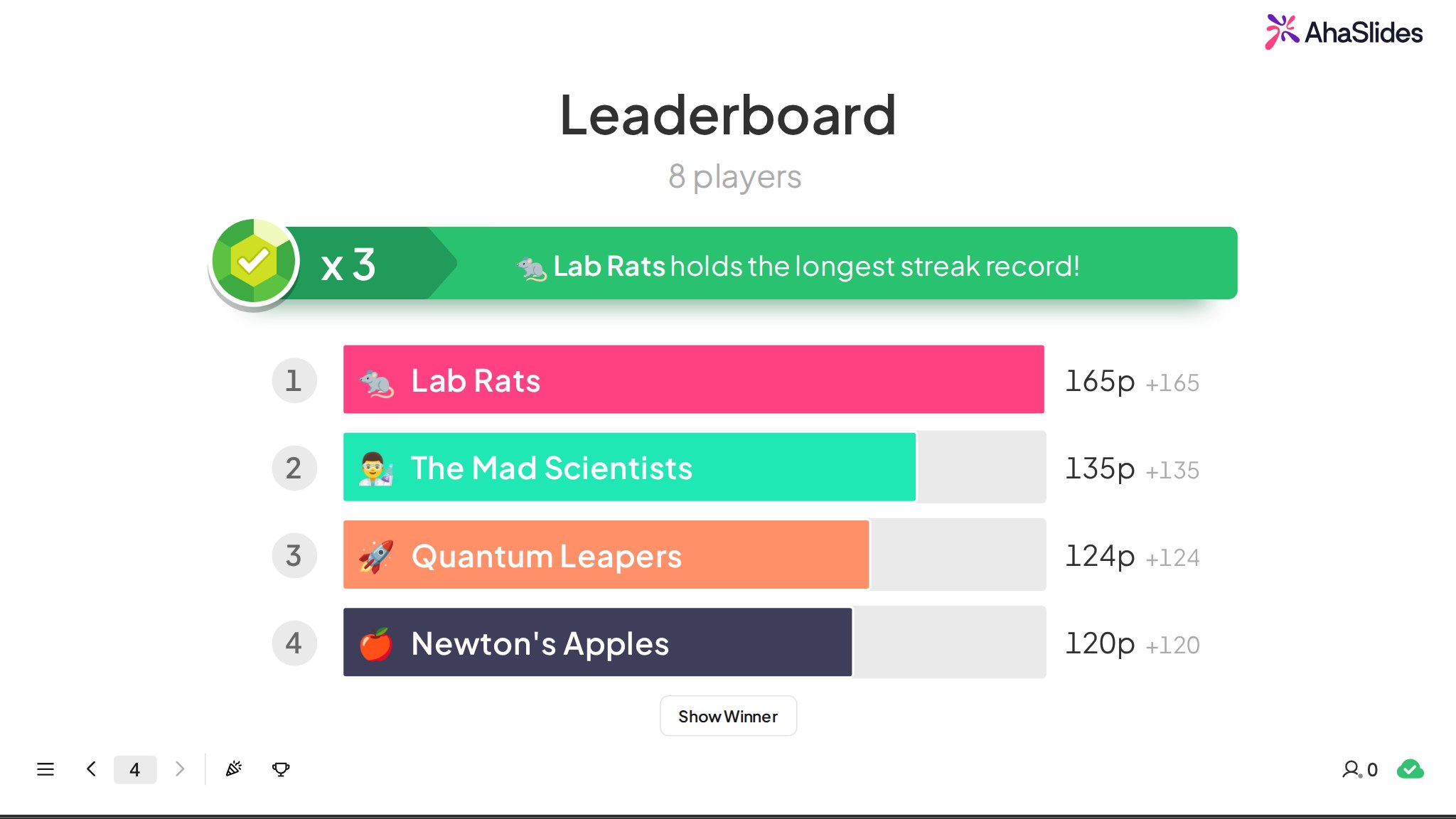
Finish with the leaderboard so the top team gets its moment.
Etsitkö lisää? Kokeile meidän trivia yläkoululaisille, yleistietokysymyksiä lapsille or maantiede tietokilpailu.
Usein kysyttyjä kysymyksiä
What are good science trivia questions for kids?
Start with questions linked to everyday life and school topics: how many hearts an octopus has, whether sharks have bones, or how many bones are in the human body. Most of the easy round above suits children aged around 10 and up, and our trivia questions for tweens mix science with other subjects.
How do you make science trivia harder?
Ask for specific terms rather than general ideas (crepuscular, synergist, the Challenger Deep), include myth-busting questions where the common answer is wrong, and use fill-in-the-blank questions so players cannot guess from a list of options.
How many questions should a science quiz have?
For a lesson starter, 5 to 10 questions take under ten minutes. For a quiz night, three rounds of 10 to 15 questions, rising in difficulty, works well.