Just like superheroes have special powers, sentences have special jobs. Some tell us things, some ask questions, some give orders and some show big feelings. This guide explains the four types of sentences with examples, adds the four sentence structures, and gives you a 16-question types of sentences quiz with answers to test yourself, your class or your team.
The four types of sentences at a glance
- Ilmoitus: makes a statement and ends with a full stop.
- Kysely: asks a question and ends with a question mark.
- Pakollinen: gives a command or request and ends with a full stop or an exclamation mark.
- Exclamatory: expresses strong feeling and ends with an exclamation mark.
Understanding the basics: the four types of sentences
1. Declarative sentences
Declarative sentences are little packages of information. They tell us something or give us facts, and they usually end with a full stop.
Esimerkkejä:
- Aurinko paistaa kirkkaasti taivaalla.
- Kissani nukkuu koko päivän.
- Hän lukee mielellään avaruudesta kertovia kirjoja.
Milloin niitä käytetään: Use declarative sentences to share what you know, explain ideas and tell stories. Most of what you write or say will be declarative.
2. Interrogative sentences
Interrogative sentences are little detectives. They ask questions to get information, often starting with who, what, where, when, why or how, and they end with a question mark.
Esimerkkejä:
- Mikä on suosikkivärisi?
- Where did you go for your holiday?
- Miten teet voileivän?
Milloin niitä käytetään: Use them to find things out, check understanding and keep a conversation going. Teachers and quiz hosts rely on them heavily.
3. Imperative sentences
Imperative sentences give instructions. They tell someone what to do, they often start with a verb, and the subject (you) is usually left out.
Esimerkkejä:
- Ole hyvä ja sulje ovi.
- Anna minulle suola, kiitos.
- Älä unohda kastella kasveja.
Milloin niitä käytetään: Use them for instructions, recipes, directions and requests. Adding please keeps the tone polite.
4. Exclamatory sentences
Exclamatory sentences are shouting words. They express strong feelings such as excitement, surprise or joy, and they end with an exclamation mark.
Esimerkkejä:
- Mikä kaunis auringonlasku!
- Vau, olet tehnyt upeaa työtä!
- En voi uskoa, että voitimme pelin!
Milloin niitä käytetään: Use them sparingly in formal writing, but freely in speech, stories and messages to friends.
Going deeper: sentence structures
The four types describe what a sentence does. Sentence structure describes how it is built, using clauses. An independent clause can stand alone as a sentence, and a dependent clause needs a main clause to make sense (Purdue OWL).
- Simple: one independent clause. She loves gardening.
- Yhdiste: two independent clauses joined by a conjunction such as and, but or so. She loves gardening, and he loves cooking.
- Monimutkainen: one independent clause plus at least one dependent clause. She loves gardening because it helps her relax.
- Compound-complex: two or more independent clauses and at least one dependent clause. She loves to paint, and her art often sells well, although it takes a lot of effort.
Types of sentences quiz: 16 questions with answers
Use these questions in class, at a team training session or in a quick revision game. Players can write answers on paper, or you can run the quiz live and let everyone answer on their phones.
Round 1: name the type
Is each sentence declarative, interrogative, imperative or exclamatory?
- The train leaves at nine o'clock.
- Have you finished your homework?
- Turn left at the traffic lights.
- What a fantastic goal that was!
- Birds build nests in spring.
- Where is the nearest station?
- Wow, this cake is delicious!
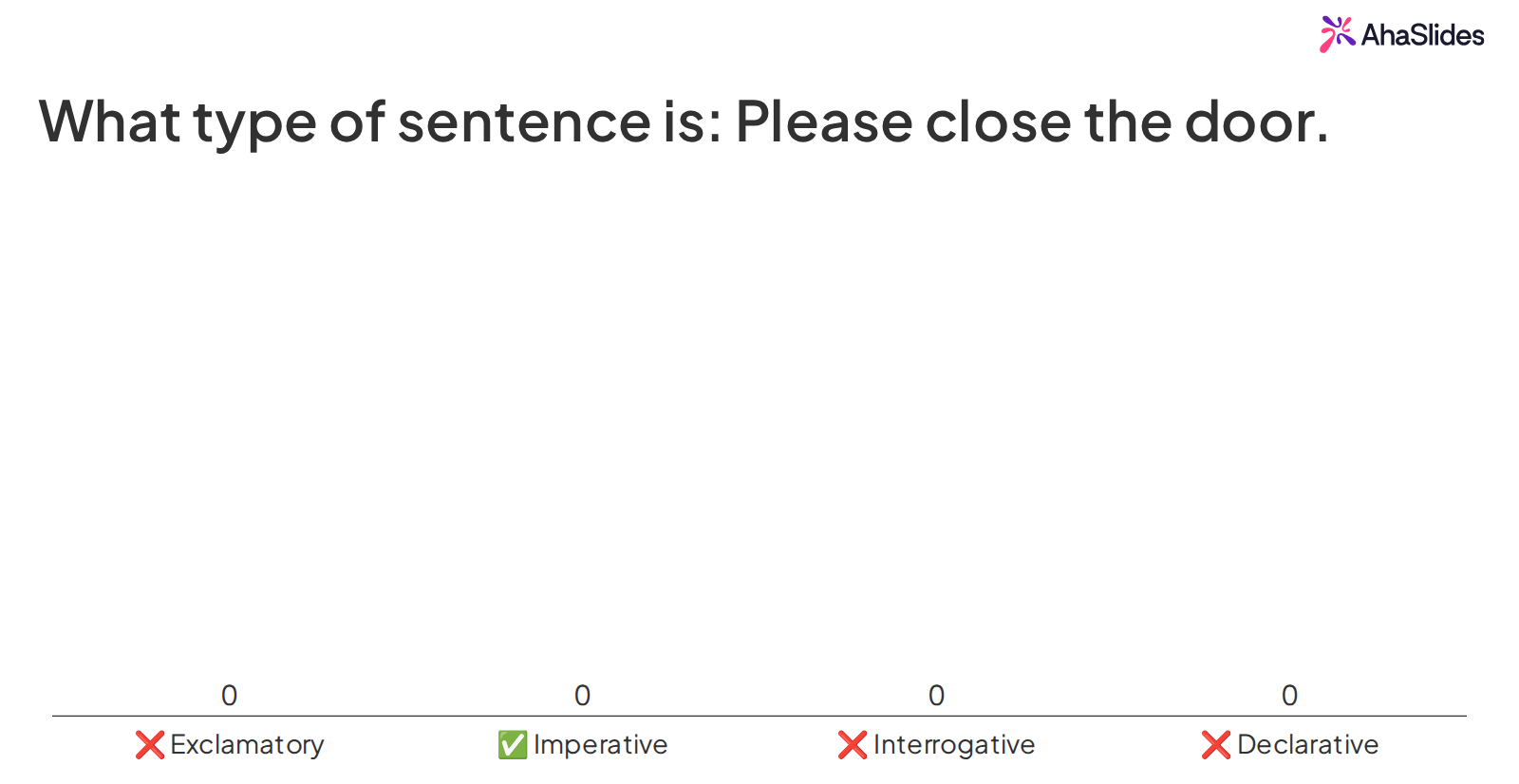
- Käytä aina turvavyötä.
Round 2: name the structure
Is each sentence simple, compound, complex or compound-complex?
- The dog barked.
- Halusin mennä ulos, mutta satoi.
- When the bell rang, the students left the room.
- She stayed in because it was cold, and she watched a film while the rain fell.
Round 3: true or false
- An imperative sentence can end with an exclamation mark.
- Every question you ask is an exclamatory sentence.
- A dependent clause can stand alone as a complete sentence.
- Lause Minne olet menossa? is interrogative.
vastaukset
- Deklaratiivista.
- Interrogative.
- Pakollinen.
- Exclamatory.
- Deklaratiivista.
- Interrogative.
- Exclamatory.
- Pakollinen.
- Yksinkertaista.
- Compound (two independent clauses joined by mutta).
- Complex (the dependent clause comes first).
- Compound-complex (two independent clauses and two dependent clauses).
- Totta.
- False. Questions are interrogative. Exclamatory sentences express strong feeling.
- False. A dependent clause needs a main clause.
- True. It asks a question and ends with a question mark.
Make your own types of sentences quiz with AhaSlides
A live quiz turns grammar practice into a game. With a free AhaSlides visailu voit:
- Rekisteröidy ilmaiseksi osoitteessa and create a presentation.
- Add a multiple-choice slide for each sentence and mark the correct type.
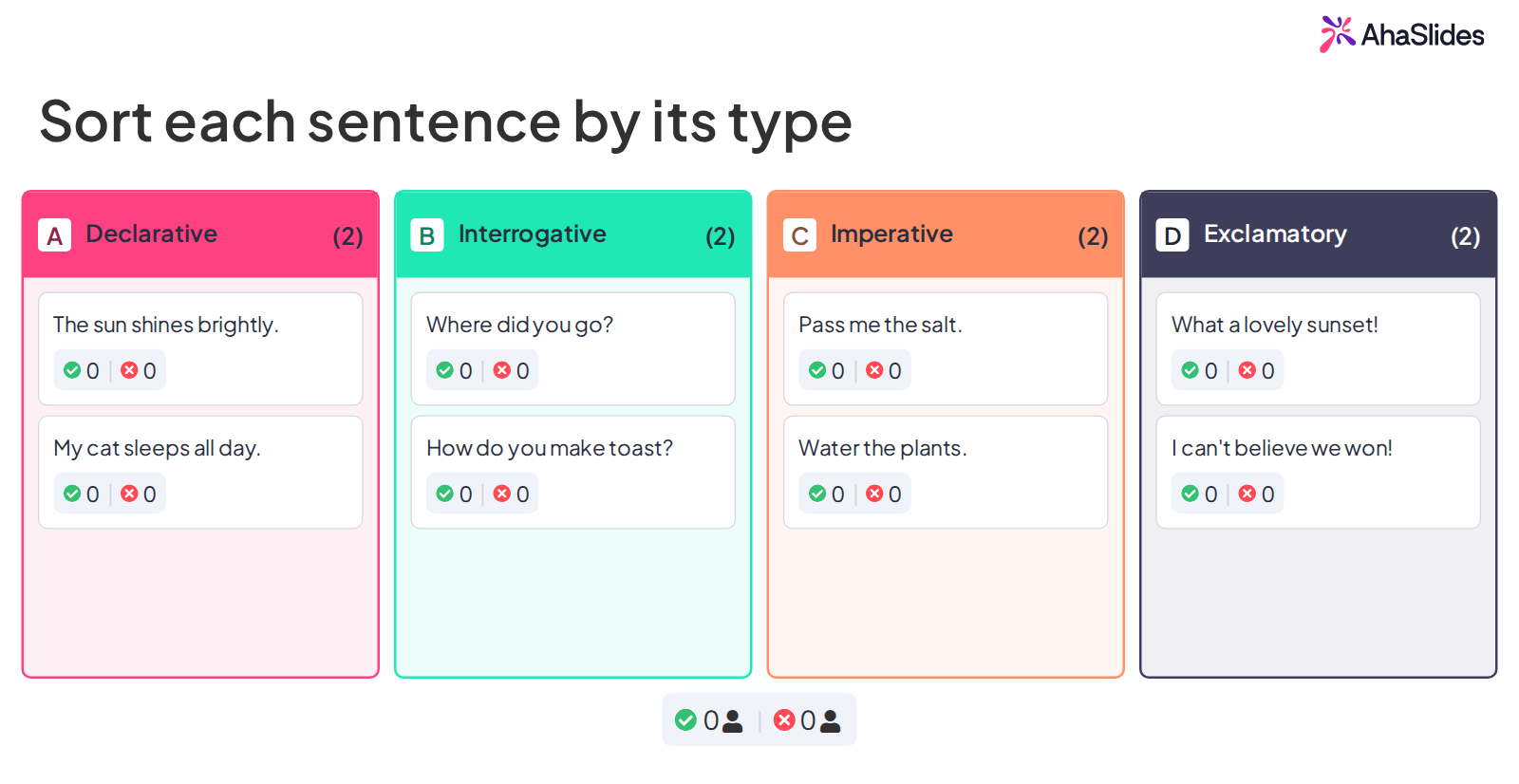
- Use a Categorise slide to ask players to drag sentences into the four types.
- Share the join code. Learners answer on their phones, and the leaderboard shows who is ahead after every question.
Looking for more classroom ideas? Browse our tietokilpailukysymykset lapsille or start from a ready-made deck in the AhaSlides mallikirjasto.
Other websites to practise sentence types
- Merithub: understanding the different types of sentences, a quiz for English learners.
- ProProfs: sentence structure quiz, covering simple, compound, complex and compound-complex sentences.
Usein kysyttyjä kysymyksiä
Mitkä ovat neljä lausetyyppiä?
Declarative, interrogative, imperative and exclamatory sentences.
Voiko yhdellä lauseella olla useampi kuin yksi tyyppi?
Yes, in tone. For example, an interrogative sentence can express excitement: Wow, did you see that? In formal grammar, though, each sentence is classed by its main purpose.
Kuinka tunnistan kappaleen lausetyypin?
Look at the sentence's purpose and its final punctuation. A statement is declarative, a question is interrogative, a command or request is imperative and a strong feeling is exclamatory.