A quiz is the fastest way to find out what your students actually know, and the easiest way to get a quiet room talking. This guide covers why quiz games work, how to write questions that go beyond recall, and how to run one live in class with students answering on their phones.
I fatti in breve
| La Domanda | Risposta |
|---|---|
| Why do quizzes help students remember? | Pulling an answer from memory strengthens it more than rereading (the testing effect) |
| How long should a classroom quiz be? | 8 to 15 questions, or 5 to 10 minutes, for a review; longer for end-of-unit games |
| Do students need devices? | No. Teams can share one phone, and you can run a paper version too |
| Can I use one for grading? | Better as low-stakes practice; keep high-stakes tests separate |
Why quizzes work in the classroom
If students switch off, they stop learning. Regular low-stakes quizzes pull them back in, and the research behind that is solid.
Retrieval practice strengthens memory
Trying to recall information, known as richiamo attivo, strengthens memory more than passively reviewing it. In a well-known study, Roediger and Karpicke (2006) found that students who took practice tests remembered more a week later than students who simply restudied the same text. A quiz game turns that "testing effect" into something students enjoy.
Interaction beats passive listening
Richard Hake's 1998 analysis of more than 6,000 physics students found that classes built around interactive engagement achieved roughly twice the learning gain of traditional lecture courses. A live quiz is one of the simplest ways to make a lesson interactive, because every student answers every question.
Points and feedback keep attention
Points, a leaderboard and instant feedback give students a reason to try. Unlike a final exam, a quiz game is low stakes, so a wrong answer becomes a talking point rather than a mark against them. Teams add another layer: students explain their thinking to each other before they commit to an answer.
Quizzes show you the gaps
Formative assessment means checking understanding while there is still time to act on it. With live results on the board, you can see straight away which question caught most of the class out and reteach it before moving on.
What counts as a quiz game
A quiz game is a quiz with game mechanics on top: points, a timer, a leaderboard and sometimes teams. The best ones do not just add points to a test. The game mechanics serve the learning goal.
You do not need technology. Flashcard races, classroom Jeopardy boards and quiz scavenger hunts all work. Digital tools such as AhaSlides add instant scoring, results you can review afterwards and question types that are hard to run on paper, like picture questions.
How to create and run an effective quiz
1. Start from the learning goal
Before writing questions, decide:
- Which key ideas need reinforcing?
- Which misconceptions do you want to surface?
- Which skills need practice?
Then mix question levels using Bloom's Taxonomy. Recall questions have a place, but higher-order questions make students use what they know. Instead of asking students to name the parts of a cell, ask what would happen if one part stopped working.
Here is one topic across all six levels:
- Ricordando: Qual è la capitale della Francia?
- Comprensione: Explain why Paris became the capital of France.
- L'applicazione di: How would you use what you know about Paris's geography to plan an efficient tour of its main landmarks?
- Analizzando: Compare and contrast how Paris and London developed as capital cities.
- Valutare: Assess how well Paris's urban planning balances tourism with the needs of residents.
- Creazione: Design an alternative transport system that would address one of Paris's current urban challenges.
2. Vary the question types
Different formats test different things and keep the pace fresh:
- Scelta multipla for quick checks of facts and concepts
- Vero o falso for basic comprehension
- Risposta breve to test recall without hints
- Senza limiti precisi questions for explanation and reasoning
- Domande sulle immagini for visual analysis, such as identifying a diagram or a historical figure
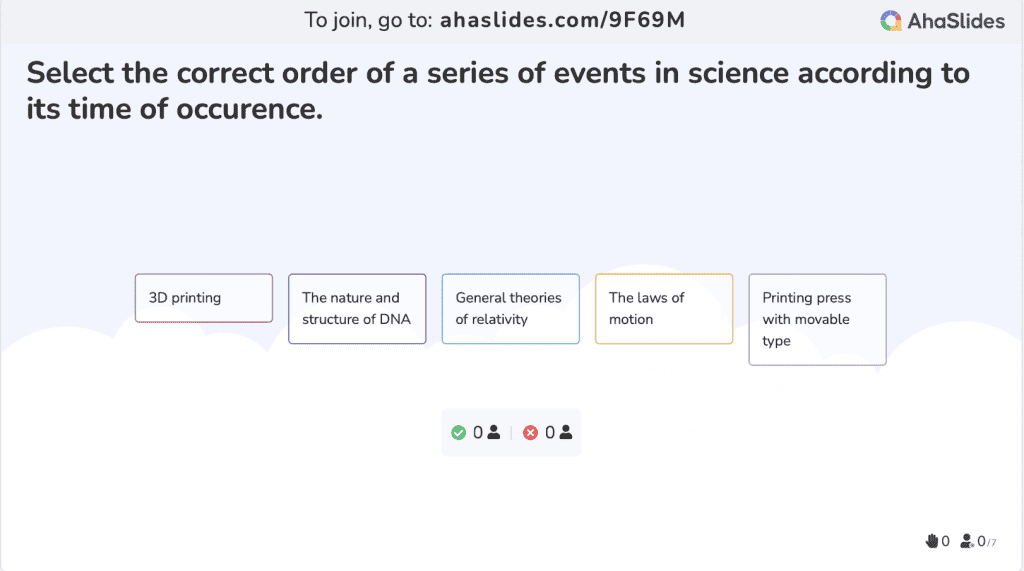
- Giusto ordine for sequences, like the stages of a process or events on a timeline
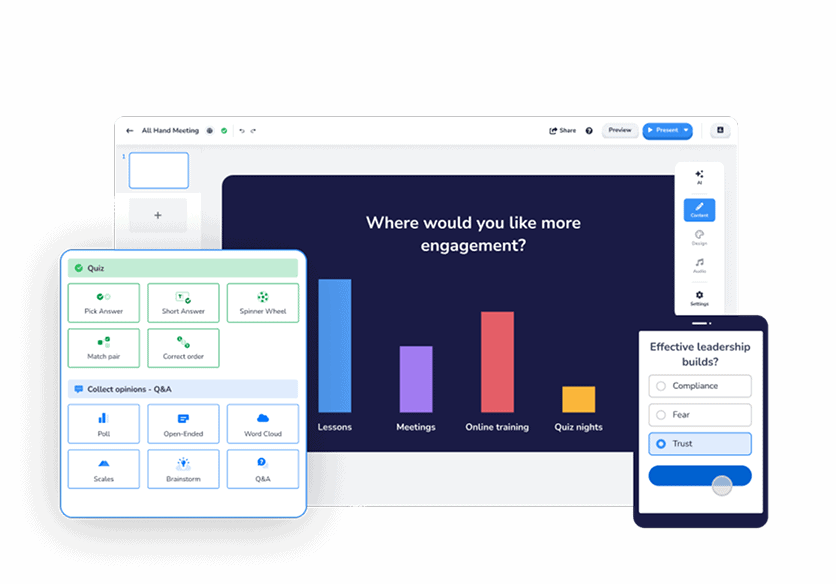
In AhaSlides you can build all of these from the slide menu, so one quiz can move between formats without switching tools.
An image question works especially well in science, history and art, where students need to recognise what they are looking at.

A correct-order question asks students to put steps or events in sequence, which tests understanding of a process rather than a single fact.
3. Set the pace
Decide how long each question gets. Easy recall questions may need 10 to 15 seconds; a reasoning question needs 30 to 60. A timer per slide lets you set this question by question. Keep the whole quiz short enough that students finish while they are still concentrating.
4. Show the leaderboard sparingly
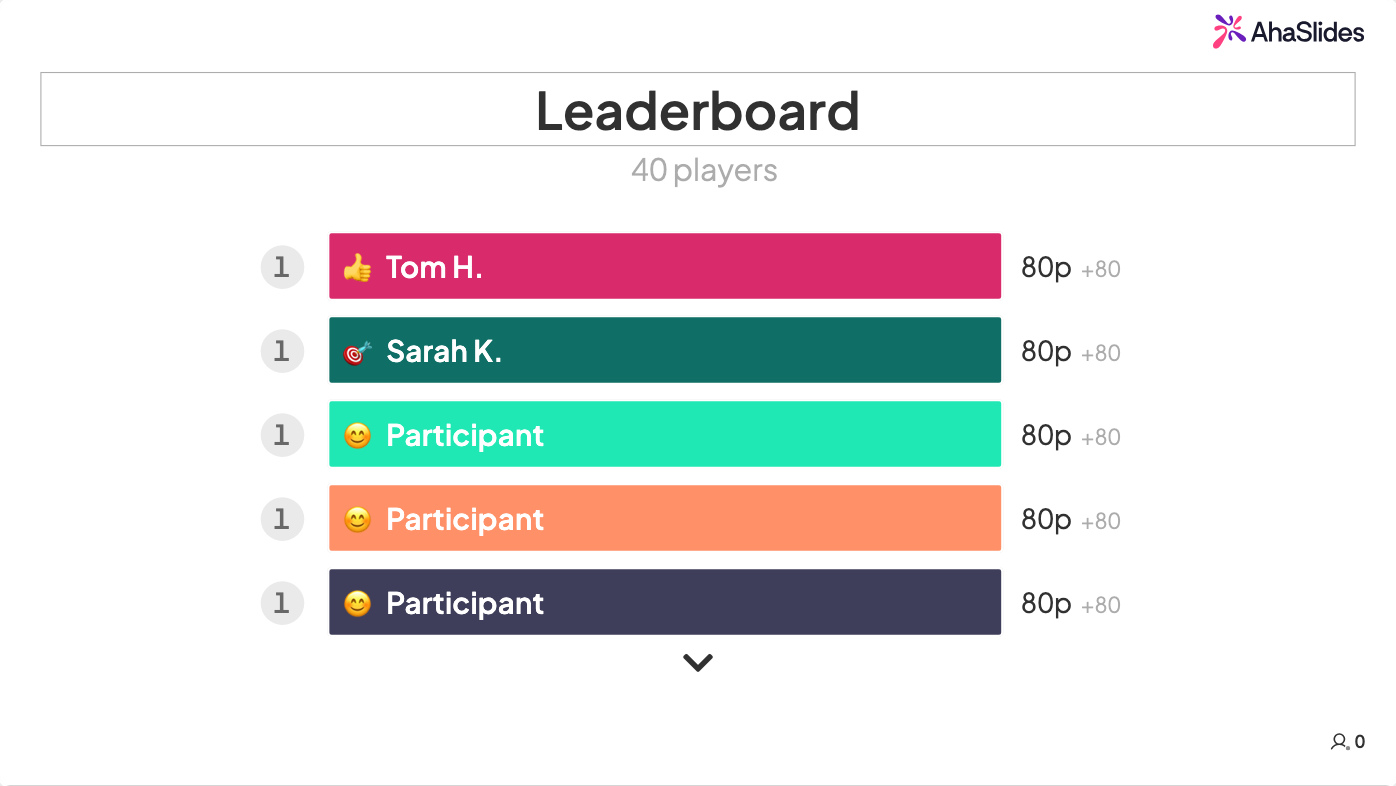
A leaderboard after every question can discourage students who are behind. Showing it after each round, or only the top few, keeps the competition friendly. Team mode helps too, because no single student carries the score.
Quiz tools to compare
There are plenty of tools for classroom quizzes, and the right one depends on how you teach.
- AhaSlides combines live quizzes with polls, word clouds, a spinner wheel and team mode, and works inside PowerPoint and Google Slides. It has a free plan; check the pagina dei prezzi for current education plans.
- Wayground (in precedenza Quizizz) is strong on self-paced quizzes with game elements.
- espediente is built around earning and spending in-game currency.
- Fioretto is known for its range of game modes.
- Mentimeter is good for simple polls and is less game-focused.
If you already teach with slides, adding quizzes to the deck you have is often quicker than switching platforms. A ready-made quiz from the libreria di modelli can save planning time, and the built-in AI can draft questions from a topic for you to edit.
Low-tech quiz ideas
Screens are optional. Some analogue options:
- Board game adaptations: write curriculum questions for a Trivial Pursuit-style game, put questions on Jenga blocks, or adapt Taboo so students explain vocabulary without using the "forbidden" words.
- Classroom Jeopardy: draw a board with categories and point values, let teams choose questions, and use raised hands or a buzzer to manage answers.
- Quiz scavenger hunt: hide QR codes or printed questions around the room, and require a correct answer to unlock the next location.
These work well for kinaesthetic learners and give everyone a break from screens.
Use quizzes across the unit
Quizzes are not only an end-of-unit activity.
Before class. In un lezione capovolta, a short quiz on the pre-class material shows what to clarify in the lesson.
During projects. Use a quiz to check prerequisite knowledge before a project starts, and quick checkpoints along the way.
For revision. Schedule short review quizzes through the unit, build a cumulative quiz that mirrors the real exam, and use the results to see which topics need another pass. Students can also revisit a quiz on their own for independent study.
Where quiz games are heading
AI tools can now draft questions from a learning objective, and the analytics can show which concepts each student is struggling with. Treat AI-generated questions as a first draft: read every question and answer before it reaches students. Immersive formats such as virtual and augmented reality are also being tried, but they are still far from a normal classroom.
Concludendo
Quiz games work because they combine retrieval practice, instant feedback and a bit of friendly competition. To get started:
- Try one short quiz on a topic you have just taught
- Mix recall and higher-order questions
- Ask students what they thought and adjust
- Share what works with colleagues
Pronto a provarlo? Iscriviti per AhaSlides gratuita and build your first classroom quiz in a few minutes.
Domande frequenti
How long should a classroom quiz be?
For a review or warm-up, 8 to 15 questions is plenty. For an end-of-unit game, 20 to 30 questions in rounds keeps energy up without dragging.
Gli studenti hanno bisogno di dispositivi personali?
No. In team mode, groups can share one phone, and you can also run a quiz on paper or with mini whiteboards.
Should quiz scores count towards grades?
Most teachers keep quiz games low stakes. The learning benefit comes from practising retrieval and getting feedback, and grading every game can add stress that cancels it out.
Referenze
- Roediger, H. L., & Karpicke, J. D. (2006). Test-enhanced learning: Taking memory tests improves long-term retention. Scienza Psicologica, 17 (3), 249-255. https://doi.org/10.1111/j.1467-9280.2006.01693.x
- Hake, R. R. (1998). Interactive-engagement versus traditional methods: A six-thousand-student survey of mechanics test data for introductory physics courses. Giornale americano di fisica, 66 (1), 64-74. https://doi.org/10.1119/1.18809