
A title is an advertisement for everything that follows it. It is the first thing a reader sees in a bookshop, a search result or a conference agenda, and often the only thing they use to decide whether to give you their time.
This guide gives you 90 creative title ideas across non-fiction, fiction and presentations, ten published titles that show what works, and ten practical techniques for writing your own.
Īsi fakti
Īsumā4 ātras atbildes
How many title ideas are here?
atbilde90: 30 non-fiction, 30 fiction and 30 presentation titles
What makes a good title?
atbildeClear, specific and honest about what the reader gets
How long should a title be?
atbildeAs short as it can be while staying clear; long titles get cut off in search results
Can a group help choose one?
atbildeYes, collect ideas and vote on them live with a brainstorm slide
Why a creative title matters
Most of us have picked up a book or clicked an article purely because of its title. A title that signals a clear benefit, solves a problem or hints at an intriguing story gives readers a reason to engage before they have read a word.
There is hard evidence for how much wording moves behaviour. A 2023 study in Daba Cilvēka uzvedība analysed around 105,000 headline variations tested on the news site Upworthy and found that, for a headline of average length, each additional negative word increased the click-through rate by 2.3%. Small word choices change how many people read on. That power cuts both ways, which is why the mistakes below matter.
Kļūdas, no kurām jāizvairās
- Excessive length. Long titles are hard to read and harder to remember. Google's own guidance notes that while there is no limit on title length, titles are truncated in search results as needed, so put the important words first.
- Lack of clarity. Readers should understand your title instantly. Avoid jargon, complex language or ambiguous terms that might confuse or alienate them.
- Misleading or clickbait titles. Pique interest, but never promise more than the content delivers. A reader who feels tricked will not come back.
- Ignoring how it looks. On a cover or a title slide, font, colour and layout matter too. A strong title set in an unreadable font still loses.
- Assuming nobody else has used it. The ASV Autortiesību birojs says a title is not protected by copyright, though trademark law can apply to some, so run a quick search to see whether a well-known book or brand already uses yours.
30 non-fiction title ideas
Non-fiction presents factual information, real events or real people: articles, blog posts, research papers, biographies, memoirs, travel writing and more. The best non-fiction titles are straightforward and tell readers what they will get out of the content.
First, four published non-fiction titles that do this well:
Published non-fiction4 published titles
- Influence: The Psychology of Persuasion, Robert Cialdini
- A People's History of the United States, Howard Zinn
- The 7 Habits of Highly Effective People, Stephen R. Covey
- Quiet: The Power of Introverts in a World That Can't Stop Talking, Susan Cain
Now 30 non-fiction title ideas for articles, blog posts and books:
Self-improvement and mindset12 nosaukumi
- Ignite your inner spark: Unleashing the power within
- The path to greatness: Discovering your true potential
- Rise and shine: Embracing your journey of transformation
- Empowered living: Creating a life of purpose and passion
- Unstoppable confidence: Embracing your authentic self
- The road to success: Navigating challenges with resilience
- Dare to dream big: Manifesting your best life
- Growing well: Thriving in every area of life
- Thank you, Monday: How a gratitude habit changes your week
- Awaken your inner warrior: Conquering obstacles with courage
- Find your true north: Discovering your life's purpose
- The resilient mindset: Thriving in adversity
Guides, lists and how-tos13 nosaukumi
- 10 surprising ways to boost your productivity
- The ultimate guide to mastering self-care
- How to unlock your creativity and find your inner artist
- The top 5 strategies for building a successful online business
- 10 must-try recipes for delicious, healthy meals
- The secrets to finding happiness in everyday life
- The science of mindfulness: Transform your life with awareness
- From cluttered to organised: Decluttering tips for a stress-free life
- The art of effective communication: Enhance your relationships
- Mastering time management: Achieve more with less stress
- The road to financial freedom: Strategies for building wealth
- The ultimate guide to fitness: Getting into your best shape ever
- Unveiling the secrets of successful blogging: iekšējās informācijas padomi un triki
ceļot5 nosaukumi
- Exploring the hidden gems: Unforgettable travel destinations
- Travel for idiots
- The myth of travel
- Travel: The complete blueprint
- The great book of intrepid travel
30 fiction title ideas
Fiction covers imaginative, made-up stories, and its titles lean heavily on metaphor, mood and mystery. Six published novels whose titles show how it is done:
Published novels6 published titles
- Brave New World, Aldous Huxley
- The Catcher in the Rye, J.D. Salinger
- Dzīvnieku ferma, Džordžs Orvels
- Nogalināt mockingbird, Hārpers Lī
- The Grapes of Wrath, John Steinbeck
- A Wrinkle in Time, Madeleine L'Engle
And 30 fiction title ideas for fantasy, dark fiction and dark comedy:
Fantāzija10 nosaukumi
- Whispers of the Forgotten
- Echoes in the Mist
- Shadows of Destiny
- The Enigma's Key
- Beneath the Crimson Moon
- The Silent Symphony
- A Dance with Time
- The Weaver's Tale
- The Starlight Chronicles
- Of Dreams and Dragons
Dark and dystopian10 nosaukumi
- Shattered Reflections: The Cracked Reality
- The Silent Rebellion: Echoes of the Lost
- Ashes of the Horizon: When Dreams Burn
- Fading Embers: Darkness Within
- Whispers in the Ruins: A Bleak Symphony
- Fragments of Tomorrow: A Broken World
- The Shadow's End: Where Hope Fades
- The Veil of Secrets
- The Last Lantern of Varrow
- The Quiet After Orrin
Dark comedy10 nosaukumi
- Sardonic Shenanigans
- Dark Laughter Club
- Twisted Tales and Wicked Wit
- Macabre Mischief
- Black Comedy Cabaret
- The Cynical Circus
- Grim Grins and Grisly Giggles
- Morbidly Hilarious
- Gallows Wit and Satirical Schemes
- Morose Merriment
30 presentation title ideas
A presentation title has to work on an agenda, a title slide and an invitation email, so it should tell the audience what the talk covers and why it is worth their attention. The right tone depends on whether you are presenting at school or at work. Student titles should be informative and engaging: state the topic clearly, then spark some curiosity. Work titles should be results-oriented, highlighting the value and outcomes of what you are presenting.
Student presentations15 nosaukumi
- The Power of Renewable Energy: Shaping a Sustainable Future
- Exploring Ancient Civilisations: A Journey Through Time
- The Future of Technology: Innovations Shaping Our World
- Talking Guts: How Gut Health Affects Mental Wellbeing
- Beyond the Headlines: An In-Depth Look at Global Politics
- Breaking the Silence: Shedding Light on Mental Health Stigma
- The Art of Travel Photography: Capturing Moments and Memories
- The Science of Happiness: Strategies for a Fulfilling Life
- Stargazing 2.0: Exciting Developments in Astrophysics
- The Power of Storytelling: How Narratives Shape Our World
- The Art of Communication: Finding Your Voice
- Amazing Animals: Discovering Nature's Wonders
- Let's Get Creative: Fun Art Projects for Kids
- Fun with Numbers: Maths Games and Puzzles for Curious Minds
- Why Should We Eat Breakfast Every Day?
Work presentations15 nosaukumi
- Driving Innovation: Strategies for Business Growth and Adaptation
- Efficiency Redefined: Streamlining Operations for Better Performance
- Ethical Leadership: Building Trust and Integrity in the Workplace
- Driving Sales Growth: Effective Strategies for Customer Engagement
- Quality Management: Driving Excellence and Customer Satisfaction
- Nepārtrauktas mācīšanās kultūras veidošana
- Data-Driven Decision Making: Turning Insights into Growth
- Breaking Barriers: Overcoming Obstacles in the Workplace
- From Problem to Opportunity: Embracing a Solutions-Oriented Mindset
- Empowering Employees as Problem Solvers
- More Women at the Top: Fixing the Leadership Pipeline
- Selling Smarter: Psychology and Techniques for Sales Professionals
- The Power of Diversity: Harnessing the Strength of Every Team Member
- Overcoming Procrastination: Strategies for Boosting Productivity
- Future-Proofing Your Career: The Power of Upskilling and Reskilling
How to write great title ideas
1. Add a subtitle
A subtitle clarifies the focus, targets a specific audience or highlights the key benefit. In "Exploring Paradise: Island Hopping in the Caribbean", the main title sets the mood and the subtitle tells readers exactly what the article covers.
2. Make it easy to say
A title people can pronounce is a title people can recommend. "Nourishing Your Body: Fuelling for Optimal Health" works better as "Eating Well: Fuelling for Optimal Health", which keeps the message in plainer language.
3. Borrow a famous phrase
A well-known quotation, proverb or idiom carries instant familiarity and emotion. "From Impossible to I'm Possible: Embracing the Journey" plays on a popular saying and gives a self-help book an upbeat hook.
4. Lift a strong phrase from your own work
Pull a short, punchy line from the content itself. A persuasive essay on voting could become "Your Voice, Your Power: Igniting Change through the Ballot", which gives readers a glimpse of the argument inside.
5. Use a listicle format
Numbers promise clear, digestible information. "A Beginner's Guide: 5 Steps to Mastering a New Language" tells readers exactly what they will get and how much of it.
6. Start with a descriptive power word
Words such as comprehensive, essential, practical, proven, insightful and actionable signal value before the reader gets to the topic. Use one, not five.
7. Frame a problem and its solution
"From Chaos to Calm: Effective Strategies for Organising Your Life" names a relatable problem (disorganisation) and promises a way out, which is often all a reader needs to click.
8. Make a comparison
Comparing two options invites readers to find out which one wins. For example, "Traditional vs Digital Marketing: Choosing the Right Strategy for Your Business".
9. Write a how-to
A how-to title promises step-by-step guidance on a specific outcome, such as "Mastering Public Speaking: A Step-by-Step Guide".
10. Get help from tools and your audience
Title generators are handy when you are stuck. Try Portent's Content Idea Generator, HubSpot's Blog Ideas Generator, AtbildePublikā for the questions people actually search, or Ryan Robinson's Blog Nosaukuma ģenerators. Treat the output as a starting point and rewrite it in your own voice.
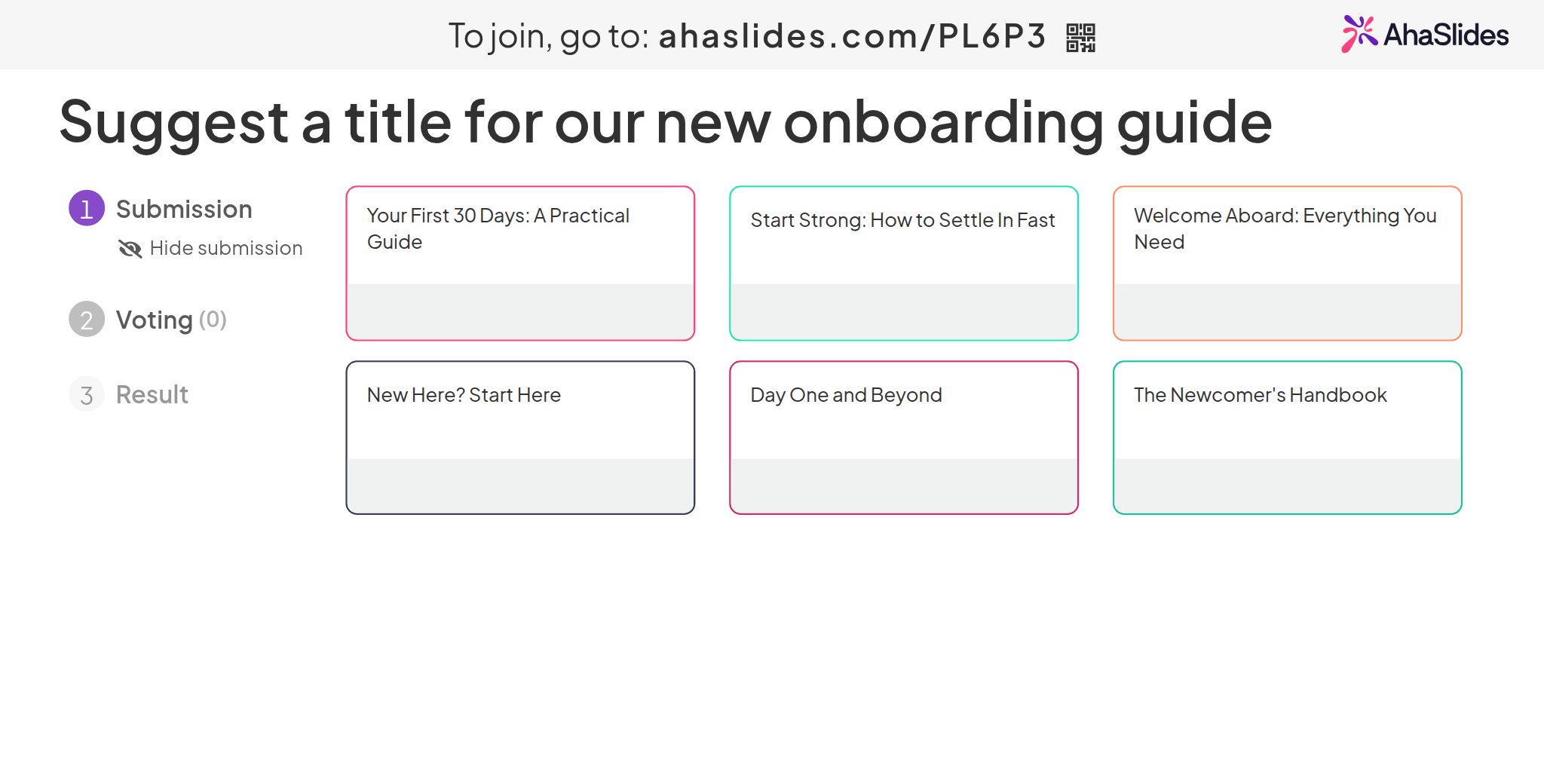
For a presentation, a workshop or a team project, your audience is an even better generator. Put a brainstorm slide up on AhaSlides, let everyone submit title ideas from their phones, then move to the voting stage so the group picks the winner. You get dozens of options in a couple of minutes, and people back the title they chose.
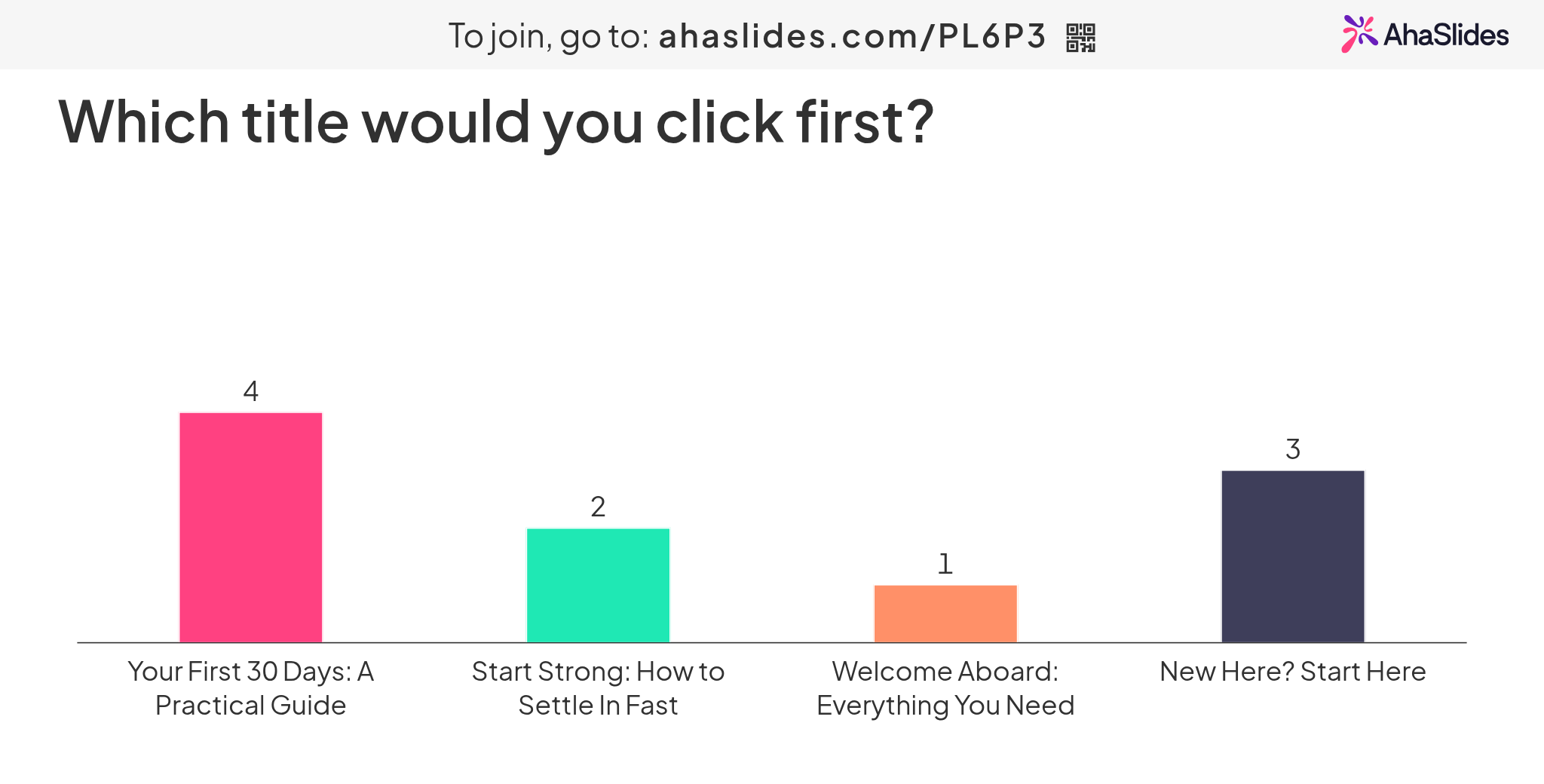
If you already have a shortlist, a quick live Aptauja settles it just as fast.
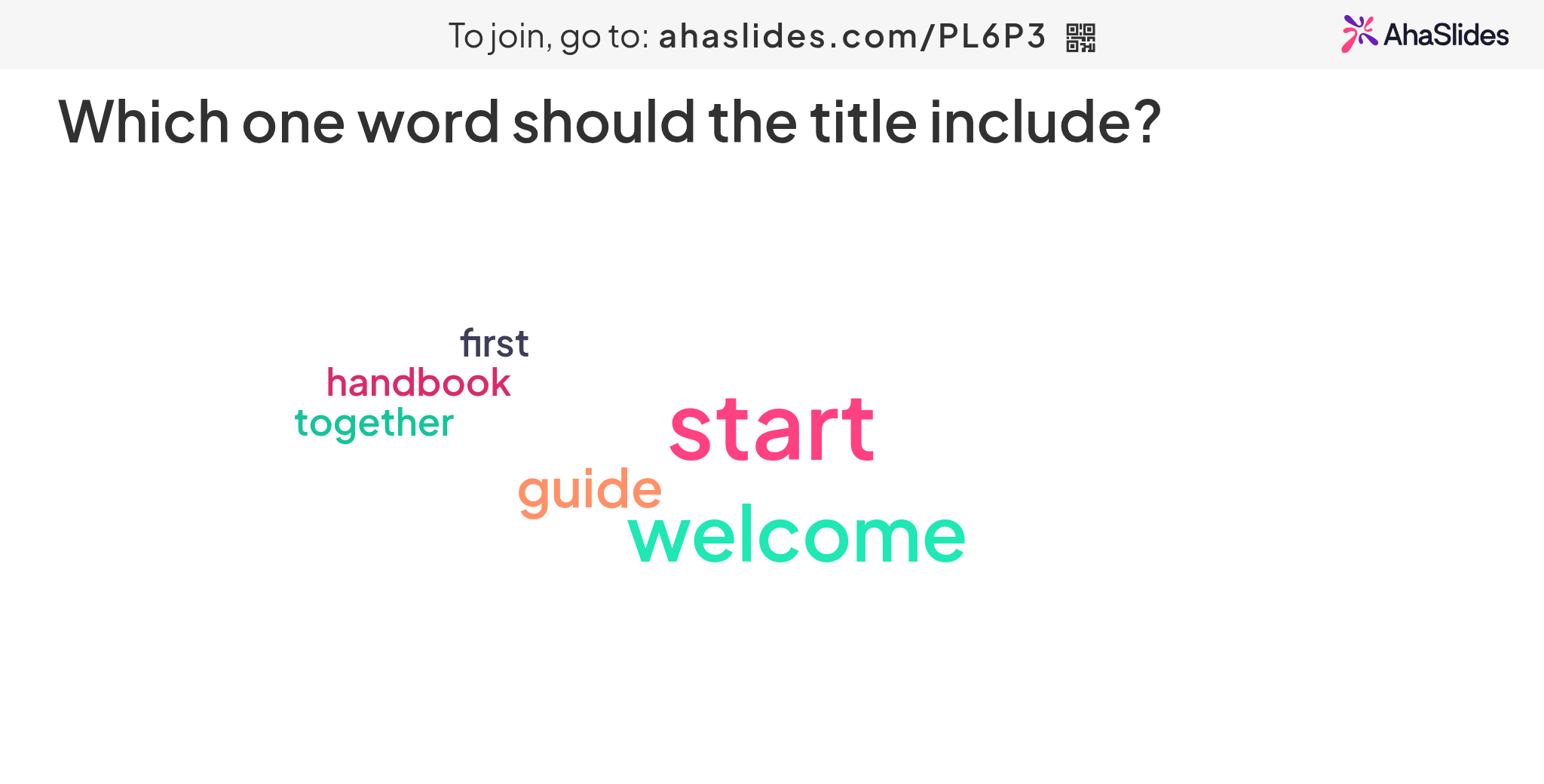
To pick the key word rather than the whole title, ask the room for one word and let a vārdu mākonis show the favourite.
Grunts līnija
Whether you are writing non-fiction or fiction, presenting a project or publishing a blog post, time spent on the title is time well spent. Match it to your genre, audience and purpose, keep it clear and honest, and give readers a reason to want what comes next.
Biežāk uzdotie jautājumi
What makes a good title?
A good title is short but clear, and readers can understand it in a second or two. It signals the benefit of the content, whether that is solving a problem or hinting at an intriguing story, without promising more than the content delivers.
How long should a title be?
There is no fixed rule. For anything that will appear in search results, keep it concise and put the most important words first, because Google truncates long titles as needed to fit the screen. For a book or a presentation, the test is whether someone can remember it and repeat it after hearing it once.
How do I come up with a creative title quickly?
Write down ten options without judging them, using a few of the techniques above (a subtitle, a number, a problem and solution, a strong phrase from your own work). Then cut the list to three and test them on a few people from your target audience. The one they remember is usually the one to use.