WHMIS 2015 uses 9 pictograms (CCOHS: WHMIS pictograms). Workers read a label at a glance, so they need to know each symbol on sight and what it warns about.
This quiz has 29 questions with answers in 3 rounds: name the pictogram (9), what it means (10), and labels and safety data sheets (10). Each round has an Mūsu izvēle, and every answer comes from CCOHS or the Hazardous Products Regulations. It is written for Canadian supervisors, health and safety reps and trainers running a WHMIS refresher.
Two notes before you start. WHMIS is also regulated by each province and territory, so small differences exist: use these answers as a prompt and check your own jurisdiction. And in Round 1, show the pictogram from the CCOHS pictogram chart on the slide. The line starting "Slide shows" describes it. The chart also shows an environment pictogram, which WHMIS did not adopt, so crop it out.
Round 1: Name the pictogram (9 questions)
Most WHMIS pictograms have a red border shaped like a square set on one of its points. Inside is the symbol, and the two together are the pictogram.
Set 1: Physical hazards and corrosives (5 questions)
Slide shows: a flame. What is this pictogram called? Atbilde: Flame. CCOHS
Our pick. Slide shows: a flame above a circle. What is this pictogram called? Atbilde: Flame over circle. It is the one to separate from the flame: the circle points to oxidising gases, liquids and solids, not to products that burn on their own. CCOHS
Slide shows: a cylinder. What is this pictogram called? Atbilde: Gāzes balons. CCOHS
Slide shows: liquid dripping from two test tubes onto a hand and a surface. What is this pictogram called? Atbilde: Korozija. CCOHS
Slide shows: a bomb exploding. What is this pictogram called? Atbilde: Exploding bomb. CCOHS
Set 2: Health hazards and biohazards (4 questions)
Slide shows: a skull with two crossed bones. What is this pictogram called? Atbilde: Skull and crossbones. CCOHS
Slide shows: a person with a star-shaped burst across the chest. What is this pictogram called? Atbilde: Health hazard. CCOHS
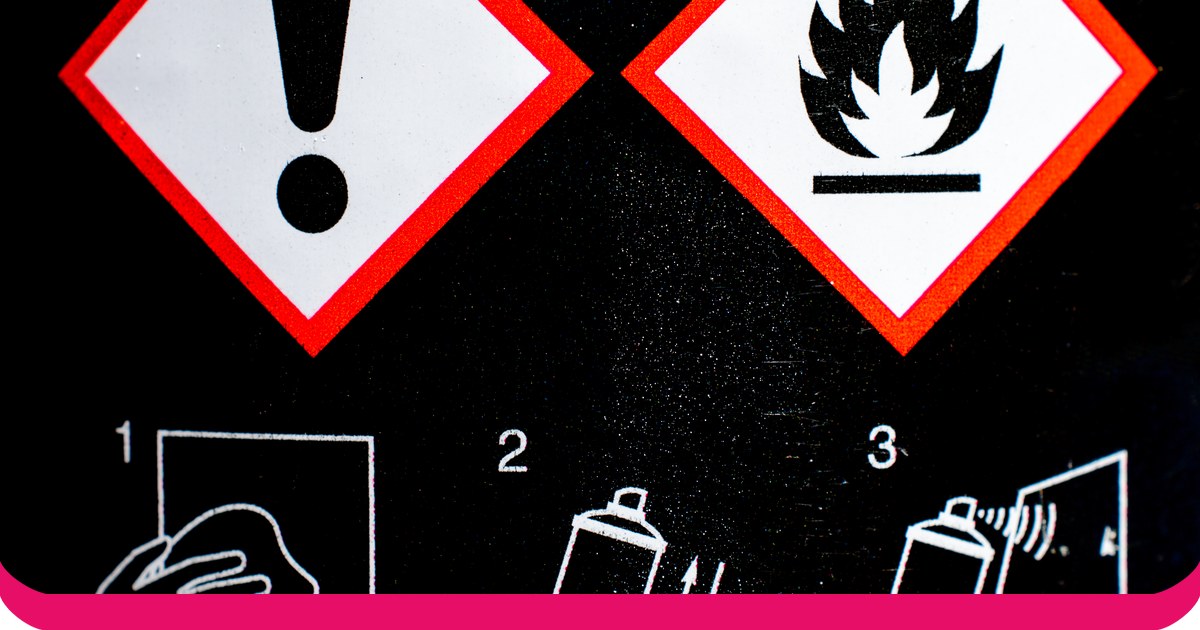
Slide shows: an exclamation mark. What is this pictogram called? Atbilde: Exclamation mark. CCOHS
Slide shows: the biohazard symbol, three crescents around a small circle inside a plain black circle. What is this pictogram called? Atbilde: Biohazardous infectious materials. This is the ninth pictogram on the CCOHS list.
Round 2: What does it mean? (10 questions)
Naming a symbol is half the job. The second half is knowing what hazard it stands for.
Set 1: What each pictogram warns about (5 questions)
What does the skull and crossbones pictogram warn about? Atbilde: Acute toxicity by mouth, on the skin or by inhalation, in categories 1, 2 and 3. CCOHS
Name two hazards that the corrosion pictogram covers. Atbilde: Any two of: corrosive to metals, skin corrosion, serious eye damage. CCOHS
Name two hazards that the health hazard pictogram covers. Atbilde: Any two of: carcinogenicity, germ cell mutagenicity, reproductive toxicity, respiratory sensitisation, specific target organ toxicity or an aspiration hazard. CCOHS
Our pick. A product carries the exclamation mark. Which of these could it mean: skin irritation, eye irritation, a skin sensitiser, or lower-category acute toxicity? Atbilde: All four, plus specific target organ toxicity from a single exposure (category 3). It covers more than one kind of hazard, which is why we picked it: a worker who treats it as "mild" is guessing. CCOHS
What does the biohazardous infectious materials pictogram warn about? Atbilde: Microorganisms, nucleic acids or proteins that cause, or probably cause, infection in humans or animals. CCOHS: hazard classes
Set 2: Which pictogram goes with this hazard? (5 questions)
Which pictogram goes with a flammable liquid? Atbilde: Flame. CCOHS
Which pictogram goes with an oxidising solid? Atbilde: Flame over circle. CCOHS
Which pictogram goes with a compressed gas in a cylinder? Atbilde: Gas cylinder, for gases under pressure. CCOHS
Which pictogram goes with a product that can cause cancer? Atbilde: Health hazard, for carcinogenicity. CCOHS
Which pictogram goes with a self-reactive substance of type A? Atbilde: Exploding bomb. Type B self-reactive substances carry both the flame and the exploding bomb. CCOHS
Round 3: Labels and safety data sheets (10 questions)
A pictogram sits on a label, and the label points to the safety data sheet (SDS). These questions cover who labels what, and where to find the detail.
Set 1: Labels (5 questions)
In which languages must a supplier label be written? Atbilde: English and French, either on one bilingual label or on two labels. CCOHS: labels
Which two signal words do WHMIS labels use? Atbilde: "Danger" for high-risk hazards and "Warning" for less severe ones. CCOHS: labels
Name one situation where a workplace label is required. Atbilde: Any one of: a hazardous product made and used at the workplace, a product decanted into another container, or a supplier label that is lost or illegible. CCOHS: labels
True or false: a product poured into a container for immediate use always needs a full workplace label. Atbilde: False. A workplace label is not necessary if the product is used immediately, or if it stays under the control of the person who decanted it during one shift. The container must still show the product identifier. CCOHS: labels
Our pick. A worker pours a hazardous product into a spray bottle that several colleagues will use over the week. What does the bottle need? Atbilde: A full workplace label. More than one person will be in control of the product and it is not used right away. The employer is responsible for preparing and applying workplace labels when appropriate, and provinces and territories regulate their requirements, so check yours. It is a real daily question, which is why we picked it. CCOHS: labels
Set 2: Safety data sheets (5 questions)
Who must provide an SDS, and when? Atbilde: The supplier, at the time of sale. CCOHS: SDS
How many sections does a WHMIS SDS have? Atbilde: 16, noteiktā secībā. Hazardous Products Regulations, Schedule 1
Which SDS section holds the hazard identification, with the pictograms and signal word? Atbilde: 2 sadaļa. CCOHS: SDS
Where do you look to see when an SDS was last revised? Atbilde: Section 16, Other information, which gives the date of the latest revision. CCOHS: SDS
Who must be able to get to the SDS for a product? Atbilde: The workers exposed to it and the health and safety committee or representative, readily available. CCOHS: SDS
Ways to host a WHMIS symbols quiz with AhaSlides
A WHMIS refresher works best when each person answers for themselves. Build the slides from the questions above.
- Izvēlieties atbildi: show a pictogram, give four names as choices, and turn on the team leaderboard. Rounds 1 and 2 convert one to one.
- Vārdu mākonis: "Which symbol do you see most at work?" The biggest word tells you which pictogram to drill first.
- Vērtēšanas skala: "How confident are you reading a label?" Rate 1 to 5, then spend time with the lowest scores.
- Atvērts, anonīms: "Which product at work are you unsure about?" People name what they would not ask aloud.
- Jautājumi un atbildes: the supervisor takes questions on labels and the SDS file for your own site.
For more ideas see 100 darba drošības tēmas sarunām par instrumentu komplektu, mūsu 50-question workplace safety quiz, Kā arī ražošanas drošības apmācības kļūdas to avoid. New to quiz building? Start with kā izveidot viktorīnu. Canada: WHMIS 2015 (classroom portion) course template gives you slides ready to adapt.
Biežāk uzdotie jautājumi
How many WHMIS symbols are there?
Nine pictograms in WHMIS 2015. CCOHS lists them: flame, flame over circle, gas cylinder, corrosion, exploding bomb, skull and crossbones, health hazard, exclamation mark and biohazardous infectious materials.
What are the WHMIS 2015 symbols?
Flame, flame over circle, gas cylinder, corrosion, exploding bomb, skull and crossbones, health hazard, exclamation mark and biohazardous infectious materials. Most sit in a red border shaped like a square set on one of its points. The biohazardous infectious materials pictogram is the exception: it is a black symbol in a circle with no red border.
Is there an environment symbol in WHMIS?
No. The GHS has an environmental hazards group, but WHMIS did not adopt it. CCOHS notes you may still see environmental information on labels and safety data sheets, because WHMIS allows it.
What is the difference between WHMIS and GHS?
WHMIS is Canada's workplace hazard communication system, and it has aligned with the GHS, the Globally Harmonized System of Classification and Labelling of Chemicals. The two differ in places: WHMIS has the biohazardous infectious materials pictogram and leaves out the environment one.
Who needs WHMIS training?
Workers who use hazardous products at work. The employer must educate and train them on the hazards and safe use of those products, and CCOHS says employers should review the WHMIS education and training programme at least annually, and more often if work conditions or hazard information change. Check your own jurisdiction.
Kur sākt
Run Round 1 at your next safety meeting and note which pictograms people hesitate on. Those are the ones to repeat in Round 2 this week, and the 9-pictogram count gives you a clear finish line: everyone names all 9.