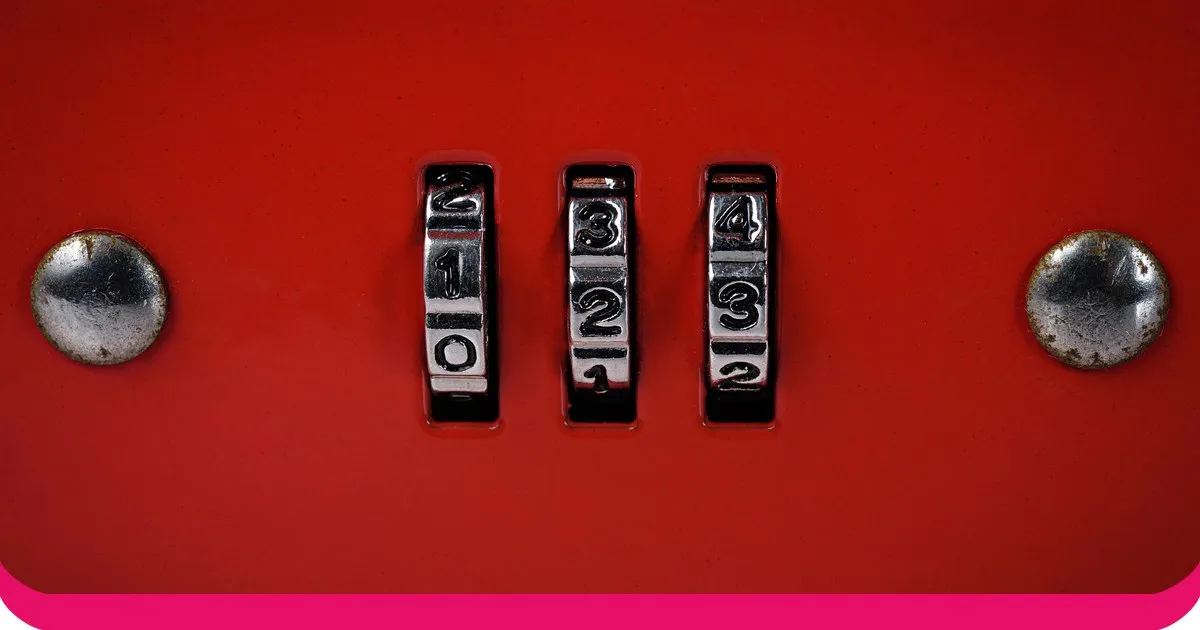
Puzzles, strategy games and quizzes all ask you to reason, remember and think ahead, which is why people call them intelligence test games. This post picks 10 that are worth your time, explains what each one asks of your brain and shows how to turn them into a live group activity.
We are also honest about the science. Playing these games will make you better at these games. Whether that carries over to general intelligence is a much shakier claim, and we cover what the research actually found.
Scurte
QuestionAnswerHow many games are on this list?10, across puzzles, strategy, memory, word and quiz gamesDo they measure your IQ?No. They exercise reasoning skills but are not a scored intelligence testDo brain games make you smarter?Research shows people improve at the trained task, with little evidence of wider transferCan I play them in a group?Yes, several work well as live team or classroom activities on AhaSlides
What makes a good intelligence test game?
An intelligence test game gives you a problem with a clear answer and asks you to work it out with reasoning rather than luck. The best ones share three traits:
- A clear rule set. You know what counts as a right answer, so you can tell if your thinking worked.
- Rising difficulty. Each level asks a little more of you than the last.
- Feedback imediat. You find out quickly whether your approach was sound, so you can adjust.
If you want a formal assessment of reasoning ability, that is a different thing: see our guide to the test de tip de inteligență and the professional tests psychologists use.
10 intelligence test games
1. Sudoku
Sudoku asks you to fill a 9 by 9 grid so every row, column and 3 by 3 box holds the digits 1 to 9 once. It needs no arithmetic, only deduction: you eliminate options until one cell has a single possible answer. Start with a 4 by 4 version for children, and move on to "hard" grids where you must hold several possibilities in mind at once.
2. Nonograms (Picross)
In a nonogram, number clues beside each row and column tell you how many squares to fill in a run, and the finished pattern reveals a picture. It is logic in its purest form: every square is deduced, never guessed. Many puzzle apps carry them under the name Picross.
3. Șah
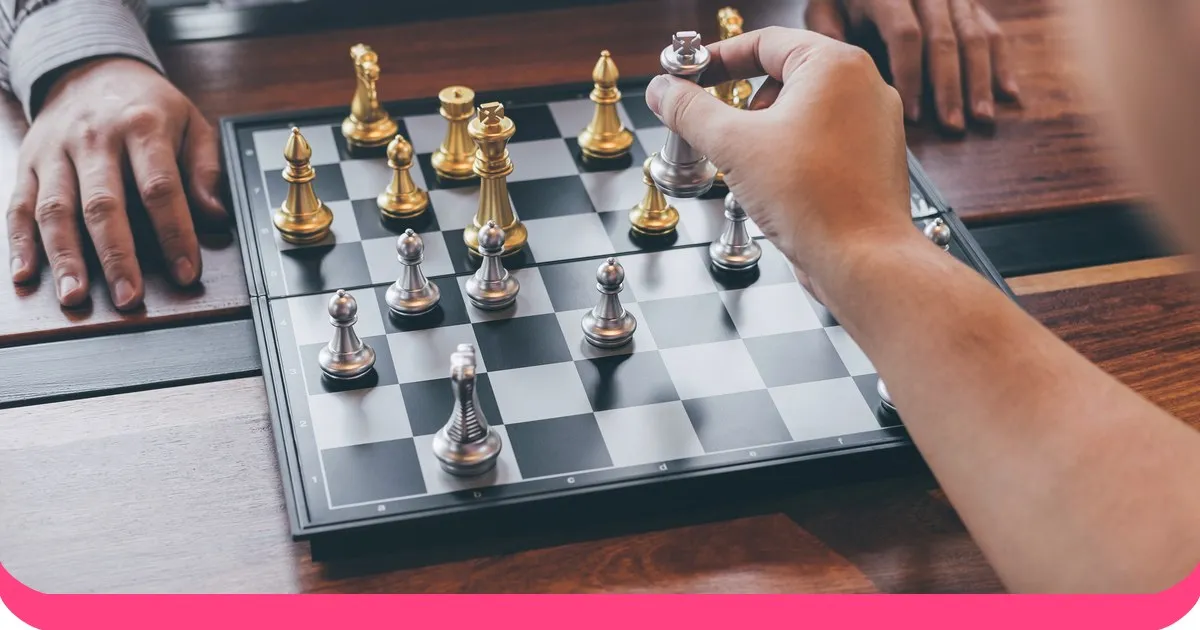
Chess rewards planning several moves ahead while anticipating your opponent's replies. It makes you weigh short-term gains against long-term position, which is why schools and clubs use it to teach strategy. Free apps and websites match you with players at your level, and puzzle modes let you practise tactics in five-minute bursts.
4. Tower of Hanoi
Move a stack of discs from one peg to another, one disc at a time, never placing a larger disc on a smaller one. It was published by the French mathematician Édouard Lucas in 1883, and the pattern is neat: a stack of n discs needs at least 2^n - 1 moves, so 3 discs take 7 moves and 5 discs take 31. Psychologists still use versions of it to study planning.
5. Memory match
Flip cards to find matching pairs. It looks like a children's game, but it trains the working memory you use to hold a phone number or a set of instructions in your head. Raise the difficulty by adding more pairs or by shortening the time you can see each card.
6. Tetris
Tetris asks you to rotate and place falling blocks so they fit, deciding in under a second where each one goes. Alexey Pajitnov created it in 1984, and it remains one of the best-known spatial reasoning games. Try planning where the next two pieces will go before the current one lands.
7. Valea Monumentului
This puzzle game by ustwo games (2014) has you guide a character through architecture that bends the rules of perspective, so paths connect that should not. It exercises spatial reasoning and rewards patient experimentation over speed.
8. Riddles and lateral thinking puzzles
Riddles make you drop your first assumption and look at the problem another way. Try these on a friend, answers below:
- What has keys but cannot open locks? Răspuns: a piano.
- The more of me you take, the more you leave behind. What am I? Răspuns: pași.
- What comes once in a minute, twice in a moment and never in a thousand years? Răspuns: the letter M.
9. Number sequences and logic problems
Spotting the rule behind a pattern is at the heart of many reasoning tests. Two to try:
- What comes next: 2, 6, 12, 20, 30, ? Răspuns: 42. The gaps grow by 2 each time (4, 6, 8, 10, 12).
- A bat and a ball cost £1.10 together. The bat costs £1.00 more than the ball. How much is the ball? Răspuns: 5p, not 10p. Most people answer 10p first, which is why the question is a classic for showing how fast, intuitive thinking can mislead you.
10. Live quizzes and trivia
Quizzes test recall, speed and the ability to reason from partial knowledge, and they are the most social game on the list. A quiz works well as a warm-up, an icebreaker or a review at the end of a lesson. The next section shows how to run one.
Do intelligence test games make you smarter?
They are fun, and they build skill at the task itself, but the evidence for wider benefits is mixed. Here is what the research says:
- A large online trial found no transfer. In a 2010 study in Natură, more than 11,000 people did six weeks of online brain training. They improved on the tasks they practised, but the researchers found no evidence that this carried over to other cognitive tasks.
- A major review reached a similar view. Simons and colleagues (2016) reviewed the evidence behind commercial brain-training products and concluded that the studies did not justify the claim that they improve everyday cognition.
- Some training effects last, within the trained skill. The ACTIVE trial followed older adults for ten years and found that the reasoning training group still showed benefits in reasoning ten years on, while the gains from memory training had faded by then.
So play these games because you enjoy them and because practice makes you better at the puzzle in front of you. Do not expect a game to raise your IQ, and be wary of any app that promises it will.
How to use these games with a group
Intelligence test games work well as a shared activity with a clear structure. Here is a format that works in a classroom or team session:
- Pick three or four games, not ten. Mix one logic puzzle, one riddle round and one quiz so different people get to shine.
- Put the problems on slides. Show one riddle or sequence at a time, and give players 30 seconds to answer on their phones.
- Use pick-answer questions for the tricky ones. Multiple choice (like the bat and ball question) works well because the wrong answer is tempting, which sparks discussion once the answer is revealed.
- Afișează clasamentul între runde. It keeps the competition friendly and gives you a natural break.
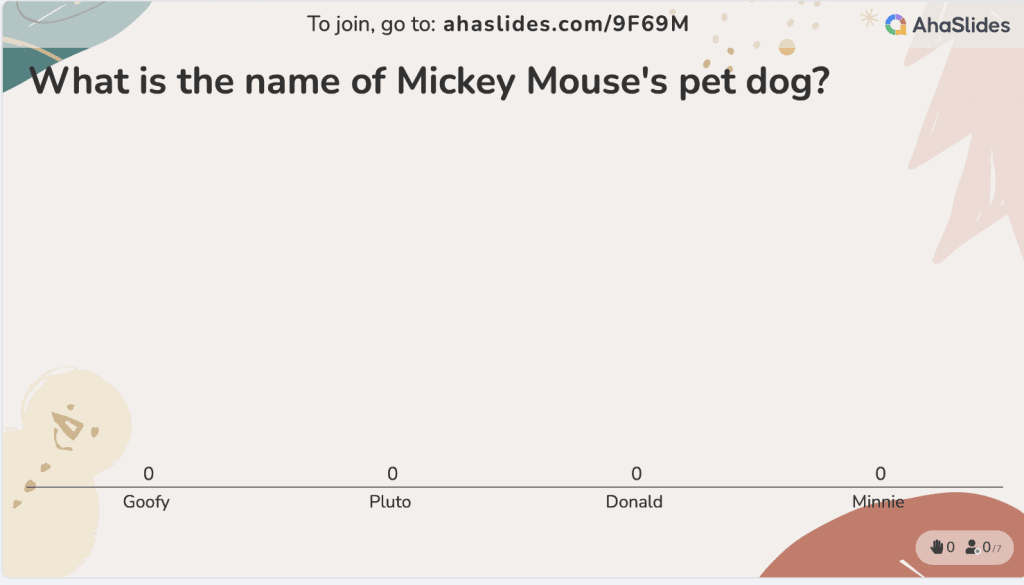
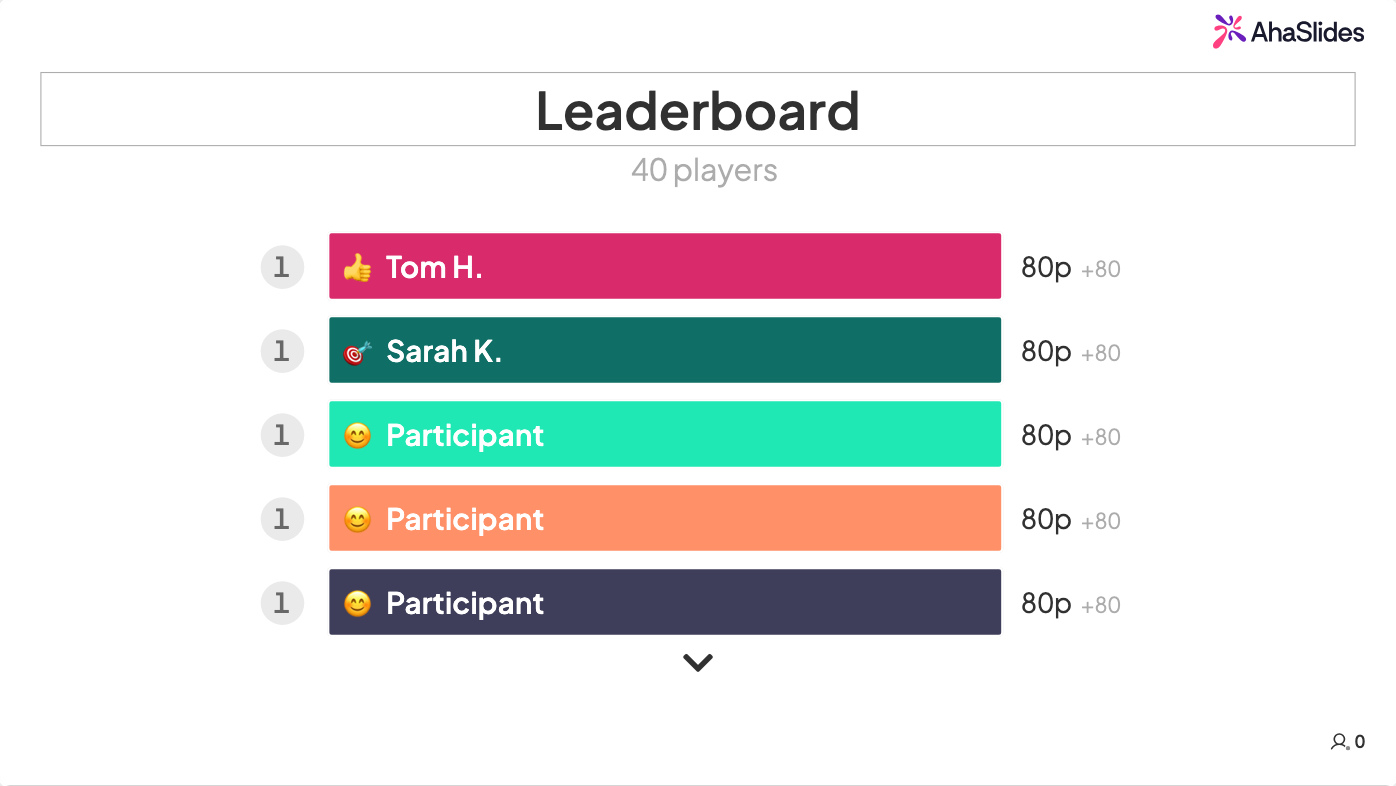
Poți construi toate acestea cu AhaSlides creator de teste onlinesau începeți de la un test deja creat în biblioteca de șabloane. For a set of ready-made questions, try our test de geografie.
Întrebări frecvente
Are intelligence test games the same as an IQ test?
No. An IQ test is a standardised assessment that a qualified professional administers and scores against population norms. The games on this list exercise reasoning, but they do not produce a score you can compare with anyone else's.
How long should I play brain games each day?
There is no proven "right" amount. The research does not support a specific daily dose, so treat it like any hobby: play for as long as you enjoy it, and vary the games so you keep meeting new kinds of problem.
What is the best intelligence test game for kids?
Memory match, simple Sudoku grids and riddles are good starting points, because they are easy to learn and can be made harder as children improve. Chess is a rewarding next step once they are comfortable with the rules.